


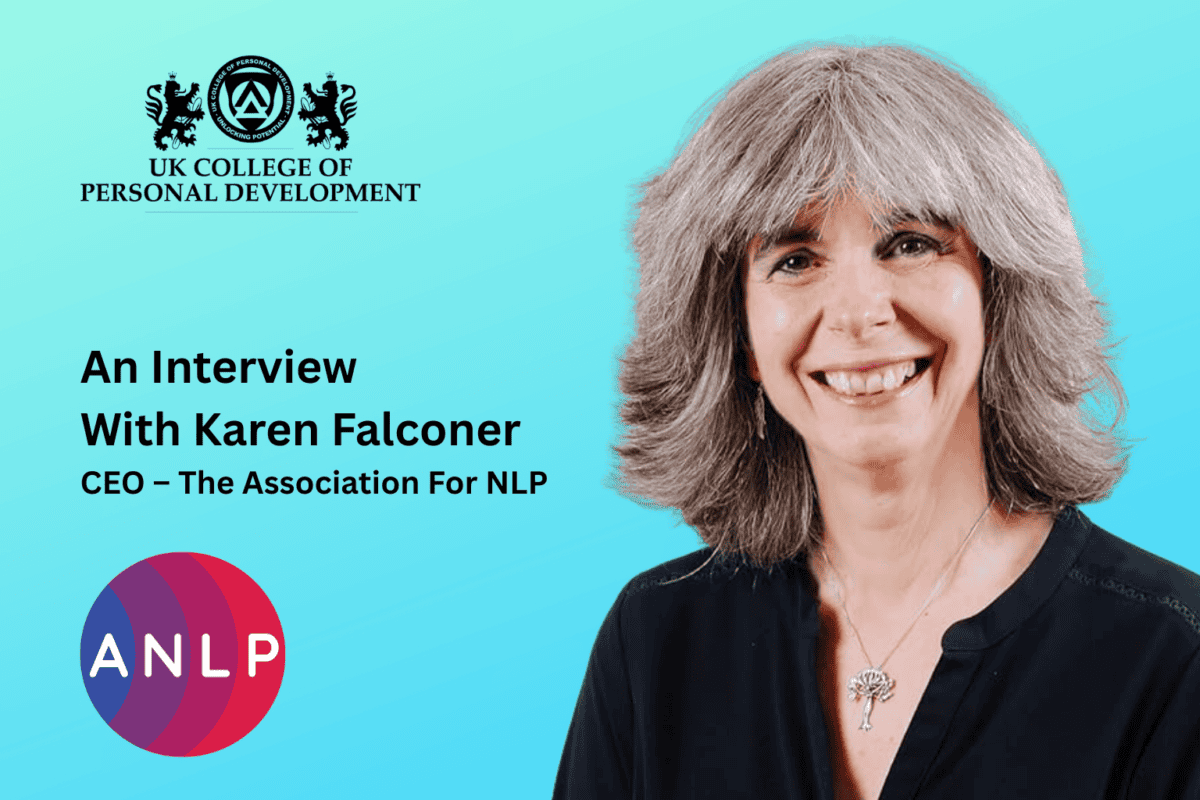
An Interview With Karen Falconer – CEO – The Association For NLP
As many of you will know, we regularly have interview guests on our live Be Inspired Group events. Back in July this year, we were thrilled to have Karen Falconer – the CEO of the ANLP on the show.
We had really great and massively positive feedback with a question if we would consider printing the transcript, after a little reflection we thought – why now. so, here is the interview in full.
Tony – OK, so we’ve got a fantastic guest this evening who I’m now going to introduce. I was going to give this big, long, huge introduction, but I thought I won’t do that. She might get embarrassed by that. So I thought I won’t do that. We’ll get her to introduce herself.
Tony – So please have a big warm U-K-C-P-D Be Inspired Group. Welcome, very special guest. Karen Falconer: hello Karen, Good evening to you.
Karen – Hi Tony, how are you?
Tony – I’m very, very well. I’m boiling. It’s so hot in this room with all the lights.
Karen – Yeah, I was going to say, I’ve got the windows open here and we live in a cul-de-sac, so there could be a street party at any moment. Who knows?
Tony – Alright, so Karen, tell us a little bit about yourself. I can see here on your description, you’re the CEO of ANLP International, etc, I mean I know you quite well, but for those who kind of have a sense of, yeah, I’ve heard our name, I’ve maybe seen it in Rapport or Tony’s mentioned it on a course or something. Tell us a little bit about yourself.
Karen – Oh, you’ve really put me on the spot there. I’d preferred you to introduce me and be embarrassed. Who am I? So I, I’m a mom of two and a grandmom of two.
Tony – Surely not.
Karen – Yes, absolutely. And a wife and a daughter and all those sorts of things.
Karen – I am an NLP trainer, although I often say whilst I am an NLP trainer, I do actually use my NLP skills every day, but not actually for training or doing one-to-one coaching because I run the association for NLP, which is the professional body for NLP.
Karen – And if I were to, or if me or any of the team were to do our own coaching or do our own training, then we would be in direct competition with our members, which would be incredibly unethical. So whilst we are all trained, we do not actually use our skills to be in competition with our members.
Karen – So yes, I run the association for NLP, like you say, editor of, I dunno if I’m called editor, publisher of Rapport Magazine, which is one of the things we do. We also run the NLP conference, which has changed quite a lot in the last few years and is changing again for next year. So we like to keep on our toes and keep things moving forward into the future. Like you were talking about training.
Tony – That’s right. So how did you get involved in NLP? Because I think you’ve got a business background as I recall.
Karen – Yeah, I was, well, I’m still an accountant. I used to train small businesses to be self-empowered and do their own accounts rather than relying on that very expensive qualified accountants. So I think unbeknownst to me, before I even knew what my life purpose was, I was actually empowering small businesses to be able to hold on their own two feet. How did I get into NLP? Completely by accident. Isn’t that the same for all of us?
Tony – Yeah
Karen – Yeah. Back in the days when they used to do evening classes, I was flicking through the brochure that had come through the door and there was a six week introductory course into Neuro-linguistic Programming and that was all it said. And I thought, well that sounds like it’s either about computer programming, I’ve just done a course in c plus plus, so it’s going to be about computer programming or it might be about personal development, which I was into as well.
Karen – So I just signed up for it, not actually knowing what it was, and probably before the days where we relied on Google quite so much. So I just turned up was pleasantly surprised. And I think one of the things that was said to me was that they did this course because it’s something that’s always stuck with them and where you can do a lot many other courses and as soon as you get back into the real world, it just all crumbles away and the reality is very different to what you’ve learned on a course. Whereas I think with NLP, it just kind of stuck there. The elements of it stuck and so that was the start.
Tony – Yeah, that was the start. So it’s interesting, I didn’t know this, that that’s how you started actually, because that’s how I started. But not going to the course. I used to deliver the course at the local college in the evening classes. We started off at a six week, then went to eight and then went to 10 weeks. And then I thought actually we could do this. And then I quit my corporate job and the college was born type thing. But I think most people know that story, but I didn’t know that about you.
Tony – So that’s interesting that those bite-sized kind of or way into going, this is interesting stuff and well yeah, I can use this in my work in myself helping other people. And before you know it, you are, you’re an NLP trainer.
Tony – Yeah, yeah. So that’s who you got interested in NLP and then to become head of the ANLP. How did that happen?
Karen – Yeah, that was probably a bit of another accident really. You know, were saying about, well-formed outcomes.
Tony – Oh yes. Sometimes the universe gives it to us.
Karen – Exactly. It’s smacks you in the face with it. Again, it was part of a plan that I didn’t realise. So when I was on my practitioner course, I was the demo subject for, well-formed outcomes, would you believe? And my well-formed outcome that they were helping me to formulate was that I wanted to create this space where like-minded professionals could come and gather because there’s a tendency to go on a course and then go back into real life and everything falls by the wayside.
So I had this wonderful idea and at the time it was very much, I kind of thought there needed to be this physical space, a bit like one of those London clubs or something like that that would be for people to come and gather. So that was my goal and I started pursuing it. I had the next step, I knew what the destination was and I had the next step, which I thought was very much more around property and having to find this physical space to hang out in.
And I was pursuing that side of things. And then it must have been three or four years later, my NLP trainer contacted me and said, are you still pursuing this goal? And I said, well, yes, still stuck on the property bit. How am I going to raise enough money for this very expensive property?
And they said, well actually the ANLP is about to fold. It needs rescuing. We’ve got an offer from somebody in the state who wants the database and wants the magazine but doesn’t want the membership. They clearly understood that my values included fairness and respect and things like that. And I just thought, well that’s not fair that the membership just get pushed aside, don’t want that bit. And with my accountant’s hat on, I went and looked at the figures and with my accountant’s hat on, wouldn’t have touched it with a barge pole, but there was something here and gut and heart just pushed head logic aside and said, I have to do this. So I did.
Karen – It was the well-formed outcome that got me here. but interesting, not in the way that I initially thought. When you are saying about how do you eat an elephant – one bite at a time, I think that’s actually quite important. It’s important to know the next step or the next two steps and not be fixated as I was on it has to be this path.
Tony – The how changes. Well yes, and I’m old enough and been around long enough, I feel like I’m a dinosaur these days have been around NLP for so long to remember the old ANLP. And I think I’ve told you this before and I’ve still got all that original stuff, which I think is interesting. I’m hanging onto it still. Strange legacy stuff. And then of course all of the things happened that happened with Richard. And I thought, God, I dunno what’s going on in this organisation, but I continue to be a member. I’m a professional person, I’ll be a member of a professional body. And then by chance there was exhibition thing going on in London, Excel, yeah, east London at the big expo centre. I can’t think what it’s called, ed Excel or whatever it’s called. Excel. Excel, yeah, Excel. And that’s where I met you for the first time.
Karen – Yeah.
Tony – And I thought, wow, now this is a person I can do business with because straight talking, empathy, real love and concern for the stuff as it were. And I thought, yeah, we’re on the same page here because similar to you, I wanted to build a space, well we could have people together and we kind of did at one point have a space as you know, many, many times. The training centre that we did have in Swindon, obviously things changed and we couldn’t do that because of Covid and the world changed and we changed, we had to and all of those kind of things.
That said hopefully next year, I’ll say hopefully next year, we are planning putting everything in place to have a big get together for all members. But we’ll talk more about that in the future.
So here you are, head of ANLP and you must have thought, okay, what’s the first step? So what did you do to turn it around to make it the thing? Because it’s not what it is.
Karen – No, it’s like probably one of the most, if not the most respected NLP professional bodies in the world.
We certainly, we are the only properly independent professional body as in we are not backed by or tied to a specific training school or trainer. We don’t have anybody pulling our strings. And I think that’s really important from an independence perspective because it allows us to be totally inclusive and not be biased towards any particular training school or training methodology or anything like that. We’re open to all sorts of suggestions. And it’s funny, I mean reminding me about the Excel, that was January, 2006, Tony, when we met then when –
Tony – I was a young man,
Karen – You and me both. Well not a man, a young person, a younger person. And in January, 2006, I was still in the first year having taken over ANLP and making a lot of mistakes. And it is lovely because in hindsight that was an expensive event to be at.
And in hindsight, would that have been the right thing to do? Probably not. However, I’d never have met you if we hadn’t gone there. So it’s all these things happen for a reason. I’m a firm believer in that all these things happen for a reason and I didn’t have a proper business plan. I just was heart led, do it.
And started with, well actually what we took over, we took over a database that it seemed everybody else had anyway, so it wasn’t really special or anything like that. We took over the website that was a one page website at the time I remember that had somebody else’s name and face on it because they’d just utilised it for their own purposes because nothing else was happening. The conference had disappeared and was being run by somebody else. The magazine had all but disappeared and was being run by somebody else. It was like all the things had been dug up out of the garden and gone and been replanted somewhere.
And I think it’s all these years later, we pulled back the magazine, we got the website up and running. I put a lot of money into it. At the time I was still being an accounts trainer and clearly earning more than I knew what to do with because I was throwing money into ANLP because I just believed in it passionately and it was my hobby at the time. I still was working full time. And then there’s those touch points aren’t there in life where it was starting to take off a bit. And then I had a really big accounts client in Central London and they said, we are moving offices and we want you to come and work for us full time. And I had a young child at the time and it was, I’m not sure I want to start commuting into London, frankly.
And funnily enough, that was around the same time as 7 – 7, the London bombings and one of the bombings was on a train that I could have been on. So it’s really one of those things that made me think and I thought, well actually you know what, now is the time to commit to making ANLP work? Fingers crossed, jump off a cliff and give up the really lucrative, lucrative client and just make a NLP work.
Tony – Yeah. Yeah. That’s interesting because in a way the college is a similar kind of parallel story and I thought just as you were doing your thing, we were doing our thing, but the college was a hobby, say a hobby part-time, job type hobby. I was interested in it at the time. I also managed a band and I did some other things as well because a workaholic managed a band.
Alright, that’s another story. But then the college just began to grow and grow became, well, it became a thing, become incorporated and we had to have insurance, all these kind of grown-up things. And it became me, what I did and changed over the years. You’re in it, you’re in it, but ..
Karen – You’re right, you got to feel it. If you don’t feel it, you won’t do it. There are easier ways to pay the rent.
Tony – You also wrote a book.
Karen – I did.
Tony – We give a copy of this to all of our graduating practitioners because containing here is some wisdom and so real, what I might call practical, not just practical but common sense things. If you’re going to set up a practise, you might need to think about that, whether it be a coaching practise or an NLP slash coaching practise.
This really is one of the best of the books and that’s why we give it to everybody because it’s just feels so bloody useful. And we think that’s your go-to step one of setting in my practise, what do I need to know?
Karen – And then of course the other thing is when you graduate from college and all of the accredited trainers I think do the same thing, membership of the ANLP, you update your profile, it gets visited a lot by people looking for practitioners or trainers and coaches.
All of these things are listed on the website, update your profile and your specialism and all those kind of things.
Tony – And there’s loads of resources that people can download, which is really, I think back when I was first joined the ANLP, they don’t want any of that. I can tell you now, not at all. The photocopy material they set us up, which is kind of, I suppose that was the world then in the world now is very, very different. If you tried that now people go, you must be joking.
Karen – Yes, exactly.
Tony – So that’s where you’re at. ANLP is up and running, it’s all happening. A lot of things have changed over the years. You mentioned about the conference changing and I understand why that is. What’s next for the ANLP and for you do you think?
Karen – Well, becoming a bit older, I think things do change somewhat and thinking about next steps and everything like that. So yes, we are. I see James, James who’s one of our lovely members.
Tony – James is commenting and saying about the conference.
Karen – ,We have had to move with the times, move with the flow and we are changing the conference. And James, we are going to be running the in-person event in-person weekend every other year at the moment. So every two years we’ll see how that pans out and we’ll probably end up changing it again at some point in the future, but it’s not going to have the masterclass anymore. It’s going to be two full on days of presentations happening all day in a couple of streams. So that would be quite exciting.
Karen – There’s a particular project that Tony has been involved with and it was a madcap idea that actually again, it started in 2012, I’m kind of ashamed. 2012,
Tony – That’s right. Our first meeting in 2012.
Karen – 12 years that we’ve been working on this project. So I think it’s, again, it’s about believing it, believing it’s going to happen and it will happen. It’s just that when you’re dealing with other people, you can’t always completely control the timeline. But the project we’re working on is again around professionalism in NLP and it’s about bringing, introducing regulated qualifications in NLP. We currently have another application in with ofQual . I think over the years, this might be our 10th or 11th, however it does feel now that we are in more of a tote process. Those first few applications that we were putting in back in, I mean our first application that we used consultants for back in 2012 was rejected within an hour.
Karen – That’s how far we’ve come. But it definitely feels like there’s a tote process now. The test operate affects it and we are getting vaguely more useful feedback as you can hope to get from a public sector body. That’s a different story for another day and probably not live broadcast, but we are working on it and we have a plan in place. And again, we have our 12 month plan, which we kind of haven’t had before. We’ve had, let’s get the next application in. But it’s again like what you were talking about, having that goal beyond the goal. So this time we’ve got the goal beyond the goal, beyond the goal, we know exactly what we’re doing. If we get rejected again this time there is one more application to go in, then there is a plan B. So it’s all in place and it will happen.
Tony – Yeah, sure. And having been there from the very beginning, and I remember that first, all those people sat around a big table in the conference room that we had back in the day.
Karen – It is interesting how many of us are still alive and standing with it. So it is a case of we’re doing this and I think that’s what’s driving me through, especially you and Kash and all the work that you guys have done.
Tony – I’ve done my bit, but you guys have been like a laser beam. And when it happens, we’ll have you back for another chat and we’ll get all of the practitioners and master practitioners on because I think they’ll want to know because it’s such a big thing that we’re say we you are about to do, it’ll warrant a whole session or all of its own. But suffice to say, when I say it’s big, it’s big and it will probably be career changing for a lot of people.
Karen – It really, really will.
Tony – It will hopefully be a game changer for the field of NLP.
Karen – That’s the intention.
Questions from those on the webinar:
Sarah: – How do you think NLP can be made more mainstream? I’ve never encountered anyone who knows what it is outside of coaching clients.
Karen – Very good question. I mean I’ve devoted some time to this in the book because I think, I believe that one of the things we need to do is talk about it together. So in the book I talk about there being a sort of my daffodil principle, which is in our field we are encouraged to be unique and individual and we can be quite maverick and very options oriented and that sort of thing. And the difference between NLP and food is that people know they need food, so therefore the supermarkets can compete in prices and experience and all that sort of thing. Sainsbury’s, Tesco’s, Aldi, they are all competing for your business. Whereas in NLP, people don’t know that they need us yet. So we have to work together to get NLP elevated and NLP out there because even though we’re all unique and beautiful daffodils, when we are standing on our own, we are not seen so easily.
But if you think about when you drive around a corner or you go to Holland or something like that, whatever that field is, rates, whatever, you see that massive field of all those individual little daffodils making that huge impact. That’s what we need to do first of all, and stop that sort of. And also I think the other thing is that we need to stand up and be loud and proud that it’s NLP because I think one of the things that sometimes people have a tendency to do is hide behind it. That was really good. It was, you’ve spent a lot of time and a lot of money and a lot of investment getting an NLP certificate, so be proud of that. I mean people say, oh, we should change the name. We’d be stuck because we’re the association for NLP and it might be a bit of a clunky name, but it’s the one we’ve got. So it’s working with that and standing proudly and saying this is what we do.
Tony – Yeah, so you are right. And the term NLP Neuro-linguistic Programming is a mouthful. And I think in many ways people go, what the hell is that?
But Judith DeLozier, said to me once, yes it’s weakness, but it’s also its strength because people go, what? And then you get to explain, well really this is about applied positive psychology, but even better because it really works and it really works because it’s quick, it’s simple. And I can teach you to do this in half an hour.
Karen – Two examples, I mean we’ve actually got a speaking slot at the Festival of Education next week, which is really exciting. 45 minutes. The NLP for Education project that’s sponsored by ANLP. We have a speaking spot, we are rapidly frantically getting the website pulled together and all that sort of thing.
And then we were on a singing holiday recently in Italy and the husband of one of the people on the singing holiday turned up the last evening and we were talking over the dinner table and it turns out that he’s a GP and he was asking, well, what is NLP? And I said, well, it’s like CBT but better.
Tony – Yeah, I always say that too.
Karen – And because I said that he’s now in touch with us, he wants to take it to his PCN and that sort of thing. It was one phrase that got him hooked. And I think that’s the thing. Sometimes it’s that one phrase that’s going to get their attention. And we were just lucky. That’s just happened to be what I said.
Tony – You got to make, well these opportunities come along you got to have. So I would say to students have the elevator pitch, this is what it is.
A question form Shelly: I think sometimes people hide behind the name because she doesn’t because there are some dreadful practitioners out there.
Tony – That is true. Now interestingly, I think the project that we’ve kind of mentioned, that will change that massively.
Karen – And as does the Association. That’s the whole point. We have a complaints policy, a code of ethics and all that sort of thing. And sadly, well really good. We very rarely have to invoke. I think in 16 years we’ve invoked the complaints policy twice because the people who belong to ANLP are ethical and authentic and all that sort of thing. However, we could be handling a complaint a week because we are turning people away.
Sorry, we can’t deal with that because they’re not a member of ANLP, they’re not a member of A NLP, that sort of thing. And it is, but that’s the point. And I’ve heard that before Pete said by people that they don’t want to associate themselves, but actually it’s kind of like when the St. George’s flag was hijacked by the BNP, we have to come back and take that flag as being, it’s the England flag. You see that when England are playing football, not necessarily very well, but when England are playing football or playing sports, we suddenly get behind the flag and it becomes the flag of our nation. But actually it’s the same with NLP. We have to claim NLP for the good people out there.
A question from Steve: Given what you’ve just said about awareness, are there any plans to expand on the 10 marketing tips help guide on the ANLP website?
Tony – Perhaps as a new member there are not aware of Steve is literally just qualified.
Karen – I think the expansion of that is the book. The book was based on the 10 tips. So if you get the NLP professional ..
Tony – Steve will have a copy of that, because I did send that out recently.
Karen – So our focus at the moment is the project and the conference because that will be the game changer. It’ll be yes. And also Steve for things when you’re a member of ANLP, some of those things come out during our community cafes and things like that. So the community cafes and the members clinics, the book’s called the NLP Professional. And apparently it’s sold out on Amazon, but you can get it on our website: https://anlp.org/
Tony – Okay. Any more questions? If not, we’re going to wrap up. We’re going to stick within our time, which is my commitment to the group. So while the people are thinking if there’s any more questions, Karen, we really, really appreciate you coming along this evening and giving up your evening.
I know you give up lots of evenings with your cafes and your support group and the trainer stuff that you do. Although I don’t often come to a lot of these things for obvious reasons because I’m doing this and due to calls and all those things I have to do. So we really, really appreciate it.
And for me, on behalf of all of the college members that are practitioners, I want to thank you for all the support you give us because I’ve often said without you, professional body and the ILM as well and the Association For Coaching, but NLP is the real thing in my heart that I have a love for and I really appreciate all the support that you give us because it really, really is appreciated.
We’ve got a few more. Thank you both. Have a wonderful summer, guys have a fantastic summer. The normal week stuff will still happen. Just the live things will come back in September and we’ll line up some fantastic guests and we’ll have Karen back again when we have some really big news. So that’s what’s going to happen there.
Have a wonderful summer and I will see you very, very soon. Take care of yourselves. bye for now.
Additional Information:
Association For NLP – https://anlp.org/
NLP Training Programmes: https://ukcpd.co.uk/nlp-qualifications/
Be Inspired Group: https://ukcpd.co.uk/be-inspired-group/

