


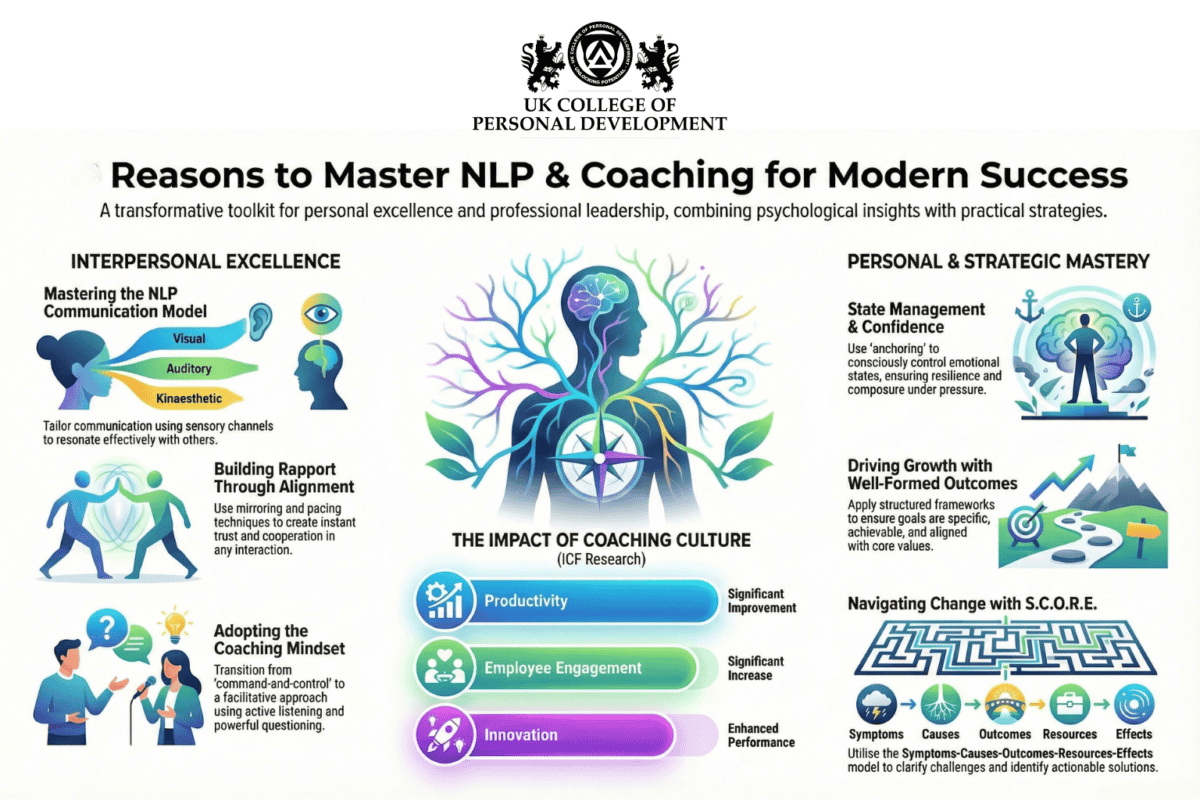
Here at UKCPD (UK College of Personal Development) we are often asked about “the skills for success”, and how to develop them in a meaningful way. As we approach the end of 2024, we thought now would be a good time to take a look at the skills and the mindset we all need to develop for success in the modern world.
The 7 Skills for Success in the Modern World
We have published many articles on NLP and Coaching, however, its often misunderstood just how Neuro-Linguistic Programming (NLP) and coaching are such transformative disciplines, that when combined provide practical strategies with powerful psychological insights, enabling individuals to achieve personal and professional excellence.
Studying NLP and Coaching equips individuals with tools to navigate the complexities of the modern world, foster meaningful relationships, and achieve remarkable success. Below, we explore seven compelling reasons to study NLP and coaching and how these disciplines offer a comprehensive skill set for thriving in today’s dynamic environment.
1. Mastering Communication Skills
Effective communication is at the heart of success in the modern world. The ability to convey ideas clearly, understand others deeply, and navigate conversations skilfully is crucial in personal and professional contexts.
The NLP Communication Model
NLP’s Communication Model emphasizes the interplay between internal thought processes, language, and behaviour. By understanding how people perceive and process information through sensory channels (visual, auditory, and kinaesthetic), practitioners can tailor their communication to resonate with others effectively. The model also highlights the importance of avoiding distortions, deletions, and generalizations that hinder clarity.
Why Communication Skills Are Vital
- Leadership: Leaders inspire and guide teams through precise and motivational communication.
- Negotiation: Success in business and interpersonal interactions hinges on the ability to negotiate and persuade.
- Collaboration: Building trust and rapport in teams depends on understanding and aligning with diverse communication styles.
2. Enhancing Self-Awareness and Confidence
NLP and Coaching Tools help individuals develop profound self-awareness and the confidence to lead with poise and authenticity.
State Management
One of the most impactful applications of NLP is state management—the ability to consciously control one’s emotional and mental states. By mastering techniques like anchoring, practitioners can access empowering states at will, fostering resilience and composure.
Leadership Benefits
Leaders who demonstrate self-awareness and confidence instil trust and stability in others. This ability to “lead from within” not only enhances personal effectiveness but also inspires confidence in teams.
Academic Insight: Goleman (1998) notes that emotional intelligence, a core component of self-awareness, is a critical factor in leadership effectiveness.
3. Adopting a Coaching Mindset: The New Leadership Paradigm
In the modern workplace, coaching is emerging as a preferred leadership and management methodology.
The Coaching Mindset
A coaching mindset involves guiding individuals or teams to unlock their potential rather than dictating instructions. It emphasizes active listening, powerful questioning, and fostering self-directed growth.
Organizational Impact
Research by ICF (2019) highlights that organizations adopting coaching cultures experience improved employee engagement, productivity, and innovation.
Key Insight: Leaders equipped with coaching skills transition from “command-and-control” styles to facilitative approaches, aligning with the demands of the contemporary workforce.
4. Developing an Outcome-Focused Attitude
The ability to set and achieve clear goals is essential for success. NLP’s Well-Formed Outcomes model provides a structured framework for goal setting that integrates seamlessly with coaching methodologies.
The Well-Formed Outcomes Model
This NLP model emphasizes specific, achievable, and ecologically sound goals:
- Specificity: Defining clear objectives.
- Sensory Evidence: Identifying how success will look, sound, or feel.
- Ecological Validity: Ensuring goals align with personal and organizational values.
Benefits in Coaching Frameworks
Outcome-focused coaching ensures that clients maintain clarity, accountability, and sustained motivation toward achieving their objectives.
5. Managing Change with NLP and Coaching Models
Change is a constant in personal and organizational contexts. Combining NLP tools like Logical Levels and the S.C.O.R.E model with a coaching approach provides a robust methodology for navigating and implementing change.
Logical Levels
This NLP framework addresses change at multiple levels, from environment and behaviour to beliefs and identity. It helps individuals and organizations identify and align these levels for sustainable transformation.
S.C.O.R.E Model
S.C.O.R.E (Symptoms, Causes, Outcomes, Resources, Effects) is a problem-solving framework that aids in clarifying challenges and identifying actionable solutions.
Organizational Relevance
These models empower leaders to manage resistance, align teams, and implement strategic changes effectively.
6. Building Rapportful Relationships
In an interconnected world, the ability to develop rapportful relationships is a critical skill. NLP offers powerful tools for creating trust and cooperation through verbal and non-verbal techniques.
Key NLP Techniques for Rapport
- Language Patterns: Mirroring and pacing speech to align with others’ communication styles. Understanding and utilizing visual, auditory, and kinaesthetic cues to enhance connection.
- Eye Access Cues: Understanding and skilfully responding the the patterns opens up the opportunity to ask the right question at the right time.
Professional and Personal Impact
Strong rapport leads to enhanced teamwork, effective conflict resolution, and deeper personal relationships.
7. Developing a Personal Philosophy for Success
NLP and Coaching enable individuals to craft a personal philosophy grounded in the principles of success.
The Presuppositions of NLP
These foundational beliefs serve as guiding principles for personal and professional growth, key operating principles such as :
- There is no such thing as failure, there is only feedback.
- If you always do what you have always done, you will always get what you have always had.
- Where attention goes, energy and focus follows.
- The meaning of my communication is the response I get.
- To really understand, ACT!
- The map is not the territory.
Having a deep understanding of the above and their practical application to problem solving and mindset is key to the development of a personal philosophy for success.
The Four Pillars of NLP
The pillars—Rapport, Outcome Orientation, Acuity, and Flexibility—are deeply interconnected with the presuppositions, forming a comprehensive framework for success.
- Rapport: Building trust and alignment.
- Outcome Focus: Prioritizing clear goals.
- Acuity: Sharpening observational skills.
- Flexibility: Adapting strategies to achieve desired outcomes.
Key Insight: By internalizing these principles, individuals develop resilience, resourcefulness, and a growth-oriented mindset.
Studying NLP and coaching provides an unparalleled skill set for thriving in the modern world. From mastering communication and self-awareness to adopting a coaching mindset and managing change, these disciplines empower individuals to achieve their fullest potential. The combination of NLP’s psychological insights and coaching’s facilitative approach makes this a powerful toolkit for personal success and organizational excellence.
UKCPD’s NLP Practitioner & Coaching Diploma – Live – Interactive – Online
The NLP Practitioner & Coaching Diploma offered by the UK College of Personal Development (UKCPD) is a comprehensive, 20-day intensive training program designed to equip individuals with professional certification in both Neuro-Linguistic Programming (NLP) and coaching. Delivered through a live, interactive online platform, this course combines high-quality pre-study materials with engaging live sessions, providing a robust foundation for aspiring coaches and NLP practitioners.
Key Features of the NLP Practitioner & Coaching Diploma:
- Comprehensive Curriculum: The programme is structured into 20 modules conducted over weekends across eight to nine months. This format allows participants to absorb and integrate knowledge effectively, with ample time for reflection and practice between sessions.
- Accredited Certification: Graduates receive certifications from two esteemed professional bodies: the Association for NLP (ANLP), and the Association for Coaching (AC). This recognition underscores the programme’s adherence to high standards of training and professional development.
- Practical Application: Emphasizing experiential learning, the course includes live training, tutor support, and group practice sessions. Participants engage in practical exercises to develop critical thinking and apply NLP and coaching models in real-world scenarios.
- Additional Qualifications: The programme also offers a Level 2 Award in First Aid for Mental Health, enhancing the practitioner’s ability to support clients comprehensively.
Benefits of Enrolling in the NLP Practitioner & Coaching Diploma:
- Enhanced Communication Skills: NLP techniques enable practitioners to understand and influence communication patterns, fostering better relationships and effective client interactions.
- Leadership Development: The course cultivates leadership qualities by teaching methods for goal setting, problem-solving, and motivating others, essential for personal and professional growth.
- Personal Growth: Participants gain self-awareness and confidence, empowering them to overcome personal limitations and achieve success in various life aspects.
Why Choose UKCPD for NLP and Coaching Training?
With over 25 years of experience, UKCPD is renowned for delivering accredited NLP training focused on practical application within coaching.
Full details can be found HERE
Embarking on the NLP Practitioner & Coaching Diploma with UKCPD offers a transformative journey, equipping you with the skills and confidence to excel as a Professional Coach and NLP Practitioner. Whether aiming to start a new career or enhance your current practice, this program provides the tools necessary for impactful personal and professional development.
References
- Think BIG – The Journal of Personal Development (2022) – What is the NLP Communication Model?
- Think BIG – The Journal of Personal Development (2024) – Coaching As A Leadership Model
- Think BIG – The Journal of Personal Development (2023) – Logical Levels as a Coaching Model
- Think BIG – The Journal of Personal Development (2024) – Well-Formed Outcomes: The Key to Goal Setting Success
- Goleman, D. (1998). Emotional Intelligence: Why It Can Matter More Than IQ. Bantam Books.
- International Coaching Federation. (2019). Global Coaching Study.
- O’Connor, J., & Seymour, J. (1993). Introducing NLP: Psychological Skills for Understanding and Influencing People. Thorsons.
- Dilts, R. (1990). Changing Belief Systems with NLP. Meta Publications.
- Think BIG – The Journal of Personal Development (2024) – Developing a Personal Philosophy For Success
- UKCPD – NLP Practitioner & Coaching Diploma Training Programme

