


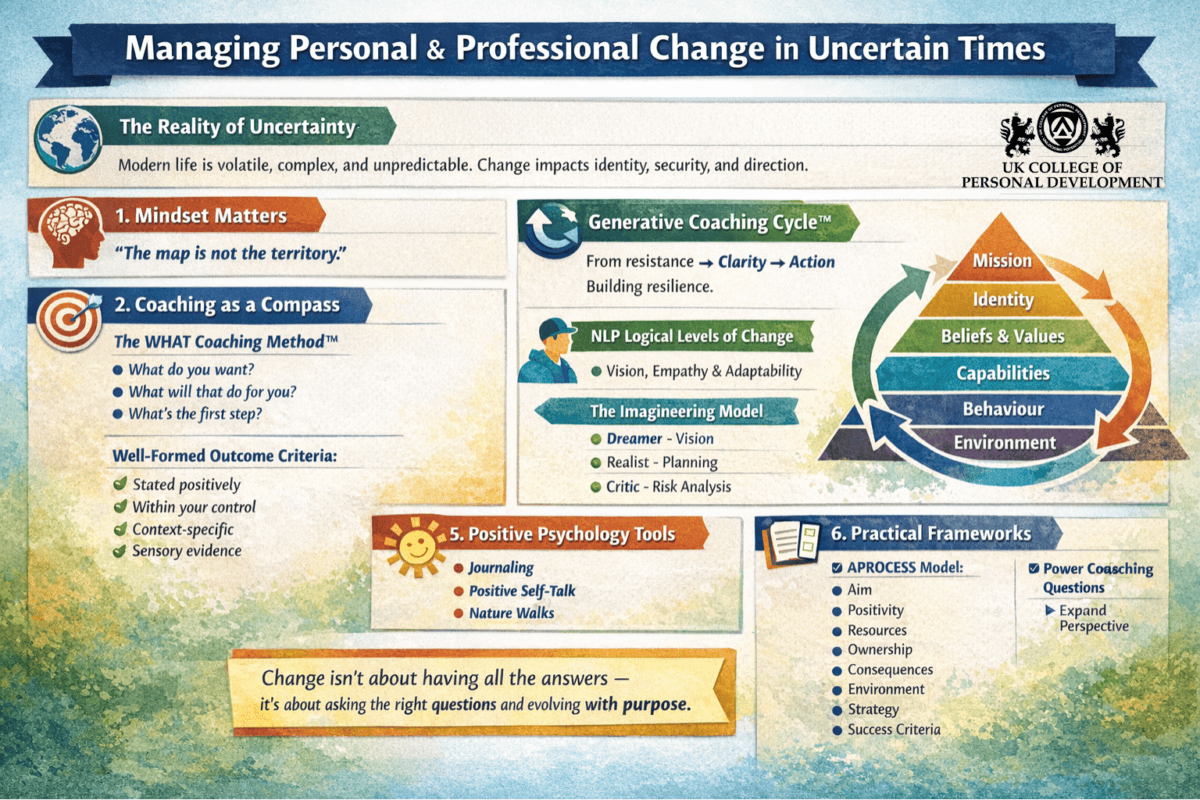
Managing Personal and Professional Change in Uncertain Times
In our increasingly volatile world, managing personal and professional change has become not only a necessity but a defining skill for thriving. Change—whether imposed or chosen—can disrupt our sense of identity, security, and direction. But with the right tools, mindsets, and frameworks, uncertainty becomes a catalyst for growth.
This article explores how coaching methodologies, Neuro-Linguistic Programming (NLP) models, and key leadership principles can support individuals and organisations in navigating change constructively.
The Nature of Change in Uncertain Times
Uncertainty, as described by contemporary leadership theorists, isn’t just a lack of predictability—it’s an environment of complexity and ambiguity where traditional planning models falter (Heifetz, 1994). It’s where leadership is not about having all the answers, but about helping people adapt.
Uncertainty affects both personal and professional domains. From career shifts, organisational restructuring, to personal reinvention—uncertainty can shake our sense of identity. NLP acknowledges that “the map is not the territory” (Dilts, Grinder & Bandler), reminding us that our perception of events shapes our emotional and behavioural responses. Change, therefore, begins with awareness and adaptation of our inner maps.
Coaching as a Catalyst for Change
Coaching offers a reflective, forward-moving framework to navigate complexity. The WHAT Coaching Method™ (Nutley, UKCPD) keeps individuals focused on outcomes, avoiding the trap of being stuck in the ‘story’ of the problem. This method promotes clarity by continually asking:
-
“What do you want?”
-
“What will that do for you?”
-
“What’s the first step?”
This aligns with the NLP principle of well-formed outcomes, which are:
-
Stated in the positive
-
Within the individual’s control
-
Context-specific
-
Include sensory-based evidence of achievement.
The Generative Coaching Cycle™ further adds depth, moving clients through discomfort, need to change, resistance, and action. This cycle is powerful because it mirrors the natural human response to change and builds resilience along the way
Using NLP to Manage Inner Change
NLP provides tools to work with the psychological and emotional effects of change. The Logical Levels of Change model (Dilts) offers a structured way to explore change across six levels:
-
Environment – where and when you act
-
Behaviour – what you do
-
Capabilities – how you do it
-
Beliefs and Values – why you do it
-
Identity – who you are
-
Mission – your sense of purpose
Change at higher levels (identity, values) has a greater influence on the levels below. This model is particularly useful during times of upheaval when individuals question their roles and purpose. Questions such as “Who are you now?” and “What new you do you want?” invite profound shifts in how we see ourselves.
Additionally, NLP techniques for resolving limiting beliefs help individuals let go of identity-level restrictions like “I’m not good enough” or “I’m not the kind of person who can lead.” These shifts are essential for sustainable change.
Leadership in Times of Change
Transformational leadership is rooted in vision, empathy, and the ability to model adaptability. According to Robert Dilts, effective leaders operate not just from authority, but from a clear alignment with their values and vision, often creating a ripple effect in others’ behaviours.
The Imagineering Model, inspired by Walt Disney and adapted by UKCPD, is a powerful leadership planning tool. It encourages individuals and teams to explore visions from three perspectives:
-
Dreamer – what’s the vision?
-
Realist – how will it work?
-
Critic – what could go wrong?
This model ensures that creativity is balanced with practical planning and risk management.
Positive Psychology and Personal Development
Uncertainty can lead to pessimism and paralysis. But as Tony Nutley reminds us: “Your limitations… are only your imagination playing tricks—you can do this”. Personal development in uncertain times requires an intentional focus on positivity, self-worth, and daily action. Techniques such as journaling, positive self-talk, and walking in nature are not just pleasant distractions—they help regulate the nervous system and boost clarity.
Practical Frameworks for Change
In addition to the models above, UKCPD offers specific, structured approaches such as:
-
APROCESS: A goal-setting and planning framework focusing on Aim, Positivity, Resources, Ownership, Consequences, Environment, Strategy, and Success criteria.
-
Power Coaching Questions: These are open-ended, reflective prompts that challenge habitual thinking and expand possibility, ideal for self-coaching or use with clients.
Managing change in uncertain times isn’t about having all the answers—it’s about asking the right questions, cultivating self-awareness, and being willing to evolve. Whether you’re coaching others, leading a team, or navigating your own transition, the combination of NLP models, coaching frameworks, and leadership principles offers a robust, holistic path forward.
As Tony Nutley wisely puts it: “That one thing you commit to doing today can—yes, it really can—improve all your tomorrows.”
References
-
Nutley, T. (2024). NLP Practitioner & Coach Training Manual. UKCPD.
-
Robert Dilts ( 1990) – A Brief History of Logical Levels – NLPU
-
Nutley, T. (2024). Logical Levels & The Generative Coaching Cycle. UKCPD.
-
Nutley, T. (2020). Resolving Limiting Beliefs. UKCPD.
-
Robert Dilts. (1998). Imagineering. Harnessing the Imagination.
-
Nutley, T. (2025). The WHAT Coaching Method. UKCPD.
-
Dilts, R., Grinder, J., Bandler, R. Various works.
-
Heifetz, R. A. (1994). Leadership Without Easy Answers. Harvard University Press.
-
Hall, L. M. (2018). Making Meaning, Living Meaningfully. Acuity Vol. 7.
-
Csikszentmihalyi, M. (1990). Flow: The Psychology of Optimal Experience. Harper & Row.

