


How Neuro-Linguistic Programming Deepens Insight, Accelerates Change, and Improves Coaching Outcomes
In an increasingly complex and fast-paced world, effective coaching requires more than good intentions and reflective questioning alone. Coaches must be equipped with practical tools that help clients understand how they think, communicate, and behave — and how these internal processes shape results. One approach that has consistently demonstrated value in this context is Neuro-Linguistic Programming (NLP).
NLP offers a structured set of models and techniques that enhance the coaching process by increasing self-awareness, improving communication, and supporting sustainable behavioural change. When used ethically and professionally, NLP complements evidence-based coaching frameworks and strengthens a coach’s ability to facilitate meaningful transformation.
What NLP Brings to the Coaching Process
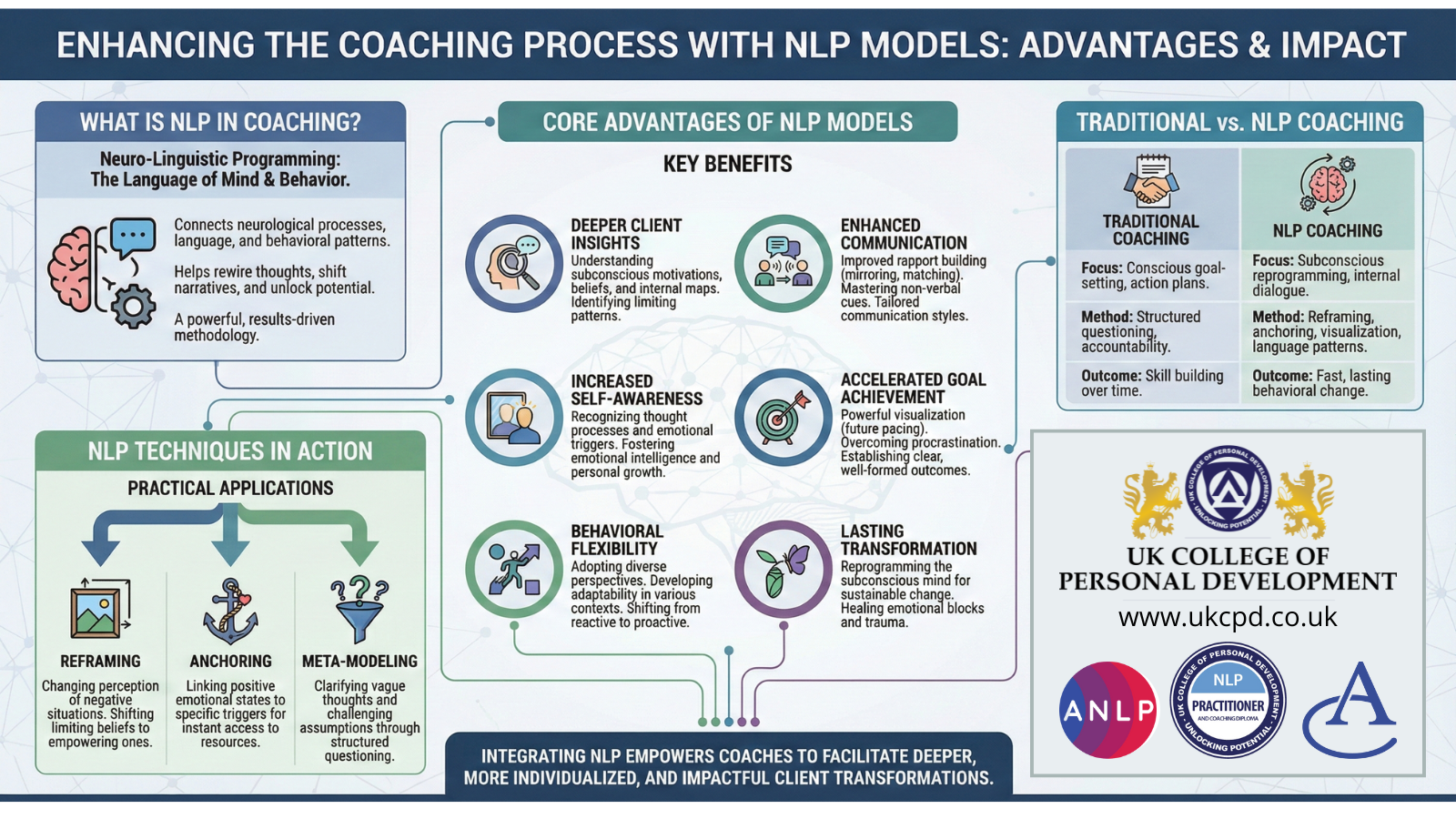
At its core, NLP explores the structure of subjective experience — how individuals perceive the world, organise their thinking, and translate internal representations into behaviour (Bandler & Grinder, 1975). Rather than focusing on content alone, NLP examines how people think, decide, and act.
For coaches, this provides several advantages:
-
A deeper understanding of how language influences thinking and emotional states
-
Practical, repeatable models that can be applied across contexts
-
Tools that align well with established coaching methodologies such as GROW and OSKAR
-
A client-centred, non-pathologising approach that treats behaviour as feedback rather than failure
As a result, NLP enhances both the process and outcomes of coaching conversations.
Key Advantages of Using NLP Models in Coaching
1. Clearer and More Effective Goal Setting
One of the most widely used NLP contributions to coaching is the Well-Formed Outcomes model. This framework helps clients transform vague aspirations into clear, actionable, and ecologically sound goals.
By exploring factors such as specificity, evidence, resources, and potential consequences, coaches can support clients to:
-
Clarify what they want rather than what they wish to avoid
-
Increase motivation and ownership
-
Reduce internal conflict and goal ambiguity
Clear goal definition is consistently associated with improved performance and persistence (Locke & Latham, 2002).
2. Enhanced Communication and Rapport
Effective coaching relies heavily on trust, rapport, and psychological safety. NLP models such as Representational Systems, Matching and Mirroring, and Sensory Acuity provide practical ways to adapt communication to the client’s preferred thinking and language patterns.
This enables coaches to:
-
Build rapport more quickly and authentically
-
Increase client engagement and understanding
-
Reduce miscommunication and resistance
Research in coaching psychology highlights the importance of relational quality as a predictor of coaching success (de Haan et al., 2016).
3. Deeper Insight into Thinking Patterns
NLP’s Meta Model offers a structured approach to identifying and challenging limiting beliefs, assumptions, and cognitive distortions. Through precise questioning, coaches can help clients:
-
Identify unhelpful generalisations, deletions, and distortions
-
Expand awareness and choice
-
Reframe problems into opportunities for learning
This aligns closely with cognitive-behavioural and solution-focused approaches, which emphasise the role of thinking patterns in behaviour change (Neenan & Palmer, 2012).
4. Supporting Sustainable Behaviour Change
Many coaching clients understand what they want to change but struggle to maintain progress. NLP techniques such as Anchoring and Submodalities focus on emotional regulation and state management, enabling clients to access resourceful states more consistently.
These approaches help clients to:
-
Manage stress and performance anxiety
-
Strengthen confidence and resilience
-
Reinforce new behaviours through positive emotional association
Behavioural consistency is significantly enhanced when emotional and cognitive processes are aligned (Bandura, 1997).
5. Values-Aligned Decision Making
NLP’s Values Elicitation and Logical Levels models help clients explore alignment between goals, identity, beliefs, and purpose. This deeper level of exploration is particularly valuable in leadership, executive, and life coaching contexts.
Benefits include:
-
Reduced self-sabotage and internal conflict
-
Greater congruence between actions and personal values
-
Increased commitment to long-term change
Values-based coaching has been shown to support more sustainable and meaningful outcomes (Passmore & Sinclair, 2020).
6. Flexible, Client-Centred Coaching Practice
Underlying all NLP models are a set of guiding principles, often referred to as NLP presuppositions. These encourage curiosity, flexibility, and respect for individual experience.
For coaches, this means:
-
Adapting tools to the client rather than forcing rigid techniques
-
Viewing feedback as information rather than failure
-
Maintaining ethical, non-judgemental practice
This approach aligns closely with professional coaching competencies and ethical guidelines across major coaching bodies.
Why Coaches Continue to Use NLP
When integrated responsibly, NLP enhances coaching practice by providing:
-
Practical, experiential tools
-
Versatility across life, leadership, and executive coaching
-
Greater confidence in handling complex client challenges
-
A complementary skillset alongside traditional coaching frameworks
Rather than replacing established models, NLP strengthens a coach’s ability to facilitate insight, learning, and behavioural change. NLP models offer coaches a powerful set of tools for understanding how clients think, communicate, and change. By enhancing goal clarity, communication, emotional regulation, and values alignment, NLP supports deeper insight and more sustainable outcomes.
When used ethically and within professional boundaries, NLP does not simply improve coaching conversations — it enhances the entire coaching process.
References:
Bandura, A. (1997). Self-efficacy: The exercise of control. New York: Freeman.
Bandler, R., & Grinder, J. (1975). The Structure of Magic I: A Book About Language and Therapy. Palo Alto, CA: Science and Behavior Books.
de Haan, E., Duckworth, A., Birch, D., & Jones, C. (2016). Executive coaching outcome research: The contribution of common factors such as relationship, personality match, and self-efficacy. Consulting Psychology Journal: Practice and Research, 68(3), 189–207.
Locke, E. A., & Latham, G. P. (2002). Building a practically useful theory of goal setting and task motivation. American Psychologist, 57(9), 705–717.
Neenan, M., & Palmer, S. (2012). Cognitive Behavioural Coaching. London: Routledge.
Passmore, J., & Sinclair, A. (2020). Becoming a coach: The role of values in coaching practice. Coaching: An International Journal of Theory, Research and Practice, 13(2), 1–14.

