


Neuro-Linguistic Programming, more commonly known as NLP, emerged in the 1970s as an attempt to model the structure of subjective experience, communication, learning and behavioural change. Its founders, Richard Bandler and John Grinder, drew upon the therapeutic work of Fritz Perls, Virginia Satir and Milton H. Erickson, as well as wider influences from linguistics, systems theory, cybernetics, anthropology and cognitive psychology (Bandler & Grinder, 1975; Grinder & Bandler, 1976; Dilts et al., 1980).
Over time, NLP developed into a broad collection of models, techniques and patterns. These include representational systems, Submodalities, anchoring, strategies, meta-programmes, the Meta Model, the Milton Model, belief change patterns, perceptual positions, neurological levels, modelling, state management and identity work. While many practitioners found these tools useful, the field also became fragmented. NLP was often taught as a collection of interventions rather than as a coherent framework for understanding the whole person.
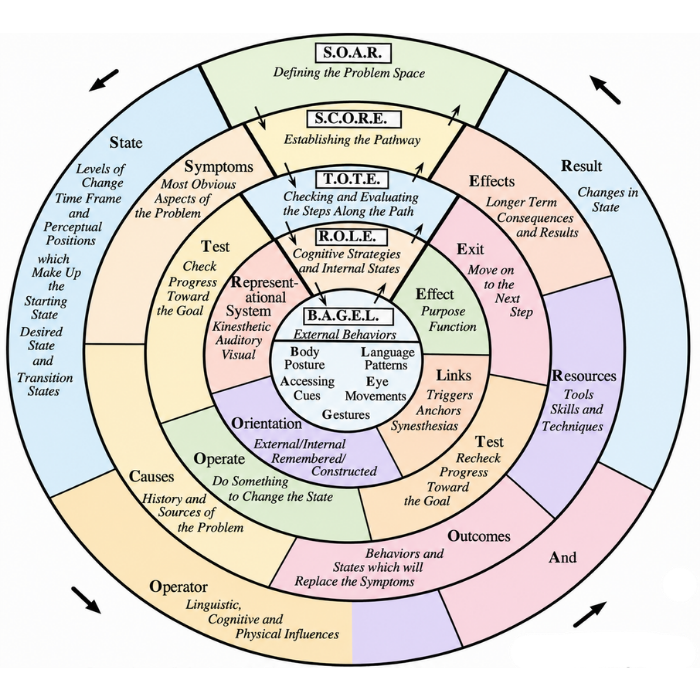
The Unified Field Theory of NLP, popularised by Robert Dilts and Todd Epstein, can be understood as an attempt to bring coherence to this diversity. Rather than treating NLP techniques as separate tools, the Unified Field Theory seeks to map how the different dimensions of human experience interact. It aims to create a holistic schema that connects physiology, language, perception, emotion, cognition, beliefs, values, identity, relationships, behaviour and wider systems.
The importance of the model lies not simply in its technical structure, but in its integrative ambition. It asks: how do the many elements of NLP fit together? How does inner experience become action? How do beliefs influence capability? How does language shape perception? How do identity, environment and relationships interact to produce patterns of behaviour? And how can change be approached systemically rather than mechanically?
This article explores the background, structure, application and limitations of the Unified Field Theory of NLP, with particular attention to its relevance for coaching, personal development, leadership and organisational learning.
1. Background: From NLP Techniques to an Integrated Field
Early NLP was primarily concerned with modelling excellence. Bandler and Grinder studied highly effective communicators and therapists, seeking to identify the patterns behind their results. Their early work focused on the relationship between language and internal representation, particularly how people structure experience through deletion, distortion and generalisation (Bandler & Grinder, 1975; Grinder & Bandler, 1976).
This work led to the development of models such as:
- The Meta Model, which analyses language patterns to recover missing information and challenge limiting assumptions.
- The Milton Model, which studies artfully vague language, metaphor and indirect suggestion.
- Representational systems, which describe how people encode experience through visual, auditory, kinaesthetic, olfactory and gustatory modalities.
- Anchoring, which examines how emotional states become associated with internal or external cues.
- Strategies, which explore the sequence of internal representations and responses that produce a behaviour or result.
- Submodalities, which examine the finer distinctions within sensory representation, such as brightness, distance, volume, tone, movement or pressure.
As NLP developed, Robert Dilts became one of the most significant contributors to its second generation. His work expanded NLP from technique-based change into larger questions of beliefs, identity, creativity, leadership, health, learning and systemic change (Dilts, 1990; Dilts, 1996; Dilts, 2003). Todd Epstein, who worked closely with Dilts, contributed to NLP training design, systemic thinking and the development of integrative models within NLP.
The Unified Field Theory of NLP is associated with this movement from isolated techniques toward a broader architecture of human experience. It attempts to organise NLP’s many models into a connected whole, making it easier to understand where an intervention belongs and how change at one level affects other levels.
2. What Is the Unified Field Theory of NLP?
The term “Unified Field Theory” is borrowed metaphorically from physics, where it refers to the search for a single framework capable of explaining multiple forces or phenomena. In the NLP context, it does not refer to a scientific theory in the same sense. Rather, it is a conceptual and practical framework for integrating the various models of NLP into a single field of relationship.
The Unified Field Theory of NLP proposes that human experience is not produced by one factor alone. Behaviour is not simply the result of environment, nor is it only the
result of belief, emotion, language or physiology. Instead, behaviour emerges from the interaction of multiple dimensions.
These dimensions include:
- External environment: where and when behaviour occurs.
- Behaviour: what a person does or does not do.
- Capabilities and strategies: how a person thinks, learns and performs.
- Beliefs and values: why a person acts and what they consider important.
- Identity: who the person experiences themselves to be.
- Purpose or spirituality: the larger system, mission or meaning within which identity is held.
- Physiology and state: the embodied condition through which experience is lived.
- Language and symbolic representation: how experience is described, framed and communicated.
- Relationships and systems: the wider interpersonal and organisational fields in which behaviour occurs.
In this sense, the Unified Field Theory is a map of relationships. It encourages practitioners to see people as living systems rather than as collections of isolated behaviours.
A simple example illustrates this. Suppose a manager struggles to give feedback to a team member. A behaviour-level view might focus only on what the manager says or does. A skills-level view might teach a feedback model. A beliefs-level view might explore whether the manager believes feedback creates conflict. An identity-level view might examine whether the manager sees themselves as a supportive leader or as someone who avoids authority. A systemic view might explore the culture of the organisation and whether honest dialogue is rewarded or punished.
The Unified Field Theory invites the practitioner to consider all these dimensions and their interactions.
3. The Roots of the Unified Field Theory: Systems Thinking and Bateson
One of the most important intellectual influences behind this model is Gregory Bateson. Bateson’s work in anthropology, cybernetics, communication and systems theory had a strong influence on early NLP, especially through his ideas about learning, feedback, ecology and logical levels (Bateson, 1972; Bateson, 1979).
Bateson argued that mind should not be understood as confined within the individual skull. Rather, mind exists in patterns of relationship, feedback and communication. A person’s behaviour is part of a wider system that includes other people, context, history, language, culture and environment. This systemic perspective became central to more advanced forms of NLP.
Bateson also developed a theory of logical levels of learning. He distinguished between different orders of learning, such as simple behavioural change, learning how to learn, and changes in identity or worldview. Dilts later adapted and popularised this idea in the form of Neuro-Logical Levels or Logical Levels of Change (Dilts, 1990; Dilts, 1996).
The Unified Field Theory draws heavily from this systemic lineage. It assumes that meaningful change requires attention to the level at which a problem is organised. A behavioural difficulty may not be solved by behavioural instruction if the deeper pattern is maintained by belief, identity or systemic reinforcement.
For example, a person may know how to speak confidently, yet still hesitate because they believe their voice does not matter. Another person may have excellent technical skills, yet fail to lead because they do not identify as a leader. In both cases, the visible behaviour is shaped by deeper organising patterns.
4. Neuro-Logical Levels as a Core Organising Model
One of the most widely known components associated with Dilts’s integrative approach is the Neuro-Logical Levels model. Although not identical to the Unified Field Theory, it forms one of its central organising structures.
The model is commonly presented through six levels:
- Environment – where and when something happens.
- Behaviour – what a person does.
- Capability – how a person acts, thinks or performs.
- Beliefs and values – why a person acts and what matters to them.
- Identity – who the person experiences themselves to be.
- Purpose, mission or spirituality – the larger system to which the person belongs.
The model suggests that higher levels organise and influence lower levels. Identity influences beliefs; beliefs influence capabilities; capabilities influence behaviour; behaviour affects and is affected by environment. At the same time, change can also move upward. Repeated behaviour may build capability; new capability may alter belief; changed belief may reshape identity.
For coaching and personal development, this is highly significant. It means that a presenting issue may not always be located at the level where it appears.
Consider the statement, “I cannot speak in public.” This could reflect different levels:
- Environment: “I struggle when speaking in large formal rooms.”
- Behaviour: “I avoid eye contact and rush my words.”
- Capability: “I have not learned how to structure a presentation.”
- Belief: “People will judge me if I make a mistake.”
- Identity: “I am not the kind of person who stands up and speaks.”
- Purpose: “I do not see why my message matters.”
The same surface statement may therefore require different interventions depending on the organising level of the problem.
5. Representational Systems and the Structure of Subjective Experience
Another core component of the Unified Field Theory is the NLP idea that human beings represent experience internally through sensory modalities. We think in images, sounds, feelings, internal dialogue, sensations, tastes and smells. These internal representations form part of the structure of subjective experience (Dilts et al., 1980).
For example, a person remembering a successful presentation may see the room, hear applause, feel pride and say internally, “I handled that well.” Another person anticipating a difficult meeting may see disapproving faces, hear critical voices and feel tension in the chest. The event has not yet happened, but the internal representation produces a real emotional and physiological response.
NLP’s contribution here is practical: if internal experience has structure, then changing that structure may change the person’s response. Submodality work, for instance, explores how qualities such as brightness, distance, movement, size, volume and location influence emotional intensity. A frightening mental image may become less compelling if it is moved further away, made smaller or drained of colour. A motivating goal may become more compelling if it is represented vividly, close-up and associated with positive feeling.
Within the Unified Field Theory, representational systems are not treated as isolated techniques. They are understood as part of a wider field. A mental image may be connected to a belief. A belief may be connected to identity. Identity may be connected to physiology and social context. This is what makes the theory systemic: a change in one part of the field may influence many others.
6. Language as a Bridge Between Inner Experience and Social Reality
The “linguistic” aspect of NLP is central to the Unified Field Theory. Language does not merely describe experience; it also shapes, filters and organises it. The words people use reveal assumptions, beliefs, values, generalisations, omissions and patterns of attention (Bandler & Grinder, 1975).
For example, the statement “I always fail when I try something new” contains a universal generalisation. “My manager does not respect me” may involve mind-reading unless supported by behavioural evidence. “I have to be perfect” contains a modal operator of necessity. “There is no point trying” reveals a belief about possibility and outcome.
The Meta Model gives practitioners a way to question such language patterns. Its purpose is not to argue with the client, but to recover specificity and choice. Questions such as “Always?”, “What specifically happened?”, “How do you know?”, “What would happen if you did?”, or “According to whom?” can loosen rigid maps of reality.
The Milton Model works differently. It uses ambiguity, metaphor, embedded suggestion and permissive language to invite unconscious processing and resourceful states (Grinder & Bandler, 1981). Where the Meta Model moves toward precision, the Milton Model often moves toward possibility.
In the Unified Field Theory, language operates at multiple levels. It expresses inner representation, influences emotional state, organises belief, maintains identity and shapes social relationships. The stories people tell about themselves can become self-fulfilling patterns. A leader who says “I am terrible with people” is not simply reporting a fact; they may be reinforcing a limiting identity. A coach who helps the person re-author that story may open the door to new behaviour.
7. Beliefs, Values and Identity
One of Dilts’s major contributions to NLP was his emphasis on beliefs, values and identity as central drivers of change. Earlier NLP often focused on strategies, states and communication patterns. Dilts extended this toward deeper questions of meaning, purpose and self-concept (Dilts, 1990; Dilts, 1996).
Beliefs are generalisations about self, others and the world. They define what seems possible, necessary, acceptable or dangerous. Values are what people consider important. Identity refers to the person’s sense of who they are.
In practice, beliefs and identity can strongly influence the success or failure of behavioural change. A person may learn a new skill but fail to use it because it conflicts with an identity-level belief. For example:
- “I know how to sell, but I do not want to be seen as pushy.”
- “I can lead the team, but I still feel like an imposter.”
- “I want to be visible online, but people like me should not draw attention to themselves.”
- “I can set boundaries, but a good person should always help.”
The Unified Field Theory suggests that change becomes more sustainable when behaviour, capability, belief, identity and purpose are aligned. This is why Dilts’s later work often uses terms such as alignment, congruence, sponsorship and mission.
In coaching, this perspective is particularly useful. Many clients do not lack information. They lack integration. They know what to do, but part of them resists doing it. A unified approach asks what that resistance is protecting, what belief sustains it, what value is involved, and what identity-level shift may be needed.
8. State, Physiology and Embodied Experience
Although NLP is often discussed in terms of language and cognition, its models are strongly embodied. Emotional state, breathing, posture, gesture, eye movement, muscle tone and rhythm are treated as integral to experience.
A person’s state influences what they perceive, remember, believe and do. In a confident state, a challenge may look manageable. In an anxious state, the same challenge may seem overwhelming. State affects access to resources.
Anchoring is one of NLP’s best-known state-based techniques. It involves associating a desired state with a specific stimulus, such as a touch, word, gesture or image. The principle is that repeated association can make the state easier to access later. While the mechanism is often described in NLP terms, it has parallels with broader learning theory, conditioning and embodied cognition.
Within the Unified Field Theory, physiology is not a secondary detail. It is part of the field. A belief is not merely a sentence in the mind; it is held in the body. A confident identity is not only a concept; it has posture, breathing, voice tone and movement. Likewise, changing physiology can sometimes shift cognition and emotion.
This has direct relevance for leadership and coaching. A leader’s words may communicate confidence, but their physiology may communicate uncertainty. A coach may ask powerful questions, but their presence and state will influence the relational field. The Unified Field Theory therefore encourages attention to both content and process, both language and embodiment.
9. Strategies, Modelling and Excellence
At the heart of NLP is the idea of modelling. NLP began not as a theory of pathology, but as a study of excellence. Its central question was: what is the difference that makes the difference? What do effective people do internally and externally that produces superior results?
Strategies are sequences of internal and external representations that lead to outcomes. A spelling strategy, for example, might involve seeing the word internally, checking whether it feels right, and then writing it down. A motivation strategy might involve seeing a desired outcome, hearing encouraging self-talk, feeling excitement, and taking action. A procrastination strategy might involve picturing difficulty, hearing internal criticism, feeling pressure, and avoiding the task.
The Unified Field Theory places strategies within a larger frame. A strategy is not just a sequence; it is influenced by beliefs, values, identity, state and context. Two people may use the same behavioural steps but produce different results because the underlying field is different.
For example, two coaches may ask the same question: “What do you want?” One asks it from curiosity, presence and respect. The other asks it mechanically. The words are the same, but the relational field is different. The Unified Field Theory therefore reminds practitioners that technique alone is not enough. The person using the technique matters.
10. The Seven “C”s and Systemic Integration
In systemic NLP, several frameworks have been used to describe the qualities needed for effective change. One such framework is the set of “C”s often associated with Dilts’s later work, including concepts such as congruence, competence, communication, creativity, collaboration, commitment and consciousness.
Although different sources may present these categories in slightly different ways, the underlying point is consistent: human change is multidimensional. Effective performance requires more than isolated skill. It involves alignment between internal state, purpose, values, behaviour and relationship.
For example, a leader may need:
- Clarity about purpose.
- Congruence between values and actions.
- Competence in communication.
- Creativity in problem-solving.
- Connection with others.
- Commitment to action.
- Consciousness of wider systemic impact.
The Unified Field Theory functions as a container for these qualities. It allows the practitioner to ask: which part of the field needs attention? Is the issue one of skill, belief, relationship, purpose, state, strategy or environment?
11. Applications in Coaching
The Unified Field Theory has particular value in coaching because coaching is rarely about technique alone. Clients often present with complex, layered issues. A person may want to change career, become more confident, improve leadership presence, build a business, navigate conflict or develop a clearer sense of purpose. Such goals cannot always be reduced to simple behavioural steps.
A unified NLP approach to coaching may involve:
- Clarifying the desired outcome.
- Exploring the current state and presenting challenge.
- Identifying the level at which the issue is organised.
- Mapping the client’s internal representations, language and emotional state.
- Exploring beliefs, values and identity.
- Identifying resources and exceptions.
- Creating alignment across levels.
- Testing new behaviours in real-world contexts.
- Reviewing ecology, consequences and systemic fit.
For example, a client who wants to become more visible professionally may initially ask for help with LinkedIn posting or public speaking. A behavioural approach may help them create a content plan. A capability approach may teach communication skills. A belief-level intervention may address fears of judgement. An identity-level intervention may help the client see themselves as someone whose voice can contribute meaningfully. A systemic approach may examine their professional audience, workplace culture or community of practice.
The power of the Unified Field Theory is that it keeps all these possibilities available. It prevents the coach from assuming that the presenting problem is the whole problem.
12. Applications in Leadership and Organisational Development
In leadership and organisational development, the Unified Field Theory can be used to understand change at individual, team and cultural levels.
Organisational change often fails because it is addressed only at the level of behaviour or process. Leaders introduce new procedures, systems or targets, but do not address the beliefs, values, identity and culture that maintain old patterns.
For example, an organisation may say it wants innovation, but punish mistakes. It may promote collaboration, but reward individual competition. It may claim to value wellbeing, but celebrate overwork. In Unified Field terms, there is incongruence between stated values, behavioural systems and cultural identity.
The model can therefore support organisational diagnosis by asking:
- Environment: What structures, systems and conditions shape behaviour?
- Behaviour: What are people actually doing?
- Capability: What skills and strategies are present or missing?
- Beliefs and values: What assumptions guide decisions?
- Identity: How does the organisation define itself?
- Purpose: What larger mission gives meaning to the work?
- Relationships: How do communication and power flow through the system?
This can be particularly valuable in leadership development. A manager may need more than a toolkit of leadership techniques. They may need to shift from “technical expert” to “people leader”, from “problem-solver” to “coach”, or from “controller” to “strategic enabler”. These are identity-level transitions.
The Unified Field Theory gives trainers and coaches a way to support those transitions holistically.
13. Ecology: The Ethical and Systemic Test of Change
A key principle in NLP is ecology. In this context, ecology refers to the wider consequences of change for the person and the systems to which they belong. A change may appear positive at one level but create problems at another.
For example, becoming more assertive may improve confidence but strain relationships if not integrated with empathy. Increasing productivity may improve performance but damage health if disconnected from values and wellbeing. Helping a client become more persuasive may be useful, but ethically problematic if separated from integrity and respect.
The Unified Field Theory makes ecological thinking essential. Since each part of the field affects the whole, change must be tested systemically. Practitioners need to ask:
- What will this change affect?
- Who else will be impacted?
- What might be lost as well as gained?
- Does this change align with the person’s values?
- Is the change sustainable?
- Does it respect the autonomy and wellbeing of others?
This is especially important because NLP has sometimes been criticised for being used manipulatively in sales, influence or persuasion contexts. A systemic and ethical interpretation of the Unified Field Theory requires that change be aligned with consent, responsibility and wider wellbeing.
14. Strengths of the Unified Field Theory
The Unified Field Theory of NLP has several practical strengths.
First, it is integrative. It provides a way to organise many NLP models into a coherent map. This is useful for practitioners who might otherwise treat NLP as a toolbox of disconnected techniques.
Second, it is systemic. It encourages attention to relationships, context, feedback and ecology. This helps avoid overly simplistic explanations of behaviour.
Third, it is flexible. It can be applied to coaching, leadership, learning, creativity, health, communication and organisational development.
Fourth, it is pragmatic. It helps practitioners ask useful diagnostic questions: Where is the issue organised? What level of change is required? What resources are missing? What is out of alignment?
Fifth, it honours subjective experience. Rather than reducing people to observable behaviour alone, it explores how people construct meaning internally through images, sounds, feelings, words, beliefs and values.
For coaches and educators, this makes the model highly usable. It provides a practical lens for helping people move from confusion to clarity, from stuckness to choice, and from fragmented effort to aligned action.
15. Limitations and Criticisms
A balanced article must also acknowledge the limitations of NLP and of the Unified Field Theory specifically.
One limitation is variability in training standards. Because NLP is taught by many different schools and organisations, the quality, ethics and evidence-awareness of NLP practice can vary significantly. Studying with an ANLP Accredited Trainer and training school is highly recommended.
Another limitation is the risk of overgeneralisation. A model that includes everything can sometimes explain too much. If every issue can be interpreted through environment, behaviour, capability, belief, identity or purpose, the model may become descriptive rather than predictive.
For these reasons, the Unified Field Theory is best used as a reflective and practical framework, not as a substitute for psychological assessment, counselling, psychotherapy, medical care or evidence-based clinical intervention.
16. Toward an Evidence-Informed Use of the Model
The most responsible way to use the Unified Field Theory today is to treat it as a heuristic: a useful map for inquiry, not a final description of reality.
In coaching, leadership and personal development, many models are valuable not because they are complete scientific theories, but because they help people think, reflect and act more effectively. The GROW model, Johari Window, transactional analysis, emotional intelligence frameworks and adult learning models are often used in this way. The Unified Field Theory can sit within this tradition if used with appropriate caution.
An evidence-informed practitioner might use the model to generate questions such as:
- What is the client paying attention to?
- How are they representing the issue internally?
- What language patterns reveal limiting assumptions?
- What beliefs or values are organising the behaviour?
- What identity-level meanings are involved?
- What systemic pressures are maintaining the pattern?
- What small behavioural experiments can test new possibilities?
- What evidence will show that progress is occurring?
This approach avoids exaggerated claims. It does not require the practitioner to claim that NLP has solved the mysteries of the brain. Instead, it uses the model as a structured way to support reflection, learning and behavioural experimentation.
17. The Unified Field Theory and Human Development
At its best, the Unified Field Theory points toward a generous and developmental view of human beings. It suggests that people are not fixed machines, but dynamic systems capable of learning, reframing, reorganising and growing.
Human experience is layered. We live in environments, develop behaviours, build capabilities, form beliefs, pursue values, construct identities and seek meaning. We are shaped by language, relationship, physiology, culture and imagination. Change, therefore, is rarely one-dimensional.
This is why the model remains attractive to many coaches and trainers. It helps explain why surface-level change often does not last. It also explains why a small shift in meaning can sometimes unlock major behavioural change.
A person who says, “I am not confident” may need skills, but they may also need a new relationship with failure. A leader who says, “My team resists change” may need strategy, but they may also need to examine trust, identity and culture. A coach who says, “My client is stuck” may need to look beyond the presenting story and explore the wider field.
The Unified Field Theory invites this wider view.
The Unified Field Theory of NLP, associated especially with Robert Dilts and Todd Epstein, represents an ambitious attempt to organise the diverse models of NLP into a holistic schema of human experience and behaviour. It draws together language, perception, state, belief, identity, capability, behaviour, environment and systemic relationship.
Its central contribution is integrative. It helps practitioners move beyond isolated techniques and toward a more systemic understanding of change. It encourages coaches, trainers and leaders to ask not only “What behaviour needs to change?” but also “At what level is this pattern organised?” and “How does this change fit the wider system?”
At the same time, the model should be used responsibly. NLP’s wider evidence base remains contested, and many of its claims require caution. The Unified Field Theory is not a proven scientific theory in the conventional sense. It is better understood as a practical framework, a map for inquiry and a way of thinking systemically about human development.
Used carefully, ethically and reflectively, it can help practitioners bring greater coherence to coaching, leadership, communication and personal change. Its value lies not in claiming to explain everything, but in reminding us that human beings are whole systems: embodied, relational, linguistic, emotional, purposeful and constantly learning.
References
Bandler, R., & Grinder, J. (1975). The Structure of Magic I: A Book About Language and Therapy. Science and Behavior Books.
Bandler, R., & Grinder, J. (1979). Frogs into Princes: Neuro Linguistic Programming. Real People Press.
Bateson, G. (1972). Steps to an Ecology of Mind. Chandler Publishing Company.
Bateson, G. (1979). Mind and Nature: A Necessary Unity. E. P. Dutton.
Dilts, R. (1990). Changing Belief Systems with NLP. Meta Publications.
Dilts, R. (1996). Visionary Leadership Skills: Creating a World to Which People Want to Belong. Meta Publications.
Dilts, R. (2003). From Coach to Awakener. Meta Publications.
Dilts, R., Epstein, T., & Dilts, R. W. (1991). Tools for Dreamers: Strategies of Creativity and the Structure of Innovation. Meta Publications.
Dilts, R., Grinder, J., Bandler, R., & DeLozier, J. (1980). Neuro-Linguistic Programming Volume I: The Study of the Structure of Subjective Experience. Meta Publications.
Grinder, J., & Bandler, R. (1976). The Structure of Magic II: A Book About Communication and Change. Science and Behavior Books.
Grinder, J., & Bandler, R. (1981). Trance-Formations: Neuro-Linguistic Programming and the Structure of Hypnosis. Real People Press.
Hall, L. M., & Bodenhamer, B. G. (1999). The User’s Manual for the Brain: The Complete Manual for Neuro-Linguistic Programming Practitioner Certification. Crown House Publishing.
O’Connor, J., & Seymour, J. (1990). Introducing Neuro-Linguistic Programming: Psychological Skills for Understanding and Influencing People. Thorsons.
Sturt, J., Ali, S., Robertson, W., Metcalfe, D., Grove, A., Bourne, C., & Bridle, C. (2012). Neurolinguistic programming: A systematic review of the effects on health outcomes. British Journal of General Practice, 62(604), e757–e764.
Tosey, P., & Mathison, J. (2009). Neuro-Linguistic Programming: A Critical Appreciation for Managers and Developers. Palgrave Macmillan.
Witkowski, T. (2010). Thirty-five years of research on Neuro-Linguistic Programming: NLP research data base. State of the art or pseudoscientific decoration? Polish Psychological Bulletin, 41(2), 58–66.

