


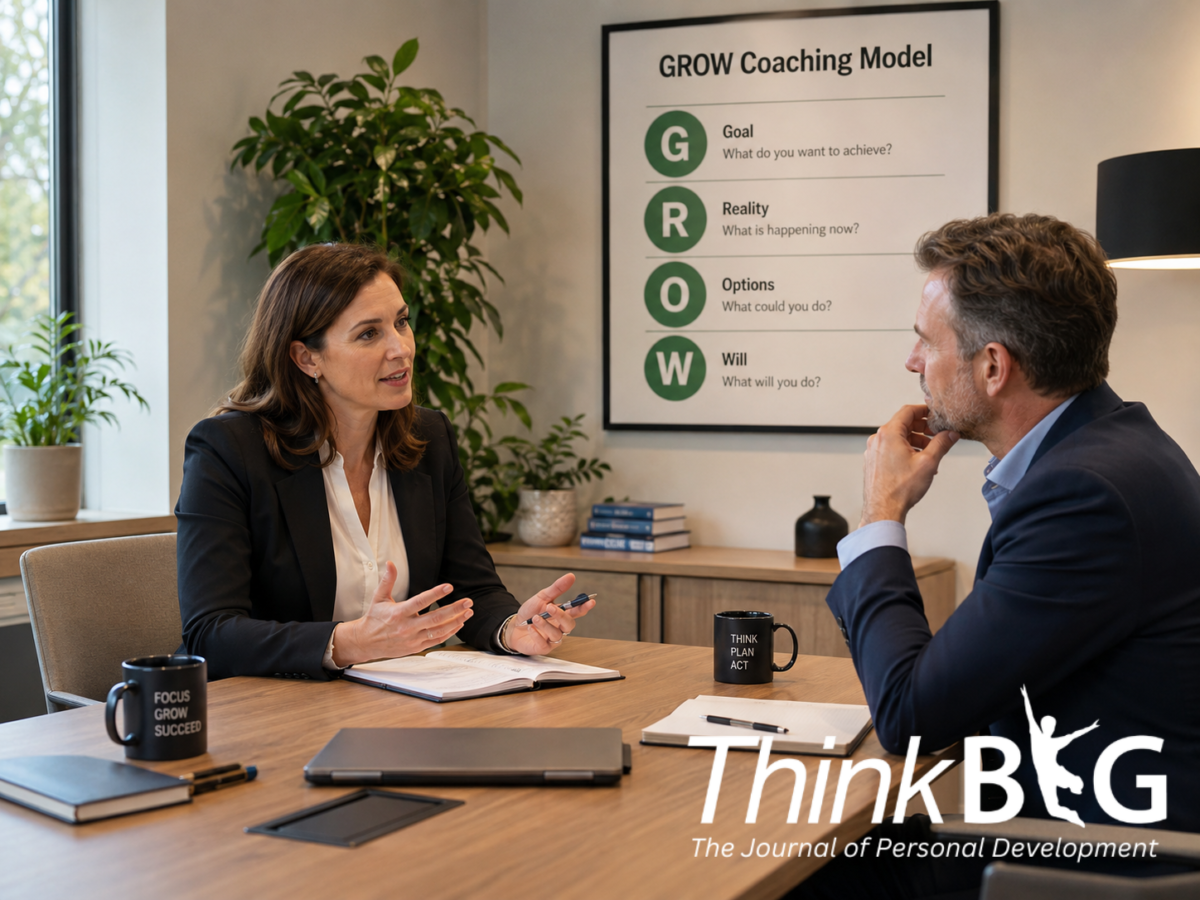
The GROW coaching model is one of the most widely recognised and frequently taught coaching frameworks in the world. Simple enough to be remembered by a new manager, yet flexible enough to support experienced coaches, GROW has become a central part of performance coaching, leadership development, executive coaching, mentoring and workplace learning.
GROW is most commonly understood as an acronym for:
- Goal – What do you want?
- Reality – What is happening now?
- Options – What could you do?
- Will / Way Forward – What will you do?
Its enduring appeal lies in its simplicity. It gives structure to a coaching conversation without turning the conversation into a rigid script. At its best, GROW helps a coach or manager move away from telling, advising and directing, and towards asking, listening, raising awareness and encouraging personal responsibility.
The story of GROW, however, is more interesting than a simple four-stage acronym. Its roots lie in sports coaching, human potential thinking, the “Inner Game” method developed by W. Timothy Gallwey, and the pioneering work of early performance coaches including Sir John Whitmore, Graham Alexander, Alan Fine and Max Landsberg. Its popularisation came largely through Whitmore’s influential book Coaching for Performance, first published in 1992, which helped bring coaching into mainstream organisational life.
This article explores the history and development of the GROW model, its philosophical origins, the contribution of its key figures, its rise through corporate coaching, and its continuing relevance today.
The Coaching Landscape Before GROW
To understand the importance of GROW, it is useful to remember that coaching, as a recognised professional discipline, is relatively young. People have always helped others learn, perform and develop, but the modern field of executive, leadership and workplace coaching emerged strongly in the late twentieth century.
Before coaching became a mainstream organisational practice, development conversations in the workplace were usually framed through training, appraisal, supervision, mentoring or management instruction. The dominant assumption was often that expertise sat with the manager, trainer or consultant, who diagnosed the problem and gave the answer.
This approach had value in technical training, but it was less effective when the issue involved motivation, confidence, judgement, personal responsibility, leadership behaviour or performance under pressure. In these situations, simply telling someone what to do often failed to produce lasting change.
GROW became important because it offered a practical alternative. It helped managers and coaches hold conversations that were structured, purposeful and performance-focused, while still being centred on the learner’s own awareness and choices.
Timothy Gallwey and the Inner Game
The deeper roots of the GROW model can be traced to the work of W. Timothy Gallwey, author of The Inner Game of Tennis, first published in 1974.
Gallwey was a tennis coach who became fascinated by a common problem in sports coaching: players often performed worse when they were overloaded with instructions. A coach could tell a player to keep their eye on the ball, relax their grip, bend their knees or follow through correctly, but the player might then become tense, self-conscious and over-analytical.
Gallwey argued that performance involved two games. The “outer game” was the visible game played against an external opponent, with goals, rules and measurable outcomes. The “inner game” was the internal struggle against fear, self-doubt, distraction, self-criticism and over-effort.
His famous distinction between “Self 1” and “Self 2” captured this idea. Self 1 is the conscious, judging, instructing mind. Self 2 is the natural learner: the body-mind system that can perform, adapt and improve when not interfered with by excessive self-consciousness.
Gallwey’s approach was revolutionary because he reduced instruction and increased awareness. Rather than telling players exactly what to change, he invited them to notice what was happening. Instead of saying “keep your eye on the ball”, he might ask the player to observe the ball carefully, notice its spin, or say “bounce” when the ball bounced and “hit” when the racket made contact.
This shifted attention from judgement to observation. The player became more aware, less tense and more able to learn from direct experience.
This principle became foundational to modern coaching. The coach’s role was not simply to transfer knowledge, but to create the conditions in which the learner could become aware, take responsibility and unlock performance.
From Sports Coaching to Human Potential
Gallwey’s work arrived during a period of wider interest in human potential, personal development, experiential learning and performance psychology. During the 1970s and 1980s, ideas from psychology, sport, education and organisational development began to influence each other more visibly.
Sports coaching offered a powerful metaphor for business and leadership. Athletes needed focus, confidence, feedback, practice and resilience. So did managers, leaders and teams. The sports coach was not merely a technical instructor; at the highest levels, the coach helped the performer remove interference and access capability.
This idea appealed strongly to early pioneers of workplace coaching. If performance could be improved on a tennis court by asking better questions, raising awareness and reducing internal interference, perhaps similar principles could be applied in the boardroom, in management meetings and in leadership development.
It was this bridge from sport to business that shaped the early development of performance coaching and, eventually, the GROW model.
John Whitmore and the Birth of Performance Coaching
Sir John Whitmore became one of the most influential figures in bringing coaching into organisational life. A former racing driver, Whitmore was drawn to Gallwey’s Inner Game ideas and helped translate them from sports coaching into the world of work.
Whitmore was closely associated with introducing Inner Game principles into Britain and Europe. Alongside colleagues, he began applying Gallwey’s ideas first in sport and then in business. The approach was based on a deceptively simple belief: people often have more potential than they are currently expressing, and skilful coaching can help them access it.
Whitmore later described coaching as unlocking a person’s potential to maximise their own performance. This definition became one of the most widely quoted descriptions of coaching. It also reflects the Inner Game influence clearly: the coach is not primarily putting knowledge in, but helping release capability that is already present.
Whitmore’s work helped establish the language of “performance coaching”. This was important because it differentiated coaching from traditional instruction, counselling, mentoring or consultancy. Performance coaching was practical, goal-oriented and action-focused, but it was also built around awareness, responsibility and self-directed learning.
Graham Alexander and the Early Development of GROW
Graham Alexander deserves significant recognition in the history of GROW. A former tennis player who became one of the UK’s leading executive coaches, Alexander was deeply influenced by Gallwey’s Inner Game approach and became one of the central figures in applying coaching principles to senior leaders and organisations.
Alexander worked with John Whitmore in the early development of performance coaching in the UK. Accounts of the early history suggest that Alexander played a major role in shaping the practical coaching process that later became known as GROW.
The model appears to have emerged not as a theoretical framework designed in isolation, but as a practical pattern discovered through coaching work. Early performance coaches were working with individuals and groups, observing what helped people clarify aims, understand current reality, generate possibilities and commit to action.
One important account links the development of GROW to corporate work in the 1980s, including programmes with McKinsey & Company. According to this account, Alexander and Whitmore were asked to define the process they were using. By reviewing coaching conversations and identifying the structure beneath effective performance coaching, they arrived at the sequence of Goal, Reality, Options or Opportunities, and Way Forward.
This matters because it shows that GROW was not simply an abstract acronym. It was a codification of an emerging practice. The model gave language and structure to something that experienced coaches were already doing intuitively.
Alexander later founded the Alexander Partnership and became known for executive coaching at senior levels. His contribution is sometimes underemphasised because Whitmore’s book became the major vehicle through which GROW reached a wider audience. However, a historically balanced account should recognise Alexander as one of the key architects of the model’s development and early application.
Alan Fine and the Performance Coaching Tradition
Alan Fine is also frequently named as one of the co-developers of the GROW model. Like Whitmore and Alexander, Fine was associated with the Inner Game tradition and with the transfer of performance coaching principles from sport into business.
Fine’s later book, You Already Know How to Be Great, published in 2010 with Rebecca R. Merrill, presents a performance approach based on reducing interference and unlocking existing capacity. This is very much in the spirit of Gallwey’s influence. The title itself captures one of the central assumptions of the coaching movement: people often do not need more information as much as they need access to what they already know, greater clarity, and a way to act.
Fine’s version of GROW has been widely used in business coaching and leadership development. His contribution reinforces the point that GROW developed within a network of practitioners, rather than through a single isolated author.
Max Landsberg and the Naming of GROW
The question of who created the acronym “GROW” is slightly more complicated than many simplified accounts suggest.
John Whitmore stated in a 2009 account that Max Landsberg coined the name GROW during a conversation with Graham Alexander, while Whitmore was the first to publish the model in the 1992 first edition of Coaching for Performance. Landsberg later included the GROW technique in The Tao of Coaching, first published in 1996.
This suggests that the model and the name may not have appeared at exactly the same moment. The coaching process itself seems to have been in use before the acronym became widely known. The acronym then helped make the process memorable, teachable and transferable.
Landsberg’s contribution is important because naming is not a minor matter in the spread of an idea. A useful acronym can help a model travel. “Goal, Reality, Options, Will” is simple, memorable and easy to teach. The name GROW also carries a powerful metaphor: coaching is about growth, development and potential.
John Whitmore’s Coaching for Performance and the Popularisation of GROW
Although GROW had several contributors, John Whitmore’s Coaching for Performance was the decisive publication in bringing the model to a wide audience.
First published in 1992 by Nicholas Brealey, Coaching for Performance became one of the landmark books in the development of workplace coaching. It presented coaching not as a marginal technique, but as a practical leadership discipline. The book connected performance, learning and enjoyment, and placed GROW at the heart of a coaching approach that managers could use in everyday organisational life.
Whitmore’s contribution was therefore not only in developing the model, but in articulating and promoting the philosophy behind it. He made coaching accessible to leaders, managers and organisations at a time when the field was still emerging.
Through Coaching for Performance, GROW became associated with a broader set of principles:
- Awareness – people improve when they see more clearly what is happening.
- Responsibility – people are more committed when they choose their own actions.
- Self-belief – coaching should strengthen confidence and ownership.
- Potential – people often have more capacity than their current performance suggests.
- Non-directive inquiry – powerful questions can create more learning than advice.
The book’s influence was enormous. It helped make coaching part of the language of leadership development and human resource practice. Many later coaching programmes, qualifications and management training courses adopted GROW because it was easy to understand, easy to practise and adaptable across different contexts.
What Each Stage of GROW Means
Although different writers use slightly different wording, the basic structure of GROW has remained remarkably consistent.
Goal
The first stage is to clarify the desired outcome. The coach helps the coachee identify what they want to achieve, either in the session itself or in a broader performance or development context.
Typical questions include:
- What would you like to achieve?
- What would be a useful outcome from this conversation?
- What does success look like?
- How will you know you have achieved it?
- Why is this important?
This stage connects strongly with goal-setting theory and performance psychology. A vague desire becomes more powerful when it is translated into a clear, meaningful and measurable goal.
Reality
The second stage explores the current situation. This is where the coach helps the coachee examine what is happening now, what has already been tried, what resources are available and what obstacles may exist.
Typical questions include:
- What is happening at the moment?
- What have you already tried?
- What is working?
- What is not working?
- What is the real challenge here?
- What evidence do you have?
- What assumptions might you be making?
This stage reflects Gallwey’s influence particularly strongly. The aim is not to judge reality, but to observe it more accurately. Good coaching helps the coachee see the current situation with greater clarity.
Options
The third stage opens up possibilities. The coach encourages the coachee to generate choices before deciding what to do.
Typical questions include:
- What could you do?
- What else could you try?
- What would you do if you had more confidence?
- What would you advise someone else to do?
- What are the advantages and disadvantages of each option?
- What is possible here that you have not yet considered?
This stage is important because people often move too quickly from problem to solution. GROW slows the process down enough to create creativity, flexibility and choice.
Will / Way Forward
The final stage turns insight into commitment. The coach helps the coachee decide what they will do, when they will do it, and how they will maintain accountability.
Typical questions include:
- What will you do?
- When will you do it?
- What is the first step?
- What support do you need?
- What might get in the way?
- How committed are you?
- How will you know you are making progress?
This stage is one reason GROW became so popular in business. It does not leave the conversation at the level of reflection. It moves towards action, ownership and performance.
Why GROW Became So Popular
The success of GROW can be explained by several factors.
First, it is simple. Many coaching models require extensive training before they can be used effectively. GROW can be introduced quickly and remembered easily.
Second, it is flexible. It can be used in a formal coaching session, a mentoring conversation, a performance review, a leadership meeting or a short problem-solving conversation.
Third, it fits organisational life. Businesses need conversations that clarify outcomes, analyse current performance, explore options and lead to action. GROW maps naturally onto this need.
Fourth, it reflects a positive view of human potential. It assumes that people are resourceful, capable of insight and more likely to act when they have ownership of the solution.
Fifth, it helped managers shift from command-and-control leadership towards coaching-led leadership. A manager using GROW does not need to have all the answers. Instead, they learn to ask better questions.
The Influence of the Inner Game on GROW
The influence of Gallwey’s Inner Game can be seen throughout GROW.
The Goal stage relates to the outer game: what is the person trying to achieve? However, it also invites the coachee to define success for themselves, rather than simply accepting someone else’s instruction.
The Reality stage reflects Gallwey’s emphasis on awareness without judgement. The coach helps the coachee notice what is happening, rather than immediately labelling it as good or bad.
The Options stage reduces interference by creating choice. When people feel stuck, they often believe there is only one route forward. Coaching expands the field of possibility.
The Will stage strengthens responsibility. The action is not imposed by the coach; it is chosen by the coachee.
In this sense, GROW is not merely a sequence of questions. It is a practical expression of a deeper coaching philosophy: people learn best when they are aware, responsible and internally committed.
Variations and Extensions of GROW
Over time, many variations of GROW have appeared.
Some practitioners interpret O as “Options”; others include “Obstacles” or “Opportunities”. Some interpret W as “Will”, while others prefer “Way Forward”, “Wrap-up” or “What next?”
There are also extended models such as TGROW, where the initial “T” refers to Topic, and REGROW, which brings review and evaluation more explicitly into the coaching cycle.
These adaptations show the flexibility of the model. However, they also highlight an important point: GROW is best understood as a conversational map rather than a rigid formula. Skilled coaches do not mechanically march through the acronym. They use it as a guide while remaining fully present to the person, the context and the emerging conversation.
Academic and Professional Perspectives
The wider evidence base for coaching has grown significantly since GROW was first popularised. Meta-analyses of workplace and organisational coaching have generally found positive effects on outcomes such as performance, skills, goal attainment, wellbeing, coping and work attitudes.
However, it is important to be precise. The research evidence supports coaching as a broad intervention more strongly than it proves the unique effectiveness of GROW as a standalone model. GROW is widely used, but coaching outcomes depend on many factors, including the skill of the coach, the quality of the relationship, the readiness of the coachee, organisational context, psychological safety and the appropriateness of the goal.
Some scholars and practitioners have also argued that GROW can be too linear or too goal-focused if used rigidly. For example, in complex life coaching, career identity work or existential questions, a person may need deeper exploration before a clear goal can be formed.
This criticism is fair, but it is not necessarily a criticism of GROW itself. It is a criticism of simplistic use. In experienced hands, GROW can be spacious, reflective and flexible. In inexperienced hands, it can become a checklist.
The quality of coaching does not come from the acronym alone. It comes from the coach’s presence, listening, ethical awareness, psychological understanding and ability to ask timely, meaningful questions.
Common Misunderstandings About GROW
Because GROW is so widely taught, it is sometimes misunderstood.
Misunderstanding 1: GROW is only for beginners
GROW is often introduced to new coaches and managers because it is easy to learn. However, simplicity does not make it simplistic. Experienced coaches can use GROW subtly and effectively, often without making the structure visible.
Misunderstanding 2: GROW must always be followed in order
The sequence is useful, but real conversations are rarely perfectly linear. A coach may move from Reality back to Goal, or from Options back to Reality, as the coachee’s understanding develops.
Misunderstanding 3: GROW is a complete coaching philosophy
GROW is a framework for structuring a conversation. It is not, by itself, a complete theory of psychology, adult development, motivation or change. It works best when supported by sound coaching skills and ethical practice.
Misunderstanding 4: GROW means the coach never gives input
GROW is often associated with non-directive coaching, but workplace coaching can include appropriate challenge, feedback or information where relevant. The key is that the coach should not take ownership away from the coachee.
The Legacy of GROW
The legacy of GROW is considerable. It helped make coaching practical, memorable and accessible. It supported the shift from instruction to inquiry, from telling to asking, and from compliance to responsibility.
Its influence can be seen in executive coaching, leadership development, management training, mentoring, education, healthcare, sport and personal development. It gave managers a simple way to hold better conversations. It gave coaches a structure that could be taught and practised. It gave organisations a common language for performance development.
Perhaps its greatest contribution is that it made coaching less mysterious. GROW showed that a powerful coaching conversation does not always require complex theory. It can begin with four human questions:
What do you want?
Where are you now?
What could you do?
What will you do?
Behind those questions sits a profound belief: people are more capable, creative and resourceful than they often realise.
The GROW coaching model emerged from a rich mixture of influences: Timothy Gallwey’s Inner Game, the human potential movement, sports coaching, early performance coaching, and the pioneering work of John Whitmore, Graham Alexander, Alan Fine and Max Landsberg.
Gallwey provided the philosophical foundation: performance improves when people reduce internal interference and increase awareness. Whitmore, Alexander and Fine helped translate these insights into practical coaching in sport and business. Landsberg appears to have played an important role in naming and spreading the acronym. Whitmore’s Coaching for Performance then took the model to a global audience and made it central to the development of modern workplace coaching.
The history of GROW is therefore not the story of one person inventing a neat acronym. It is the story of an evolving practice, shaped by several contributors, tested in real coaching conversations, and popularised at a time when organisations were ready for a new approach to leadership and performance.
Its continuing success lies in its balance of structure and freedom. It gives the coach a map, but not a script. It gives the coachee direction, but not imposed answers. It turns conversation into awareness, awareness into choice, and choice into action.
For that reason, GROW remains one of the most important and enduring models in the history of coaching.
Want to know more? Take a look at our AC Accredited Coaching Programmes.
References
Alexander, G. (2005). Tales from the Top: 10 Crucial Questions from the World’s No. 1 Executive Coach. Nicholas Brealey.
Alexander, G., & Renshaw, B. (2005). SuperCoaching: The Missing Ingredient for High Performance. Random House.
Cannon-Bowers, J. A., et al. (2023). Workplace coaching: A meta-analysis and recommendations for advancing the science of coaching. Frontiers in Psychology.
Fine, A., & Merrill, R. R. (2010). You Already Know How to Be Great: A Simple Way to Remove Interference and Unlock Your Greatest Potential. Portfolio Penguin.
Gallwey, W. T. (1974). The Inner Game of Tennis. Random House.
Jones, R. J., Woods, S. A., & Guillaume, Y. R. F. (2016). The effectiveness of workplace coaching: A meta-analysis of learning and performance outcomes from coaching. Journal of Occupational and Organizational Psychology, 89(2), 249–277.
Landsberg, M. (1996). The Tao of Coaching: Boost Your Effectiveness at Work by Inspiring and Developing Those Around You. HarperCollins.
Theeboom, T., Beersma, B., & van Vianen, A. E. M. (2014). Does coaching work? A meta-analysis on the effects of coaching on individual-level outcomes in an organizational context. The Journal of Positive Psychology, 9(1), 1–18.
Whitmore, J. (1992). Coaching for Performance: A Practical Guide to Growing Your Own Skills. Nicholas Brealey.
Whitmore, J. (2017/2019 editions). Coaching for Performance: The Principles and Practice of Coaching and Leadership. Nicholas Brealey.
Wilson, C. (2011). Performance Coaching: A Complete Guide to Best Practice Coaching and Training. Kogan Page.

