


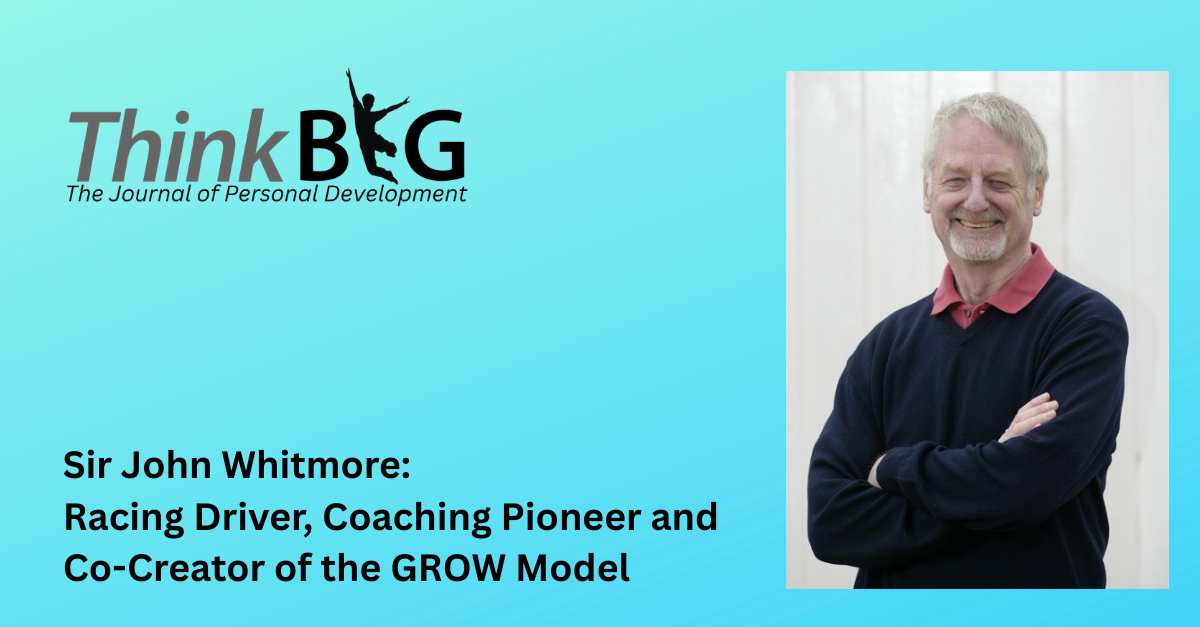
Sir John Whitmore: Racing Driver, Coaching Pioneer and Co-Creator of the GROW Model
Sir John Henry Douglas Whitmore, 2nd Baronet, was one of the most influential figures in the development of modern coaching. Remembered by many as a pioneer of executive coaching, leadership development and performance coaching, his life followed a remarkable path: from the high-speed world of international motor racing to the reflective, purposeful and transformative world of human potential, personal responsibility and organisational change.
Born in 1937, Whitmore came from a privileged British background and was educated at Eton College and the Royal Military Academy Sandhurst. Yet his early public reputation was not made in the boardroom or training room, but on the racing circuit. In his twenties, he became a highly accomplished racing driver, competing during one of the most exciting and dangerous periods in British motorsport.
A Successful Racing Driver
Before he became known as one of the fathers of business coaching, Sir John Whitmore was a serious and successful racing driver. He competed in sports car and touring car racing and built a reputation for speed, technical skill and courage. His racing career included appearances at the 24 Hours of Le Mans, one of the most demanding endurance races in the world, where he drove alongside some of the great names of the era.
Whitmore achieved notable success in saloon and touring car racing. He won the British Saloon Car Championship in 1961, driving a BMC Mini, and later became associated with the Lotus Cortina, one of the iconic touring cars of the 1960s. In 1965, he won the European Touring Car Championship, further confirming his status as one of Britain’s leading racing drivers of his generation.
His motorsport career was not simply a colourful prelude to his coaching work; it helped shape the philosophy that later defined his contribution to coaching. Racing demanded self-awareness, concentration, discipline, courage, feedback, learning and the ability to perform under pressure. These themes would reappear throughout Whitmore’s later writing and teaching. He understood from direct experience that performance was not just about technical skill. It was also about mindset, focus, responsibility and the removal of inner interference.
At the end of the 1960s, Whitmore moved away from professional racing. He went on to work in business, but he also became increasingly interested in psychology, personal development and the emerging human potential movement. This shift would eventually lead him to one of the most important influences on his work: Timothy Gallwey and the Inner Game approach.
From Motorsport to Human Potential
After leaving racing, Whitmore’s attention turned towards questions of learning, performance and personal growth. He spent time in California, where he explored new ideas in psychology and human development. This was a period when many thinkers, educators and practitioners were questioning traditional models of instruction and authority, and were beginning to look more seriously at self-directed learning, awareness and potential.
A major influence on Whitmore was Timothy Gallwey, author of The Inner Game of Tennis. Gallwey’s central insight was that performance is often limited not by lack of ability, but by internal interference: self-doubt, over-effort, fear, judgement and excessive instruction. The role of the teacher, coach or facilitator was therefore not simply to tell people what to do, but to help them become more aware, trust their own learning process and remove the obstacles to performance.
Whitmore recognised the power of this idea. He helped bring the Inner Game approach into the UK and Europe, initially through sport, including tennis and skiing. However, he soon saw that the same principles applied far beyond sport. People in organisations were also limited by fear, habit, hierarchy, lack of confidence, unclear goals and poor awareness. If individuals could learn to take responsibility for their own performance, and if leaders could learn to ask rather than simply instruct, then the workplace itself could become a place of learning and development.
This was a profound shift. Coaching was not being presented as remedial support or advice-giving. It was being reframed as a way of unlocking potential.
Performance Consultants and the Birth of Business Coaching
Sir John Whitmore went on to co-found Performance Consultants, an organisation that became central to the development of coaching in business and leadership. Through this work, Whitmore and his colleagues helped introduce coaching into organisations at a time when the term was still far more commonly associated with sport than management.
His work challenged traditional command-and-control leadership. Instead of assuming that managers should always provide answers, Whitmore argued that leaders could achieve better results by helping people think more clearly, take ownership and develop their own solutions. This did not mean abandoning standards or performance goals. On the contrary, Whitmore saw coaching as a disciplined route to higher performance. But it was performance developed through awareness, responsibility and learning, rather than pressure, fear or dependency.
One of his most famous definitions captures this beautifully:
“Coaching is unlocking a person’s potential to maximise their own performance. It is helping them to learn rather than teaching them.”
This definition became one of the most widely quoted descriptions of coaching and remains deeply influential. It places the learner, client or employee at the centre of the process. The coach is not there to impose wisdom, but to create the conditions in which insight, responsibility and action can emerge.
Sir John Whitmore and the GROW Model
Sir John Whitmore is most widely associated with the GROW coaching model, one of the best-known and most widely used coaching frameworks in the world. GROW is usually understood as an acronym for:
Goal – What do you want?
Reality – What is happening now?
Options – What could you do?
Will / Way Forward – What will you do?
The model is powerful because of its simplicity. It gives structure to a coaching conversation without making the conversation mechanical. It helps the coach and coachee move from aspiration to awareness, from awareness to possibility, and from possibility to committed action.
Although the development of GROW involved the work and influence of several early coaching pioneers, including Graham Alexander and Alan Fine, Whitmore played a central role in articulating, teaching and popularising the model. His book Coaching for Performance, first published in 1992, brought the model to a much wider audience and helped establish it as a core framework for managers, leaders, coaches and trainers.
The influence of Coaching for Performance cannot be overstated. It became one of the landmark texts in the coaching profession and introduced thousands of people to the idea that coaching could be used not only by professional coaches, but also by leaders and managers in everyday workplace conversations. Through this book, Whitmore helped move coaching from the margins of personal development into the mainstream of organisational life.
Coaching for Performance
Coaching for Performance became Sir John Whitmore’s best-known work and remains one of the classic texts in the field. Its central argument is that performance improves when people increase awareness and take responsibility. These two principles — awareness and responsibility — sit at the heart of Whitmore’s approach.
Awareness involves seeing the current situation more clearly. It includes noticing facts, feelings, assumptions, patterns, obstacles and possibilities. Responsibility involves recognising that meaningful change requires ownership. Rather than waiting to be told what to do, the individual becomes an active participant in their own development.
This was a major contribution to leadership thinking. Whitmore helped leaders understand that coaching was not a soft alternative to performance management. It was a more mature and often more effective way of achieving performance, because it developed the person as well as addressing the task.
His approach also anticipated many ideas that are now central in leadership development: psychological safety, self-directed learning, emotional intelligence, reflective practice, empowerment and purpose-led leadership. Whitmore was writing about these themes before many of them became part of mainstream management language.
Contribution to the Coaching Profession
Sir John Whitmore’s contribution to coaching was both practical and philosophical. Practically, he gave coaches and leaders a usable framework through the GROW model. Philosophically, he helped define coaching as a profession grounded in human potential, awareness, responsibility and purposeful action.
He was one of the figures who helped professional coaching emerge as a distinct field. Before coaching became widely recognised, Whitmore was already working with organisations to show that coaching conversations could transform leadership culture. He helped demonstrate that coaching was not only useful for elite athletes or individuals in difficulty, but also for senior leaders, managers, teams and whole organisations.
Whitmore’s influence extended internationally. He worked with major organisations, trained coaches and leaders across many countries, and contributed to the growth of coaching as a global profession. His work helped shape the standards, language and expectations of modern coaching practice.
He was also associated with the development and professionalisation of coaching bodies and communities. The Association for Coaching recognised his outstanding contribution to the field, and he was honoured for his impact on the coaching profession. He is also widely remembered by the Association for Coaching as one of the forefathers of modern coaching. Alongside his links with other professional bodies, including the European Mentoring and Coaching Council and the International Coach Federation, Whitmore’s work helped create the foundations on which the modern coaching profession continues to stand.
A Pioneer of Coaching Leadership
One of Whitmore’s most important contributions was his insistence that coaching was not merely a technique. For him, coaching was also a way of thinking about people. It was based on the belief that people have greater potential than they often realise, and that the role of the coach or leader is to help release that potential.
This view challenged traditional leadership assumptions. In many organisations, leaders were expected to direct, control and solve. Whitmore invited leaders to listen, question and develop. He encouraged managers to shift from giving instructions to creating awareness; from controlling performance to enabling responsibility; from dependence to ownership.
In this sense, Whitmore helped redefine what it meant to lead. His work suggested that the best leaders do not simply produce followers; they develop capable, responsible and self-aware people.
Legacy
Sir John Whitmore died in 2017, but his legacy continues through the thousands of coaches, leaders, managers and trainers influenced by his work. The GROW model remains one of the most taught and applied coaching frameworks in the world. Coaching for Performance remains a foundational text. Performance Consultants continues to carry forward the principles he helped establish.
His life story is remarkable because it joins two worlds that might seem very different: motor racing and coaching. Yet both involve performance. Both involve awareness under pressure. Both require courage, feedback, learning and disciplined action. Whitmore’s genius was to see that the lessons of performance were not confined to the racetrack. They belonged in the workplace, in leadership, in learning and in life.
Sir John Whitmore helped give modern coaching its language, its structure and much of its early credibility. As a racing driver, he understood the pursuit of excellence. As a coach and thinker, he helped others discover that excellence is not forced from the outside, but awakened from within.
His enduring message is simple and profound: people perform better when they become more aware, take more responsibility and are supported to unlock the potential they already possess.

