


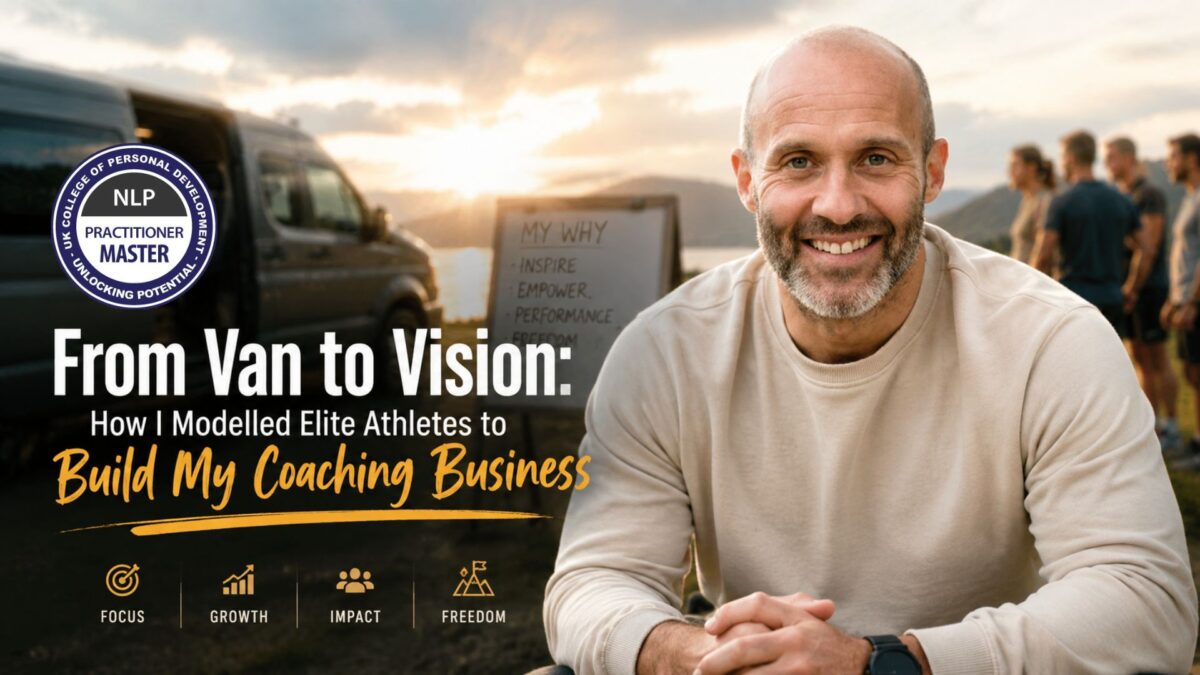
Let me tell you how I went from van driver to being a Successful Coach!
This practical and inspiring workshop explores how I took lessons from modelling elite athletes, sports teams and high performers — studying their mindset, habits, behaviours and approach to performance — and applied those lessons to my own journey from running a van business to successfully building a coaching business.
Elite performers rarely rely on motivation alone. They develop disciplines, routines and ways of thinking that enable them to remain focused, resilient and effective — particularly when circumstances become difficult.
During this workshop, we will explore some of the key principles I discovered through working with and modelling successful sportspeople and teams, and consider how those principles can be transferred into business, entrepreneurship, coaching and personal development.
Whether you are developing a coaching practice, building a new business, changing career or simply looking to achieve an important personal goal, these principles can help you develop a more purposeful and consistent approach to success.
The Athlete Mindset Model
At the heart of the workshop are six principles that I identified repeatedly among successful athletes and high-performing teams.
These became my own six non-negotiables for building a business.
- Stay 100% Committed — and Give 100%
In elite sport, commitment is non-negotiable. Athletes learn to show up fully regardless of conditions, mood, setbacks or obstacles. Sustainable high performance requires genuine commitment.
The same principle applies in business.
It means:
- Committing fully to your vision, even when results take time.
- Continuing when other people doubt what you are trying to achieve.
- Following through on decisions rather than constantly hesitating or changing direction.
- Maintaining momentum during uncertainty.
- Taking personal responsibility for your performance and results.
Commitment becomes an important part of self-leadership. When you demonstrate that you are genuinely invested in what you are trying to create, other people are far more likely to believe in you too.
- Become a Great Communicator — with Yourself and Others
Elite athletes need to communicate effectively with coaches, teammates and support professionals.
But there is another conversation taking place as well — the conversation they have with themselves.
Internal dialogue can influence confidence, focus and performance, while external communication influences relationships, teamwork and trust.
In business and coaching, effective communication means learning to:
- Explain your ideas, services and vision clearly.
- Listen carefully to customers, colleagues and clients.
- Set clear expectations.
- Use constructive internal dialogue when facing pressure or uncertainty.
- Reflect honestly on your own performance.
- Communicate in ways that engage, influence and motivate others.
Strong communication reduces misunderstandings, strengthens relationships and enables us to act with greater clarity and confidence.
- Develop a High Tolerance for Frustration
Sport teaches an important lesson: progress is rarely linear.
Training can be repetitive. Results can take time. Mistakes happen. Decisions go against you. Sometimes, despite doing everything correctly, things simply do not go your way.
Learning to remain composed and continue performing is therefore essential.
Business and entrepreneurship are remarkably similar.
There will be:
- Ideas that do not work.
- Customers who say no.
- Plans that need to change.
- Periods when progress appears slow.
- Problems that you did not anticipate.
Developing a higher tolerance for frustration enables you to respond rather than react.
Instead of giving up when things become difficult, you learn to adapt, remain resourceful and continue moving forward.
Resilience becomes a genuine competitive advantage.
- Enjoy What You Are Doing
Elite performers work incredibly hard, but enjoyment also matters.
Without some sense of enjoyment, purpose or personal meaning, maintaining commitment over the long term becomes increasingly difficult.
The same applies to business.
Building something around work that genuinely interests and motivates you can create:
- Greater energy and enthusiasm.
- Sustainable motivation.
- Increased creativity and curiosity.
- Greater willingness to learn.
- The ability to inspire others through genuine passion.
Enjoyment does not mean everything will always be easy.
It means there is something within the journey that makes the effort worthwhile.
- Be Consistent with Your Focus and Attention
Elite performance is built through repetition, discipline and consistent attention to the things that matter.
Athletes learn to recover quickly from mistakes, block out distractions and bring their attention back to the next action.
A lost point does not have to become a lost match.
In business, the same principle means:
- Showing up consistently, even when progress feels slow.
- Focusing on the priorities that will make the greatest difference.
- Avoiding unnecessary distractions.
- Developing routines and systems that support performance.
- Learning to refocus quickly after setbacks.
Success is rarely the result of one extraordinary day.
It is far more often the accumulated impact of many ordinary days approached consistently and deliberately.
- Always Look to Improve
Elite athletes operate within a continual cycle of performance, feedback, learning and improvement.
There is no finished product.
Even world champions continue asking:
What can I improve?
That mindset is equally powerful in business and coaching.
It means:
- Continually developing your knowledge and skills.
- Seeking constructive feedback.
- Reflecting on your performance.
- Improving your products and services.
- Learning from customers, colleagues, coaches and mentors.
- Remaining curious about better ways of working.
Continuous improvement enables both individuals and organisations to evolve rather than stagnate.
From Sporting Performance to Business Performance
I did not simply transfer a few sporting techniques into business.
I transferred an entire performance philosophy.
Over the years, I have had the opportunity to model and learn from a wide variety of national and international sports clubs, teams and individual performers — including people who have competed at championship level.
These experiences have covered a remarkably diverse range of disciplines, including rugby, ice hockey, football, clay pigeon shooting and even competitive tap dancing.
Different sports require different technical skills, but many of the psychological principles behind high performance remain remarkably consistent.
Commitment. Communication. Resilience. Enjoyment. Focus. Improvement.
Learning how elite performers think and behave — and then identifying how those patterns can be transferred into everyday life, coaching and entrepreneurship — helped me develop my own approach to building a business.
That journey took me from van driver to professional coach and business owner.
This powerful workshop is a part of our NLP Master Practitioner course, I will share what I learned along the way and, more importantly, help you consider how you can apply those same principles to your own goals.
Learning Outcomes
By the end of the workshop, participants will be able to:
- Identify six key mindset and behavioural principles associated with high performance.
- Explain how principles from elite sport can be transferred into business, coaching and personal development.
- Recognise the importance of commitment, consistency and focused attention in achieving long-term goals.
- Use approaches for managing frustration, setbacks and periods of uncertainty more effectively.
- Explore how internal dialogue and communication influence confidence, relationships and performance.
- Understand the value of feedback, reflection and continuous improvement.
- Identify personal habits, behaviours or beliefs that may currently be supporting or limiting progress.
- Create practical actions for applying the Athlete Mindset Model to a current business, career or personal goal.
Ultimately, this workshop is about far more than sport.
It is about discovering how the principles behind high performance can help ordinary people achieve extraordinary things — and how developing the right mindset, habits and behaviours can help us turn an ambition into a vision, and a vision into reality.
John Lewis is an experienced coach with a range of clients from life coaching to sports. He is an experienced runner and has competed in marathons and next year is competing in an 100km ultra marathon.
This NLP Master Practitioner programme is accredited by the leading body for NLP professionals – The Association For NLP (ANLP)

