


Perhaps you want to bring fresh insight to your coaching. Perhaps you’re ready to stretch yourself professionally. Or perhaps you feel that familiar pull towards your next challenge.
The UKCPD NLP Master Practitioner offers qualified NLP Practitioners an opportunity to develop their skills through 12 days of live online training spread over seven months.
Here are six reasons to take that next step.
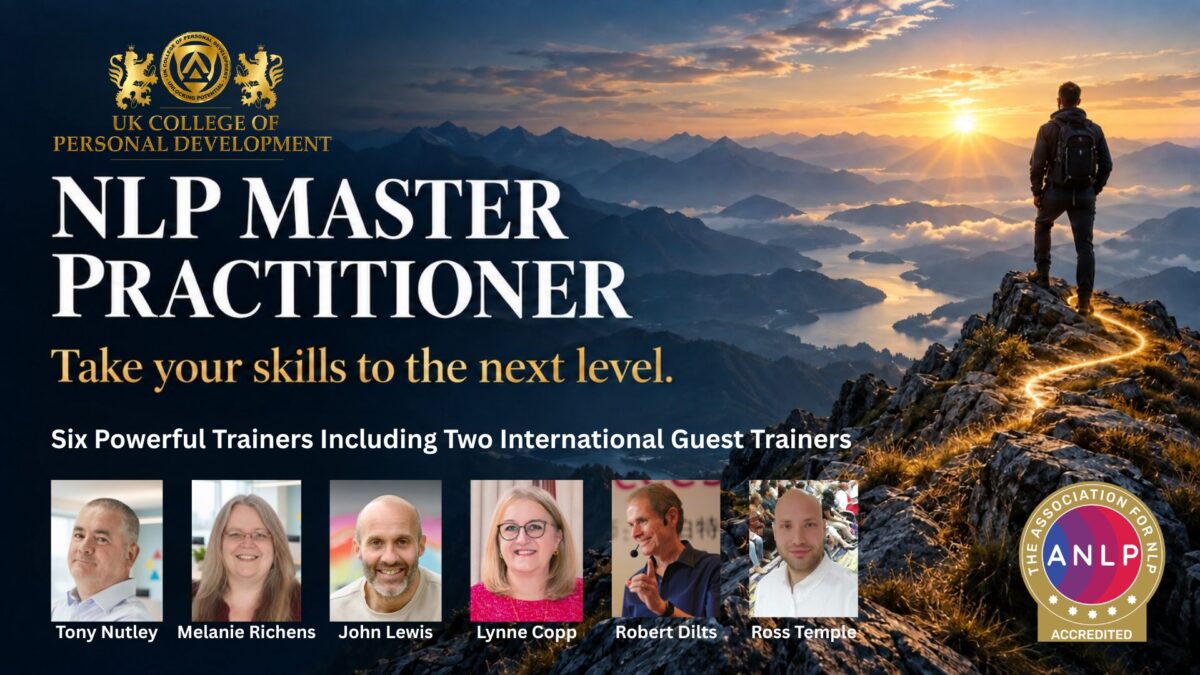
1. Learn from six inspiring trainers with different perspectives
Learning from a varied training team gives you the opportunity to explore different approaches and discover what strengthens your own practice.
The programme brings together:
- Tony Nutley — UKCPD’s Founder and CEO, bringing experience in NLP, coaching and professional training standards.
- Melanie Richens — a coach and NLP trainer whose legal and people-development background connects personal growth with professional challenges.
- John Lewis — an entrepreneur, coach and trainer bringing perspectives from business and sporting performance.
- Lynne Copp — an executive coach and leadership-development specialist with extensive organisational experience.
- Robert Dilts — an internationally recognised NLP developer, author and trainer.
- Ross Temple — a coach and mentor working with entrepreneurs, leaders and business owners.
That breadth matters. You can observe how experienced professionals ask questions, approach challenges and bring their individual strengths to their work. Each perspective offers another opportunity to reflect on the practitioner you want to become.
2. Explore workshops that connect learning with your own development
The Hero’s Journey, beliefs and identity workshops invite you to explore purpose, personal change and the assumptions that influence your choices.
Consider the value of making time to ask yourself: What am I working towards? What keeps getting in the way? What would I approach differently if I had more confidence in my own abilities?
These questions matter for practitioners, too. As you support other people’s development, your own self-awareness remains an essential part of the work.
You bring your ambitions, experiences and questions into the learning process—and create space to consider your next chapter.
3. Develop greater flexibility in your NLP practice
Workshops cover NLP Modelling, Quantum Linguistics and the Unified Theory of NLP, alongside a practical modelling project.
The opportunity here is to become more thoughtful about your choices as a practitioner.
When a conversation takes an unexpected turn, how do you respond? When a familiar approach seems less useful, what else could you explore? How do you adapt your language to the person in front of you?
Developing your practice means building a wider range of options and becoming more discerning about when to use them. This is an invitation to get curious, examine your assumptions and stretch your thinking.
Explore the workshops and full course syllabus here.
4. Bring your professional ambitions into focus
Robert Dilts’s The Success Blueprint explores lasting success. Ross Temple’s Presence, Pitch, Profit addresses presentation and ethical pitching skills.
For coaches, trainers and consultants, professional development also involves communicating the value of your work.
Can you explain clearly who you help? Do people understand what you offer? Can you present your ideas with confidence while giving others the freedom to make their own decisions?
These are useful questions whether you’re developing a practice, leading a workshop or presenting a proposal at work. Give your ambitions some attention—and consider the practical steps that could move them forward.
5. Allow time for practice, reflection and support
Alongside the workshops, the programme includes tutor calls, practice groups, group supervision and self-study resources. Lynne Copp’s Mastery in Motion workshop explores advanced coaching development.
Time between training sessions gives you room to reflect. You can notice what feels natural, identify where you need more practice and return with better questions.
There is also value in learning with other practitioners. A different observation or a thoughtful piece of feedback can open up something you hadn’t considered.
Make your development an ongoing practice: learn, apply, reflect and refine.
6. ANLP Accredited Qualification
The programme is accredited by the Association for NLP (ANLP). Successful completion includes assessment, a modelling project and a client case study.
Working towards a qualification gives your development a clear focus. It asks you to engage with the learning, demonstrate your application and take responsibility for your progress.
For prospective clients and professional contacts, it also gives you a clear way to communicate the further training you have completed.
Most of all, it is an opportunity to invest deliberately in the quality of your work and the direction of your professional future.
Ready to take your next step?
What would you like to bring more of into your practice: confidence, curiosity, flexibility or a clearer sense of purpose?
Your next stage of development starts with giving that question some attention.
Discover the UKCPD NLP Master Practitioner and enrol here.
Prefer to talk through your goals first? Visit the course page to book a free discovery call with the UKCPD team.

