


Why using your SMARTS is Better than just being SMART!
The root of all goals and resultant outcomes is a desired change. I.E. – I am not happy with where I am! In life, work, relationships etc. The truth is that the journey to achievement starts with a goal and finishes with a desired outcome. It is important to have clarity about each of these, as one of them represents a beginning step and the other represents a final result.
Here are the two main differences between goals and desired outcomes:
- Goals are part of an umbrella spectrum, while outcomes are specific and precise.
- Goals are generally not measurable, while outcomes are observable and measurable.
One of the key mindsets that NLP encourages is to have Well Formed Outcomes when planning or considering a change in direction, either in one’s personal or professional life or when thinking about change within your team or overall organisation.
Working on high quality outcomes encourages focused and forward-thinking actions that produces evidence of progress and in turn this develops confidence in the client that success and change is possible.
The key ingredients and process that enable a well-formed outcome from an NLP viewpoint is as follows:
- Want to = motivation: The belief that the goal is achievable
- How to = means: Realistic knowledge of the physical & mental steps necessary to achieve the goal.
- Chance to = opportunity: Deal effectively with interference, blocks and resistance.
- Agreed Evidence = assessment of progress: Sensory specific evidence (See, hear, feel)
For those that work in the coaching space, be in Life Coaching or Executive Coaching etc, we know and understand that the point of all coaching work is to help the client get clarity on the direction of travel and turn often vague goals into well-formed outcomes.
We know that coaching is a generative process, it’s a cycle of change that is highly focused and delivers real change, in individuals and within organisations. The process begins with questions to help gain clarity of direction, “what do you want?” “what will that do for you?”
The process includes positive intended challenges for the client, this opens up the possibilities of a better tomorrow and the process encourages the client to take stock regularly and reflect on the progress, personal insights, breakthroughs and clarity on an outcome and a strategy on how to get there.
It’s what I call The Generative Coaching Cycle™

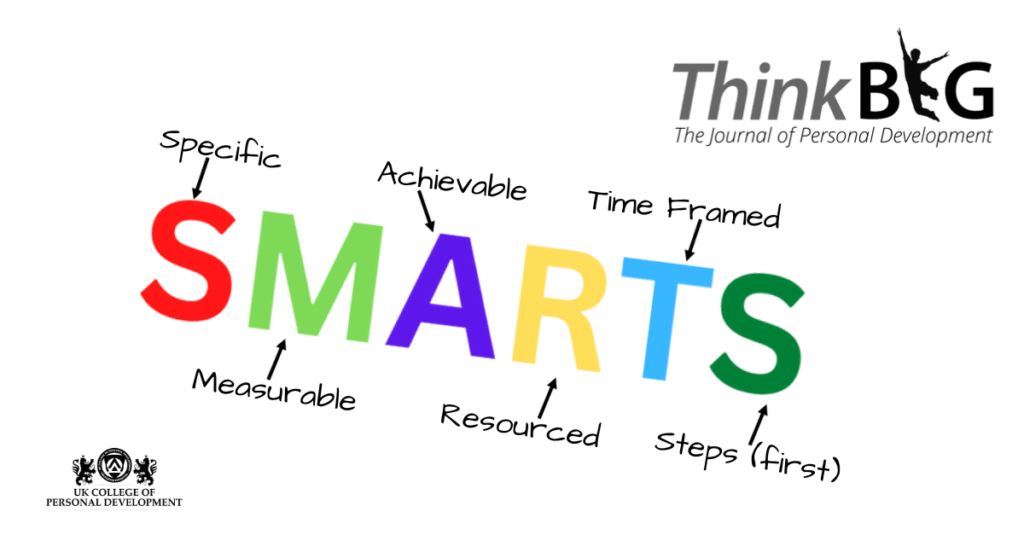
Most people are familiar with the SMART goal setting method, however strictly speaking it doesn’t fulfil the criteria for the NLP notion of well-formed outcomes. So, to fulfil this criterion we take the SMART idea and it becomes SMARTS!
The SMARTS model becomes an NLP’d version of the well-known SMART Goal setting model. We find that because most people are familiar with the SMART model, SMARTS is a user friendly and conversational approach as it helps in turning what bare often vague goals into very specific well-formed outcomes.
In fact, one student has reported that using SMARTS has personalised and humanised their outcome setting process of their appraisal system in their team.
Let’s look at the SMARTS approach in some details:
Specific – Clarity Equals Motivation
- What do you want? Be super clear and specific.
- A positive one sentence statement – I want …
- Create a picture .. what does this look like ?
- What will this do for you? – (the goal beyond the goal)
- How motivated are you?
- One a scale of 1 to 10?
Measurable – Know you benchmark of progress
- How will you measure your progress?
- What will you see, hear and feel on progress and ultimate success?
- When you start, are half way etc … be specific.
Achievable – A Reality Check
- Is this really achievable. Is this a realistic endeavour given where you are in life right now?
- Are you able to control the process, and drive this forward without having to involve a committee?
Resourced – What will it take to make this a reality?
- Do you have ALL the resources to successfully start and complete the various activities required to achieve this goal?
- Make a list, time, money, a PC, new skills etc .. if something is missing, this becomes the first step in achieving your overall outcome.
Time Framed – No schedule equals no progress
- When specifically, is this going to be achieved?
- More importantly, when will you commit to making a start?
- What date?
- What’s the first step?
- What MUST you do today?
- What else?
- What else?
The “what else” question is particularly useful in uncovering any missing elements of the strategy.
Steps (first)
- What’s the first step?
- What MUST you do today?
- What else?
- What else?
The “what else” question is particularly useful in uncovering any missing elements of the strategy.
I have been using this model for quite some time in a mix of situations, with UKCPD students and a mix of clients, both personal or Life Coaching and with senior leaders and managers, or Executive Coaching with great success.
If you give it a try, be sure to let me know how it worked for you
To your success.
Tony Nutley – Founder & CEO – The UK College of Personal Development
The UK College of Personal Development is the UK’s number one provider of NLP and Coach training services.
References
- Dilts, R. (1998). Modeling with NLP. Meta Publications.
- Doran, G. T. (1981). There’s a S.M.A.R.T. way to write management’s goals and objectives. Management Review, 70(11), 35-36.
- O’Connor, J., & Lages, A. (2004). Coaching with NLP: How to be a Master Coach. Element.
- UKCPD. (2024). NLP Practitioner & Coach Training Programmes. UKCPD.

