


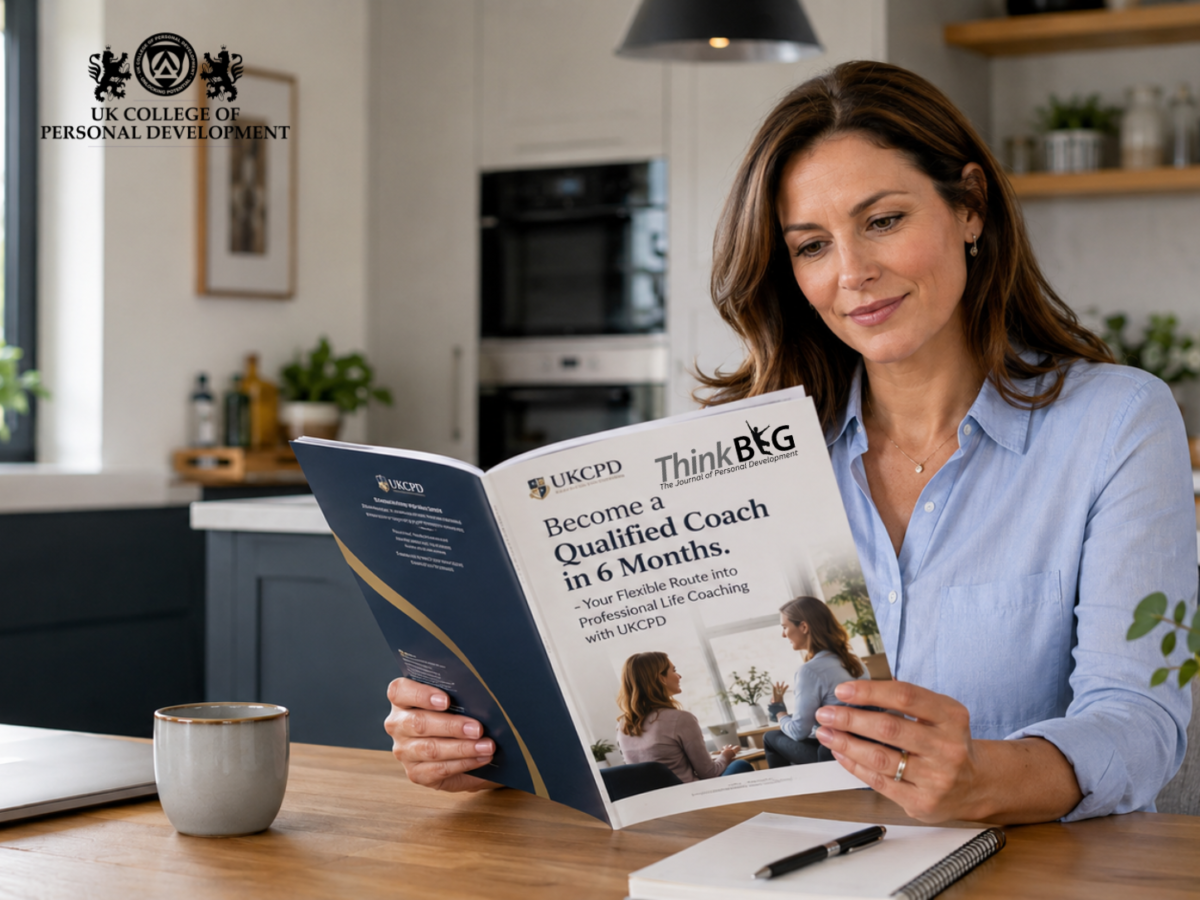
Your Flexible Route into Professional Life Coaching with UKCPD
I had a call this week where a potential student asked me “is it was possible to become a qualified Life Coach in six months?” – I looked at our upcoming schedule and said YES!
The next question was one I also hear a fair amount, its the deeper question people ask when they are serious in their consideration about embarking on a journey of becoming a powerful coach:
Could I use my life experience, communication skills and passion for helping others to become a professional coach?
For some, that question comes after years in leadership, management, HR, training, wellbeing, education or personal development. For others, it arrives during a period of personal change, when they realise that the challenges they have faced have given them insight, empathy and a genuine desire to support others.
Life coaching has become one of the most meaningful routes into personal and professional development. It gives people the skills to help others clarify goals, overcome barriers, build confidence, make better decisions and create positive change. It is practical, powerful and deeply human.
The good news is that becoming a qualified coach does not have to mean putting your life on hold.
With the right training route, structured learning, tutor support and commitment, it is possible to make real progress towards becoming a qualified coach within six months. At the UK College of Personal Development, UKCPD, our flexible online coaching qualifications are designed to help you build confidence, develop practical coaching skills and gain recognised professional credibility in a way that can work around your existing life, work and family commitments.
Why Coaching Matters Now More Than Ever
We live in a world where people are facing change at a faster pace than ever before. Careers are shifting. Organisations are evolving. People are rethinking what success means. Many are asking bigger questions about confidence, purpose, wellbeing, relationships, performance, work-life balance and personal direction.
This is where coaching has such a powerful role to play.
A coach does not simply tell people what to do. A professional coach helps people think more clearly, understand themselves more deeply, identify what matters, explore choices and take meaningful action. Coaching is built on listening, questioning, reflection, accountability and empowerment.
In many ways, coaching is not about fixing people. It is about helping people discover the resources, insight and courage they already have.
That is why coaching skills are now valued across so many areas of life and work. They are useful for:
- aspiring professional life coaches
- managers and leaders
- HR and learning professionals
- wellbeing practitioners
- trainers and consultants
- teachers and educators
- career changers
- personal development practitioners
- people who want to build a coaching business
- people who simply want to communicate and support others more effectively
Whether your goal is to become a self-employed life coach, add coaching to your existing professional role, or use coaching as part of your leadership style, gaining a recognised qualification can give you structure, confidence and credibility.
Do You Need a Qualification to Become a Life Coach?
In the UK, there is no single mandatory qualification required to call yourself a life coach. However, that does not mean training is unimportant.
In fact, the opposite is true.
If you want to work professionally and ethically with clients, a recognised coaching qualification can make a significant difference. It helps you understand the principles of coaching, the structure of a coaching conversation, how to ask powerful questions, how to build rapport, how to set appropriate boundaries, and how to support clients without advising, counselling or directing them.
A good coaching qualification helps you move beyond enthusiasm into skilled practice.
It gives you:
- a clear coaching framework
- practical models and tools
- ethical awareness
- reflective practice
- confidence in client conversations
- understanding of boundaries
- professional credibility
- tutor support and guidance
- evidence of training and development
For clients, a recognised qualification can also offer reassurance. It shows that you have invested in your own development and taken the process of becoming a coach seriously.
Become a Qualified Coach in 6 Months: Is It Really Possible?
For committed learners, six months can be a powerful and realistic development window.
Of course, the exact timescale depends on the qualification you choose, the study route, your available time, your assessment requirements and the pace at which you complete your learning. Some learners may complete more quickly. Others may prefer to take longer, especially if they are balancing study with work, family or other responsibilities.
However, six months is a meaningful timeframe because it gives you enough space to do more than simply read about coaching. It gives you time to learn, practise, reflect, receive feedback and begin to develop your own coaching style.
A focused six-month journey might look like this:
Month 1: Understand What Coaching Really Is
The first step is understanding the true nature of coaching.
Many people come into coach training with a natural desire to help others. That is a wonderful starting point, but professional coaching requires a very specific mindset. Coaching is not the same as mentoring, teaching, counselling, consulting or giving advice.
During the early stage of your training, you begin to explore what coaching is, what it is not, and how a coaching relationship works. You start to understand the importance of listening, questioning, contracting, confidentiality, client responsibility and ethical practice.
This stage is about building strong foundations.
You begin to shift from “How can I give this person the answer?” to “How can I help this person discover their own answer?”
That shift is central to becoming an effective coach.
Month 2: Develop Core Coaching Skills
Once the foundations are in place, the next stage is skill development.
This is where you begin to practise the essential skills of coaching, including active listening, rapport building, questioning, goal setting, summarising, reflecting and helping clients explore options.
These skills may sound simple, but when used well they can be transformational.
A powerful question at the right time can help a client see something they have been avoiding. A moment of deep listening can help someone feel genuinely heard. A structured coaching conversation can turn confusion into clarity and intention into action.
This is also where learners often begin to notice their own patterns. You may discover that you have a tendency to jump in too quickly, offer advice too soon, rescue the client, or lead the conversation towards your own assumptions.
Good coach training helps you become more self-aware, because the coach’s own awareness is one of the most important tools in the coaching relationship.
Month 3: Learn Coaching Models and Structure
Professional coaching is not just a friendly conversation. It has purpose, direction and structure.
During this stage, you begin to explore coaching models and frameworks that help you guide clients through a productive process. Models can help create clarity, structure and momentum while still keeping the client at the centre of the conversation.
You may explore models linked to goals, reality, options, action planning, values, beliefs, performance, motivation and personal change.
The purpose of a model is not to make coaching rigid. It is to give the coach a reliable structure so the client can explore freely.
As you develop, you begin to understand when to use a model, when to adapt it, and when to simply stay present with the client.
This is where coaching becomes both practical and creative.
Month 4: Practise, Reflect and Build Confidence
The fourth month is often where confidence begins to grow.
By this stage, you are no longer simply learning about coaching. You are beginning to practise coaching. You are noticing what works. You are learning from what feels awkward. You are reflecting on your own style. You are beginning to understand the difference between knowing coaching intellectually and actually coaching another human being.
Practice is essential because coaching is a skill. You cannot become a confident coach through theory alone.
You need to practise listening without interrupting. You need to practise asking questions without leading. You need to practise holding silence. You need to practise trusting the client. You need to practise staying curious rather than becoming the expert.
This is why tutor support, reflective learning and practical application are so important.
A strong coaching qualification gives you space to develop your competence gradually, with guidance and support as you progress.
Month 5: Develop Your Coaching Identity
As your skills grow, you begin to ask another important question:
What kind of coach am I becoming?
This is where your personal experience, values, interests and strengths begin to shape your coaching identity.
Some learners are drawn to life coaching, helping clients with confidence, goals, personal growth and life direction. Others are interested in career coaching, wellbeing coaching, leadership coaching, performance coaching or business coaching. Some want to combine coaching with NLP to support communication, mindset and behavioural change.
There is no single correct path.
The key is to begin developing a coaching identity that feels authentic, ethical and credible.
You may start thinking about the clients you want to support, the problems you feel passionate about helping people solve, and how your qualification could fit into your future career or business plans.
Month 6: Prepare for Practice and Progression
By month six, many learners are thinking about how to use their qualification in the real world.
This might mean preparing to work with practice clients, building a coaching profile, adding coaching to an existing role, launching a small coaching practice, or progressing to a more advanced qualification.
This final stage is about integration.
You bring together your skills, knowledge, practice, reflection and confidence. You begin to see yourself not just as someone studying coaching, but as someone becoming a coach.
And that is a powerful moment.
UKCPD’s Life Coaching Qualification Pathway
UKCPD offers a clear pathway of AC and Life Coaching qualifications, designed to support learners at different stages of their coaching journey.
Whether you are completely new to coaching or ready to develop a deeper professional practice, there is a route to suit your goals.
Life Coaching: An Introduction Online Course
This is a great starting point if you are curious about coaching and want to understand the core principles before committing to a larger qualification.
It is suitable for learners who want to explore what coaching is, what makes a good coach and how coaching can support personal development and positive change.
This is ideal if you are at the beginning of your journey and want a gentle, accessible introduction. – Discover this course HERE.
Foundation Diploma in Life Coaching (Tutor supported online study course)
The self study, tutor supported Foundation Diploma in Life Coaching offers a flexible, tutor-supported online route into life coaching. Its a practical route for beginners, aspiring life coaches, career changers and learners who want to develop the foundations of effective coaching.
This qualification introduces core coaching skills such as listening, questioning, goal setting, rapport, confidence building and personal development.
It is designed to help you move from interest into structured coaching practice. For many learners, this is the first major step towards becoming a qualified life coach.
For learners balancing study with a full-time job, family responsibilities or an existing business, this flexible online route can make professional coach training much more achievable.
Foundation Diploma in Life Coaching & NLP
For learners who want to combine coaching with NLP foundations, the Foundation Diploma in Life Coaching & NLP provides a blended route into coaching, communication, mindset and personal change.
NLP, or Neuro-Linguistic Programming, explores patterns of thinking, language, behaviour and communication. When combined with coaching, it can give learners additional tools for helping clients understand themselves, shift perspectives and create change.
This route is suitable for people who want coaching skills alongside practical NLP-informed tools.
Advanced Certificate in Life Coaching
The Advanced Certificate in Life Coaching is designed for learners who want a stronger professional life coaching qualification with greater depth.
It is suitable for aspiring and developing coaches who want to move beyond foundation-level study and build greater confidence, ethical awareness, reflective practice and professional credibility.
This is a valuable route if you want to take your coaching development more seriously and prepare for a higher standard of professional practice.
Diploma in High-Performance Business Coaching
The Diploma in High-Performance Business Coaching is suitable for learners who want to coach in professional, business and performance-focused contexts.
This route supports those who may want to work with individuals, professionals, managers, business owners or teams. It brings coaching into areas such as performance, leadership, professional development, confidence, productivity and workplace growth.
It is particularly relevant for people who already work in business, management, HR, consulting, training or leadership development.
Diploma in High-Performance Business Coaching & NLP Practitioner
For learners who want a comprehensive coaching and NLP route, the Diploma in High-Performance Business Coaching & NLP Practitioner provides a powerful blend of professional coaching and NLP Practitioner training.
This option is suitable for those who want to develop a broader professional toolkit, combining business performance coaching with advanced communication, behavioural change and NLP Practitioner skills.
It is a strong pathway for those who want to work with clients in personal, professional, leadership, business or performance settings.
Why Choose UKCPD?
Choosing where to study is one of the most important decisions you will make on your coaching journey.
You are not simply buying a course. You are choosing the people, standards, learning environment and support system that will help shape the coach you become.
UKCPD has been delivering accredited Coaching, NLP, ILM, personal development and CPD training since 1998. In 2026, that represents 28 years of helping learners develop practical skills, professional confidence and recognised qualifications.
Over that time, UKCPD has built a reputation for professional, credible and supportive training. Our approach is practical, encouraging and focused on real-world application.
We understand that learners are often balancing study with busy lives. Many are working full-time. Some are raising families. Some are changing career. Some are returning to learning after many years. Some are already working in helping professions and want to add coaching to their existing skills.
That is why flexibility matters.
Flexible Online Study That Fits Around Real Life
One of the biggest barriers to becoming a qualified coach is the belief that you need to stop everything else in order to study.
With UKCPD, flexible online and live online study routes allow you to build your coaching skills without needing to travel to a physical training centre.
This means you can study from home, reduce travel costs, avoid hotel expenses, access learning resources online and progress in a way that works around your life.
For many learners, that flexibility is the difference between “one day” and “I’m starting now.”
Online learning does not mean learning alone. Depending on the course you choose, UKCPD qualifications include structured learning, tutor support, live online training options, practical development and guidance to help you stay on track.
Practical Skills, Not Just Theory
A good coaching qualification should not simply give you information. It should help you become more capable, more confident and more effective.
UKCPD’s coaching qualifications are designed to help learners apply coaching skills in real conversations. You will explore practical coaching tools, develop your listening and questioning skills, reflect on your own development and build a clearer understanding of how to support clients ethically and professionally.
The aim is not just to help you pass a qualification.
The aim is to help you become the kind of coach who can make a meaningful difference.
What Students Say About UKCPD
UKCPD is rated with many learners highlighting the quality of support, flexibility and practical value of their studies.
One learner described their course as “flexible, practical and genuinely engaging,” explaining how the learning helped them develop confidence and their own coaching style.
Another student said they were “glad I chose this college,” highlighting the benefits of live online study, no added travel costs, weekly practice sessions and supportive trainers.
A Foundation Diploma learner described the training experience as “superb,” praising the online portal, tutor support and practical guidance.
These comments reflect what UKCPD aims to provide: professional training, flexible study and a supportive learning environment where students feel encouraged, guided and able to grow.
Who Is This Route For?
A UKCPD life coaching qualification may be right for you if:
- you want to become a professional life coach
- you are considering a career change
- you want to build a coaching practice
- you already support people in your work
- you are a manager or leader who wants better coaching skills
- you work in HR, training, education, wellbeing or personal development
- you want to combine coaching with NLP
- you want a flexible online study route
- you want tutor support and recognised training
- you want to develop both personally and professionally
You do not need to have everything figured out before you begin.
Many learners start with curiosity, a desire to help others and a sense that coaching might be the right next step. The training process helps you clarify your path as you grow.
The Benefits of Becoming a Qualified Coach
Becoming a qualified coach can open up a wide range of opportunities.
For some, it becomes the foundation of a new coaching business. For others, it enhances an existing career. For many, it creates a powerful personal transformation as well as a professional one.
The benefits can include:
- greater confidence in helping others
- improved communication skills
- stronger listening and questioning skills
- better self-awareness
- increased credibility with clients
- a recognised qualification
- practical tools for personal and professional development
- a clearer coaching structure
- new career or business opportunities
- the ability to support others through meaningful change
Coaching is not only something you do for others. It also changes the way you think, listen, lead and communicate.
That is why many learners describe coach training as one of the most valuable investments they have made in themselves.
Your Six-Month Coaching Journey Starts with One Decision
Six months from now, you could still be thinking about becoming a coach.
Or you could be well on your way.
You could have begun your qualification, developed practical coaching skills, gained confidence, worked with coaching models, practised your approach and started building your identity as a coach.
The difference begins with a decision.
If coaching has been calling you, perhaps this is the moment to listen.
Whether you want to become a life coach, add coaching to your existing career, build a coaching business, or combine coaching with NLP, UKCPD offers flexible online qualifications to help you take the next step.
Ready to Become a Qualified Coach?
Explore UKCPD’s AC and Life Coaching Qualifications today and discover the route that is right for you.
Choose your pathway. Build your confidence. Gain recognised skills. Become the coach you were meant to be.
Start your coaching journey with UKCPD today. Explore our Life Coaching qualifications and take your first step towards becoming a qualified coach.
Not sure which course is right for you? Book a free Discovery Call with the UKCPD team and get clear guidance on your best route into coaching.
Download our free guide to becoming an effective life coach and begin exploring how coaching could become part of your future.
Notes:
All our coaching qualifications are fully accredited by the professional body, The Association For Coaching and all our students are given a year’s FREE Studying Membership.

