


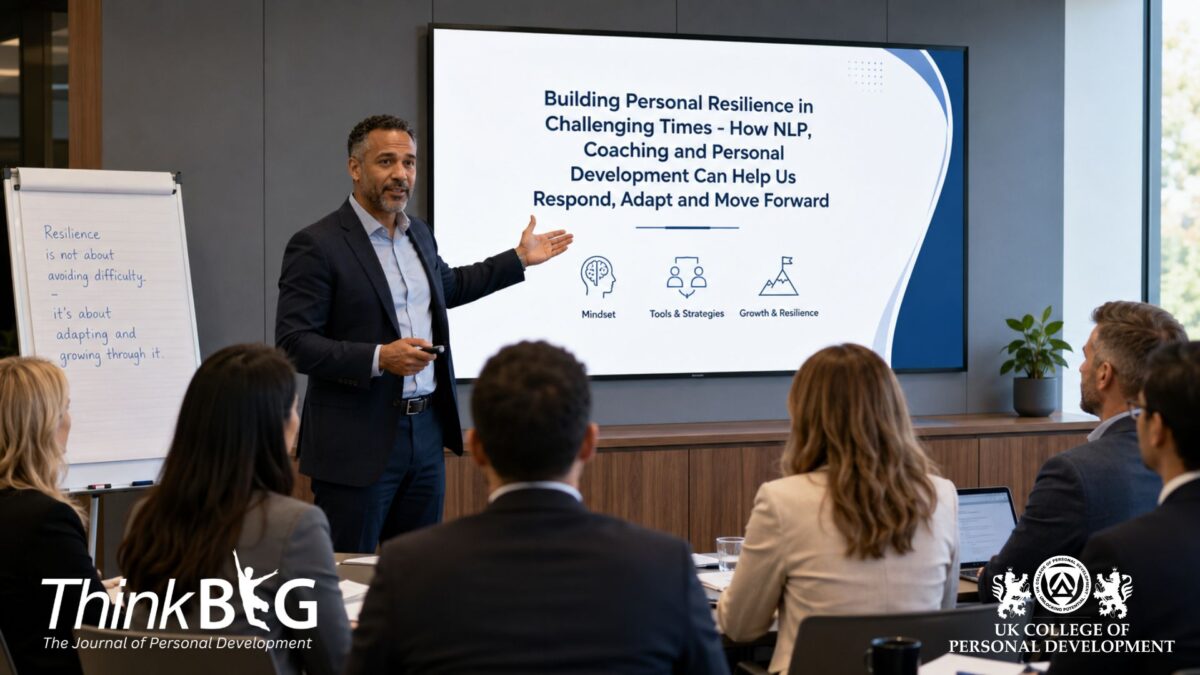
Challenging times can arrive in many different forms.
They may involve financial uncertainty, organisational change, relationship difficulties, health concerns, professional setbacks or a general sense that the world is becoming increasingly unpredictable. Although we cannot control every event around us, we can strengthen our capacity to decide how we will interpret, respond to and move forward from those events.
This is the essence of personal resilience.
Resilience does not mean pretending everything is fine. It does not require us to suppress difficult emotions, ignore genuine problems or remain permanently positive. Rather, resilience is the capacity to adapt constructively, recover our sense of direction and continue taking meaningful action—even when circumstances are difficult.
Modern resilience research increasingly describes resilience as a dynamic process, rather than a fixed personality trait. It is influenced by our thinking, emotional regulation, relationships, environment, available resources and the meaning we give to adversity. This is important because it suggests that resilience is not simply something we either possess or lack. It can be strengthened and developed.
Personal development therefore becomes much more than an interesting activity or occasional confidence boost. It becomes an investment in our ability to navigate life.
Through the study of NLP and Coaching, we can develop practical skills for managing our internal state, examining our thinking, setting meaningful goals, widening our perspective and supporting other people through periods of uncertainty.
Resilience Is Not About Becoming Invulnerable
Resilient people still experience anxiety, disappointment, frustration and self-doubt.
The difference is not that they never experience difficult emotions. It is that they develop ways of acknowledging those emotions without allowing them to determine every decision.
Resilience is not necessarily about returning to exactly who we were before a difficult experience. Sometimes adversity changes us. Resilience may involve adapting to a new reality, developing new capabilities or creating a different and more meaningful future.
Researchers have consequently distinguished between simply “bouncing back” and the possibility of adapting, learning and occasionally growing through adversity. Resilience is shaped by the interaction between the person, the situation and the resources available to them.
This means that resilience should never be used to blame individuals for struggling in genuinely difficult circumstances. Organisations and communities also have a responsibility to reduce unnecessary pressure, provide support and create psychologically healthy environments.
However, within the areas we can influence, personal development gives us tools for expanding our choices.
Why Personal Development Builds Resilience
During difficult periods, people frequently concentrate on external resources: money, time, information, qualifications, contacts and practical assistance.
All of these may be important. However, we also rely on internal resources, including:
- self-awareness;
- emotional regulation;
- confidence;
- adaptability;
- constructive thinking;
- communication;
- decision-making;
- perspective;
- goal-setting;
- problem-solving;
- the willingness to ask for help.
These capabilities are rarely developed through information alone. We strengthen them through practice, reflection, feedback and the deliberate application of personal development models.
Investing in personal development helps us understand our habitual responses. We begin to notice what triggers us, what strengthens us, what drains our energy and what enables us to perform effectively.
Instead of repeatedly reacting from unconscious habits, we become better able to pause and ask:
“What response would be most useful here?”
That small space between an event and our response is one of the foundations of resilience.
NLP and Coaching: Practical Tools, Not Magical Solutions
NLP—Neuro-Linguistic Programming—offers a collection of models concerned with the relationship between our internal experience, language, behaviour and patterns of attention.
Coaching provides structured conversations that help people clarify outcomes, examine their current reality, identify resources, generate options and take responsibility for action.
Together, NLP and Coaching can provide a practical toolkit for personal and professional development. They can help people become more aware of how they are representing a situation, how their thinking affects their emotional state and what choices may be available.
Its models can instead be used as structured personal development and coaching exercises involving attention, imagery, language, perspective, goal-setting and behavioural flexibility.
1. State Management: Developing the Ability to Reset
One of the most valuable NLP skills for resilience is state management.
A state is the combination of our emotional, mental and physiological experience at a particular moment. It affects what we notice, how we interpret events, what we believe is possible and how we behave.
When we are calm and resourceful, we are more likely to identify options. When we feel overwhelmed, our attention can narrow around threats, difficulties and worst-case scenarios.
State management does not mean denying fear or forcing ourselves to feel positive. It means recognising that our present state influences our thinking—and learning how to move towards a state that is more appropriate for the task ahead.
A practical state-management exercise
When you notice yourself becoming overwhelmed, pause and work through these five stages.
1. Name the state
Ask:
“What am I feeling right now?”
Use specific words. Instead of saying, “I feel bad,” identify whether you feel anxious, disappointed, angry, powerless, confused or mentally exhausted.
Naming the experience creates a degree of separation between you and the emotion.
You are not anxiety itself. You are a person who is currently experiencing anxiety.
2. Notice your physiology
Observe your breathing, posture, facial tension and physical energy.
Without forcing anything, lengthen your exhalation, relax your shoulders, lift your head and place both feet on the floor.
Changing posture or breathing will not remove a genuine problem, but it may create enough physiological stability to think more clearly.
3. Redirect your attention
Ask:
- What can I control?
- What can I influence?
- What do I need to accept for now?
- What is the next useful action?
These questions move attention from helplessness towards agency.
4. Change your internal language
Compare the effect of these two statements:
“I cannot cope with this.”
and:
“This is difficult, but I can decide what to do next.”
The second statement does not deny the difficulty. It creates a more resourceful frame around it.
5. Take one small action
Resilience grows through action, not reflection alone.
Make the telephone call. Write the first paragraph. Ask for assistance. Take a short walk. Review the figures. Arrange the meeting.
A small constructive action begins to restore momentum.
2. Submodalities and Anchoring: Creating Access to Resourceful States
In NLP, submodalities are the finer qualities of our internal sensory experience.
When we remember or imagine something visually, for example, the image may appear:
- bright or dark;
- close or distant;
- large or small;
- moving or still;
- clear or blurred;
- associated or dissociated.
Internal sounds may be loud, quiet, encouraging, critical, close or distant. Physical sensations may have a location, temperature, pressure, movement or intensity.
These distinctions matter because people often respond emotionally not only to what they are imagining, but also to how they are representing it.
Research into mental imagery more broadly shows that imagery can evoke emotional and physiological responses and may function in some respects like a weaker form of perception. This does not validate every claim made about NLP submodalities, but it helps explain why changing the vividness, distance or intensity of mental imagery can influence how an experience feels.
Reducing the intensity of an unhelpful image
Think of a mildly stressful future situation—not a severe or traumatic memory.
Notice the image that comes to mind.
Now experiment by:
- moving the image further away;
- making it smaller;
- reducing the brightness;
- turning down any accompanying internal sound;
- observing the scene as though watching it on a screen.
Notice whether the emotional intensity changes.
Next, imagine yourself handling the situation effectively. Bring that image slightly closer, make it clearer and notice the posture, breathing and expression of your more resourceful future self.
The purpose is not to pretend that the situation will be easy. It is to help your mind represent the possibility of coping effectively.
Creating a resilience anchor
An anchor is a deliberate association between a sensory cue and a particular state.
You may already have naturally occurring anchors. A piece of music might instantly change your mood. A familiar scent may bring back a memory. Walking into a particular building may produce confidence—or anxiety—before anything has happened.
NLP anchoring attempts to create a useful association intentionally.
- Recall a specific occasion when you felt calm, confident, determined or capable.
- Mentally return to the experience. See what you saw, hear what you heard and notice how you felt.
- Increase the richness of the memory. Make the image clearer and notice where the feeling of confidence is located in your body.
- As the feeling approaches its strongest point, apply a small, distinctive physical cue—for example, gently pressing a finger and thumb together.
- Release the cue, stand up and think about something unrelated.
- Repeat the process using two or three other genuine memories of resourcefulness, applying the same cue each time.
- Test the anchor by using the cue while thinking about a future challenge.
Anchoring should be treated as a practised state-access exercise rather than a magical switch. Its value is increased through repetition, genuine emotional engagement and application in real situations.
Work involving trauma, severe anxiety or significant mental health difficulties should be undertaken with an appropriately qualified mental health professional.
3. Well-Formed Outcomes: Creating a Clearer Future
Resilience is much more difficult when we can only see what we want to escape.
People under pressure naturally focus on problems:
- “I do not want to feel anxious.”
- “I do not want the business to fail.”
- “I do not want another argument.”
- “I cannot continue like this.”
These statements may describe the problem accurately, but they do not yet provide a destination.
A Well-Formed Outcome helps turn attention towards what we want to create instead.
A useful outcome is:
- stated positively;
- sufficiently within our influence;
- specific and observable;
- placed within an appropriate context;
- supported by necessary resources;
- consistent with our wider values and responsibilities;
- connected to an achievable first step.
Questions for creating a Well-Formed Outcome
Ask yourself:
- What do I want instead of the present problem?
- How will I know that I have achieved it?
- What will I see, hear and feel when it is happening?
- Where, when and with whom do I want this outcome?
- How much of this is within my influence?
- What resources, skills or support will I need?
- What might I gain or lose by achieving it?
- What is the smallest meaningful action I can take?
Suppose someone says:
“I want to stop feeling overwhelmed at work.”
A more developed outcome might be:
“Over the next six weeks, I want to establish a manageable weekly structure, identify my three most important priorities each morning, hold a workload conversation with my manager and finish work by 6.00 p.m. on at least four days each week.”
This does not guarantee that every difficulty will disappear. It provides direction, evidence and opportunities for action.
Research on goal achievement shows that monitoring progress can significantly improve the likelihood of attainment, particularly when progress is recorded. Research also supports the usefulness of implementation intentions—simple “if–then” plans that connect anticipated situations with chosen actions.
A Well-Formed Outcome can therefore be strengthened by adding:
“If I begin to take on work that is not a priority, then I will review my three agreed outcomes before saying yes.”
Resilience requires hope, but it also requires structure.
4. Perceptual Positions: Widening the Map
Stress can trap us inside a single interpretation.
We may become convinced that our understanding is the only possible understanding:
- “They do not respect me.”
- “My manager does not care.”
- “My colleague is deliberately being difficult.”
- “Nothing I say will make any difference.”
NLP’s Perceptual Positions model encourages us to examine a situation from several viewpoints.
First position: Your perspective
What are you experiencing?
What do you need?
What matters to you?
What boundaries may be required?
Second position: The other person’s perspective
What might they be seeing?
What pressures could they be experiencing?
What might they need, fear or misunderstand?
Second position does not mean agreeing with unacceptable behaviour. It involves developing enough curiosity to understand the other person’s possible map of the situation.
Third position: The observer’s perspective
Imagine watching the interaction as an impartial observer.
What patterns do you notice?
What is each person contributing?
What is not being said?
What advice would you give both people?
Fourth position: The wider system
Consider the team, family, organisation or community.
What wider pressures are influencing the situation?
What response would support the health of the overall system?
Perspective-taking can support social understanding under pressure, although our ability to take another person’s perspective may itself become more difficult when we are stressed.
A practical way to use this model is to place three chairs in a room. Sit in each position in turn and speak from that perspective. The physical movement helps interrupt habitual thinking and can reveal information that is difficult to access while remaining in one position.
5. Logical Levels: Finding Where Change Is Needed
Robert Dilts’ Logical Levels model offers a framework for examining change at different levels:
- environment;
- behaviour;
- capabilities;
- beliefs and values;
- identity;
- purpose or wider contribution.
The model can help us avoid trying to solve every resilience challenge at the level of behaviour.
For example, someone might tell themselves:
“I need to be more disciplined.”
However, an exploration through Logical Levels could reveal that:
- their working environment is filled with constant interruptions;
- they have not developed effective prioritisation skills;
- they believe that saying no will make them appear unhelpful;
- their identity is strongly connected with being the person who rescues everyone.
The problem is not simply a lack of discipline. Several levels may need attention.
A resilience alignment exercise
Choose a current challenge and ask:
Environment:
What around me is helping or hindering me?
Behaviour:
What am I currently doing—or avoiding?
Capabilities:
What skill would help me respond more effectively?
Beliefs and values:
What am I assuming about myself, other people or the situation?
Identity:
Who am I being in this situation? Who do I want to become?
Purpose:
What larger value, contribution or direction does this connect with?
Logical Levels should be used as a reflective map, not as a scientifically validated diagnostic hierarchy. Its practical value lies in encouraging a more complete examination of change.
Resilience may sometimes require calming ourselves. At other times, it requires learning a skill, challenging a belief, redesigning an environment, reconnecting with our values or redefining who we want to be.
6. Coaching Models: Turning Reflection into Movement
NLP can help us explore the structure of experience. Coaching provides a process for converting insight into responsible action.
One of the most familiar coaching structures is the GROW model.
Goal
What do you want?
What would a worthwhile outcome look like?
Reality
What is happening now?
What have you already tried?
What facts need to be acknowledged?
Options
What could you do?
What resources or support are available?
What would you try if you felt more confident?
Will or Way Forward
What will you do?
When will you do it?
How will you maintain progress?
Another useful framework is the NLP SCORE model:
- Symptoms: What is happening now?
- Causes: What appears to be creating or maintaining it?
- Outcomes: What do you want instead?
- Resources: What strengths, people, skills or information can help?
- Effects: What will become possible when the outcome is achieved?
These models prevent supportive conversations from becoming endless discussions about the problem. They acknowledge the present reality while maintaining movement towards resources, choice and action.
Research into workplace coaching suggests that coaching can produce positive organisational and personal outcomes, although researchers continue to call for greater consistency and methodological rigour within the field.
Randomised studies in demanding professional settings have also found that structured coaching can improve aspects of wellbeing, engagement, psychological resources and burnout. Coaching should not replace necessary organisational change, but it can help individuals develop greater awareness, agency and constructive coping strategies.
7. Do Not Forget the Foundations
NLP and Coaching provide valuable cognitive, emotional and conversational tools, but resilience is not built through thinking alone.
Our ability to respond to pressure is also influenced by:
- physical health;
- sleep and recovery;
- exercise;
- supportive relationships;
- workload;
- financial security;
- psychological safety;
- access to professional assistance.
Research has repeatedly associated social support and physical wellbeing with greater resilience. More recent evidence also suggests that sustained exercise programmes can make a meaningful contribution to psychological resilience.
A complete resilience strategy should therefore include both internal and external action.
Ask not only:
“How can I think differently?”
Also ask:
“What needs to change in my environment?”
“Who do I need to speak to?”
“Where do I need support?”
“What boundary have I been avoiding?”
“What does my body need?”
Personal responsibility is important, but it should never become personal blame.
8. Helping Other People Build Resilience
One of the greatest benefits of studying NLP and Coaching is that the learning does not end with personal change.
These skills can help you support:
- colleagues experiencing organisational change;
- employees dealing with pressure;
- managers facing difficult decisions;
- clients working through setbacks;
- business owners navigating uncertainty;
- individuals rebuilding their confidence;
- teams seeking a clearer future.
A resilience-informed coach does not simply give advice. They help people think more effectively.
They listen carefully, ask questions, identify patterns, challenge assumptions and help individuals reconnect with their own capabilities.
Instead of saying:
“Here is what you should do,”
the coach might ask:
“What would a more resourceful response look like?”
“What can you influence?”
“What strength have you used in similar situations?”
“What are you assuming that may not necessarily be true?”
“What outcome would make the greatest positive difference?”
“What is the next step?”
This approach helps people develop autonomy rather than dependency.
Becoming a Resilience Expert
Becoming an expert is not about learning a collection of impressive terminology.
Expertise develops through:
- high-quality training;
- repeated practice;
- reflective learning;
- feedback;
- professional supervision;
- ethical awareness;
- evidence-informed thinking;
- experience of working with different people and situations.
Studying NLP and Coaching can help you create a structured toolkit for resilience work. You can learn how to manage your own state, facilitate outcome-focused conversations, help people examine situations from different perspectives and support them in translating insight into action.
These capabilities are valuable for coaches, leaders, managers, trainers, consultants, HR professionals and anyone whose work involves helping people develop.
A 30-Day Personal Resilience Practice
Resilience develops through consistent application. The following four-week programme provides a simple starting point.
Week One: Manage Your State
Each day, record:
- the strongest state you experienced;
- what triggered it;
- how it affected your thinking;
- what helped you change it;
- one resourceful state you want to practise.
Create and rehearse a calm or confident anchor.
Week Two: Create Your Future
Choose one important challenge and develop a Well-Formed Outcome.
Define:
- what you want;
- how you will measure progress;
- what you can influence;
- the resources you need;
- your first three actions;
- one useful “if–then” plan.
Review your progress at the end of the week.
Week Three: Widen Your Perspective
Use Perceptual Positions on one challenging conversation or relationship.
Write down what you discover from:
- your own position;
- the other person’s possible position;
- an independent observer’s position;
- the wider system.
Decide what you will do differently.
Week Four: Coach the Way Forward
Use GROW or SCORE to coach yourself—or practise with a willing colleague or learning partner.
Avoid immediately giving solutions. Ask questions and listen.
At the end of the conversation, identify:
- the desired outcome;
- available resources;
- the chosen action;
- the completion date;
- how progress will be reviewed.
A Better Future Begins with a Better Response
We cannot eliminate uncertainty from life.
We cannot prevent every setback, guarantee every result or control every person around us. What we can do is develop greater awareness of our internal responses, expand our behavioural choices and become more deliberate about the future we are creating.
That is why investing in personal development matters.
NLP and Coaching offer practical models for managing our state, changing unhelpful representations, creating meaningful outcomes, widening our perspective, aligning different levels of change and helping others discover their own resources.
Used responsibly, these tools can help us move from reaction to reflection, from confusion to clarity and from helplessness to purposeful action.
By studying NLP and Coaching, you are not simply adding techniques to your professional toolkit. You are developing the capacity to understand yourself more deeply, respond more effectively and support others through some of life’s most challenging moments.
You can become a source of calm when circumstances are uncertain, a source of clarity when the way forward is unclear and a source of constructive challenge when people have forgotten what they are capable of.
Resilience is not built in one dramatic moment.
It is built through the small decisions we make repeatedly: how we manage our attention, how we speak to ourselves, how we respond to setbacks, how we ask for support and how consistently we continue moving towards a worthwhile future.
References
NLP Practitioner & Advanced Certificate In Life Coaching
NLP Practitioner & Diploma in High-Performance Business Coaching
Bandler, R. and Grinder, J. (1975) The Structure of Magic I: A Book About Language and Therapy. Palo Alto, CA: Science and Behavior Books.
Cannon-Bowers, J.A., Bowers, C.A., Carlson, C.E., Doherty, S.L., Evans, J. and Hall, J. (2023) ‘Workplace coaching: A meta-analysis and recommendations for advancing the science of coaching’, Frontiers in Psychology, 14, 1204166. doi: 10.3389/fpsyg.2023.1204166.
Denckla, C.A., Cicchetti, D., Kubzansky, L.D., Seedat, S., Teicher, M.H., Williams, D.R. and Koenen, K.C. (2020) ‘Psychological resilience: An update on definitions, a critical appraisal, and research recommendations’, European Journal of Psychotraumatology, 11(1), 1822064. doi: 10.1080/20008198.2020.1822064.
Dilts, R.B. (1990) Changing Belief Systems with NLP. Cupertino, CA: Meta Publications.
Harkin, B., Webb, T.L., Chang, B.P.I., Prestwich, A., Conner, M., Kellar, I., Benn, Y. and Sheeran, P. (2016) ‘Does monitoring goal progress promote goal attainment? A meta-analysis of the experimental evidence’, Psychological Bulletin, 142(2), pp. 198–229. doi: 10.1037/bul0000025.
Hiebel, N., Rabe, M., Maus, K., Peusquens, F., Radbruch, L. and Geiser, F. (2021) ‘Resilience in adult health science revisited: A narrative review synthesis of process-oriented approaches’, Frontiers in Psychology, 12, 659395. doi: 10.3389/fpsyg.2021.659395.
McGonagle, A.K., Schwab, L., Yahanda, N., Duskey, H., Gertz, N., Prior, L., Roy, M. and Kriegel, G. (2020) ‘Coaching for primary care physician well-being: A randomized trial and follow-up analysis’, Journal of Occupational Health Psychology, 25(5), pp. 297–314. doi: 10.1037/ocp0000180.
Métais, C., Burel, N., Gillham, J.E., Tarquinio, C. and Martin-Krumm, C. (2022) ‘Integrative review of the recent literature on human resilience: From concepts, theories, and discussions towards a complex understanding’, Europe’s Journal of Psychology, 18(1), pp. 98–119. doi: 10.5964/ejop.2251.
Pearson, J., Naselaris, T., Holmes, E.A. and Kosslyn, S.M. (2015) ‘Mental imagery: Functional mechanisms and clinical applications’, Trends in Cognitive Sciences, 19(10), pp. 590–602. doi: 10.1016/j.tics.2015.08.003.
Wang, G., Wang, Y. and Gai, X. (2021) ‘A meta-analysis of the effects of mental contrasting with implementation intentions on goal attainment’, Frontiers in Psychology, 12, 565202. doi: 10.3389/fpsyg.2021.565202.
Whitmore, J. (2017) Coaching for Performance: The Principles and Practice of Coaching and Leadership. 5th edn. London: Nicholas Brealey Publishing.

