


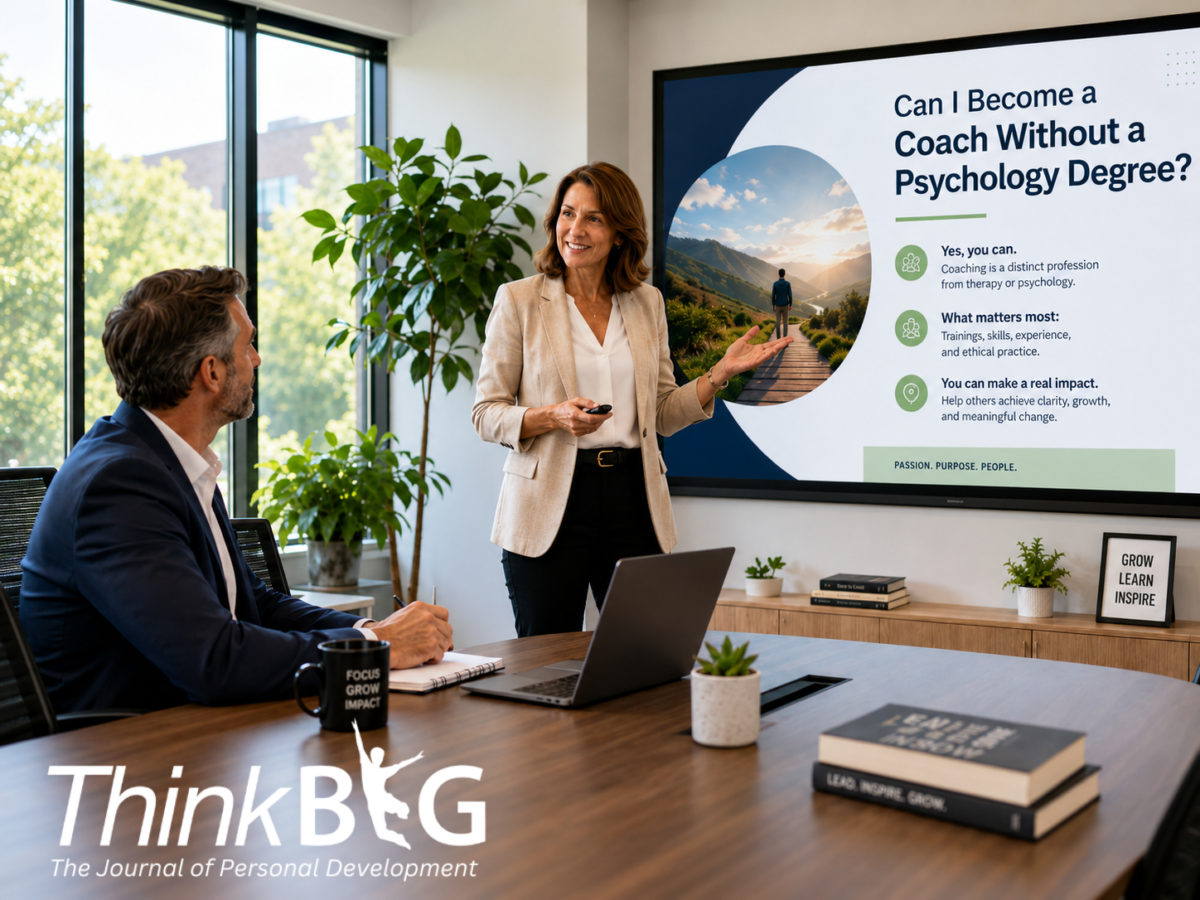
One of the most common questions people ask when they first become interested in coaching is:
“Can I become a coach without a psychology degree?”
The simple answer is yes.
You do not need a psychology degree to become a professional coach. In fact, many excellent coaches come from backgrounds in leadership, education, business, HR, training, sport, healthcare, parenting, entrepreneurship, personal development, management, creative industries and life experience.
A psychology degree can certainly be useful. It may give you a deeper academic understanding of human behaviour, cognition, motivation and emotional development. However, coaching is not the same as psychology, counselling, psychotherapy or mental health treatment. Coaching has its own identity, purpose, methods, skills and professional standards.
At its heart, coaching is about helping people move forward. It is about supporting clients to clarify what they want, understand where they are now, explore their options, overcome internal and external obstacles, take meaningful action and develop greater self-awareness along the way.
That does not require you to become a psychologist. It requires you to become a skilled, ethical, reflective and well-trained coach.
Coaching is not therapy — and that distinction matters
A good place to begin is by understanding what coaching is, and what it is not.
The International Coaching Federation defines coaching as a partnership with clients in a thought-provoking and creative process that inspires them to maximise their personal and professional potential. The Association for Coaching describes coaching as a collaborative, solution-focused, results-orientated and systematic process that supports performance, life experience, self-directed learning and personal growth.
Notice the language used here.
Coaching is about partnership, development, learning, goals, awareness, responsibility, performance and personal growth.
It is not about diagnosis. It is not about treating mental illness. It is not about analysing childhood trauma or providing psychological therapy.
That is why a psychology degree is not a requirement for becoming a coach. A coach is not pretending to be a psychologist. A coach is working within a different professional relationship.
This distinction is important ethically. A professional coach should understand the boundaries of coaching. If a client presents with issues that appear to require therapy, counselling, medical support or psychological treatment, a coach should know when to refer them to an appropriately qualified professional.
The best coaches are not those who try to be everything to everyone. They are the ones who understand their role clearly, practise safely, and work within the limits of their training and competence.
So why do people think they need a psychology degree?
It is understandable.
Coaching deals with people. It involves behaviour, belief, confidence, motivation, goals, identity, change, decision-making, communication and relationships. These are all areas that psychology also studies.
So, it is easy to assume that if you want to help people grow, change and develop, you must first study psychology at university.
But coaching does not require you to take the same route as a psychologist. In the UK, life coaching is not regulated in the same way as protected psychology professions. The National Careers Service states that life coaching is not regulated in the UK, although formal training and accreditation through a professional coaching body can improve credibility and career prospects.
By contrast, certain psychology titles are protected and regulated. The HCPC and the UK Regulated Professions Register list protected practitioner psychologist titles such as clinical psychologist, counselling psychologist, educational psychologist, occupational psychologist, forensic psychologist, health psychologist, sport and exercise psychologist, registered psychologist and practitioner psychologist.
That is a completely different professional route.
If you want to become a psychologist, you need the relevant recognised academic and professional training. If you want to become a coach, the more appropriate route is coach-specific training, coaching practice, ethical development, supervision, reflective learning and professional accreditation.
What makes someone a good coach?
A good coach is not simply someone who gives advice. In fact, coaching is often powerful because it moves away from advice-giving.
A professional coach learns how to create a safe, supportive and challenging space where the client can think more clearly, listen to themselves more honestly, explore possibilities and take ownership of their next steps.
The core skills of coaching include:
- Active listening.
- Powerful questioning.
- Building rapport and trust.
- Goal setting.
- Contracting and ethical practice.
- Helping clients clarify values and priorities.
- Encouraging reflection and insight.
- Supporting responsibility and action.
- Giving appropriate challenge.
- Maintaining professional boundaries.
- Developing self-awareness as a practitioner.
These are practical coaching skills. They are learned through training, demonstration, practice, feedback, reflection and experience. You do not need a psychology degree to begin developing them.
What you do need is a serious commitment to learning the craft properly.
Human growth is bigger than psychology alone
Psychology is one important lens for understanding people, but it is not the only lens.
Coaching draws from a wide range of ideas about human growth and development. These include adult learning, humanistic development, goal-setting theory, positive psychology, solution-focused approaches, leadership development, reflective practice, communication models and personal development traditions.
For example, Carl Rogers’ humanistic work placed great emphasis on empathy, congruence and unconditional positive regard. These ideas have influenced many helping professions and are highly relevant to coaching because they highlight the importance of the relationship, the quality of listening and the belief that people have inner resources for growth.
Albert Bandura’s work on self-efficacy also has clear relevance. Self-efficacy is about a person’s belief in their ability to take action and influence outcomes. Coaching often helps clients strengthen this sense of personal agency by setting achievable goals, reviewing progress and building confidence through action.
Adult learning theory is also central. Malcolm Knowles argued that adult learners bring experience, want relevance, value self-direction and learn best when they can connect learning to real-world challenges. Coaching is deeply aligned with this because it is client-centred, practical and focused on applying insight to life and work.
Goal-setting theory, associated with Locke and Latham, shows the motivational value of clear, meaningful and appropriately challenging goals. Coaching often helps clients turn vague hopes into specific goals and then into practical plans.
Solution-focused approaches also have a strong connection to coaching. Instead of spending all the time analysing the problem, solution-focused work explores what the client wants instead, what is already working, what resources they have, and what small steps could move them forward.
All of these ideas help explain why coaching can be powerful without requiring the coach to be a psychologist. Coaching is a field of applied human development. It is about helping people learn, reflect, choose, act and grow.
The coaching mindset: people are not broken
One of the most important differences between coaching and some other forms of support is the underlying philosophy.
Coaching does not begin with the assumption that the client is broken. It begins with the assumption that the client has potential, resources and capacity for growth.
A coach may help someone who feels stuck, uncertain, overwhelmed or lacking in confidence. But the coaching conversation is not built around diagnosing the person. It is built around helping them reconnect with their own thinking, choices, values and actions.
This is one of the reasons coaching can be so empowering.
A coach might ask:
- What do you really want?
- What matters most here?
- What have you already tried?
- What is stopping you?
- What would become possible if you believed you could move forward?
- What strengths do you already have?
- What would be a useful next step?
- What support do you need?
These questions help clients become active participants in their own growth. Rather than being told what to do, they are invited to think, decide and act with greater clarity.
Why professional training matters more than a psychology degree
Although a psychology degree is not required, professional training is extremely important.
Because coaching is not fully regulated, the quality of coaches in the market can vary. This means that clients are increasingly looking for coaches who have credible training, professional standards and recognised qualifications.
Good coach training helps you develop the practical skills, ethical awareness and professional confidence needed to work safely and effectively with real clients.
It should help you understand how to structure a coaching session, how to contract with a client, how to ask better questions, how to listen more deeply, how to use coaching models, how to manage boundaries, how to reflect on your practice and how to continue developing after qualification.
It should also give you opportunities to practise, receive feedback and develop confidence before you begin building your coaching practice.
That is why choosing the right training route matters.
Association for Coaching qualifications: a strong route into life coaching
For someone who wants to become a life coach, build a professional coaching practice or add coaching to an existing career, Association for Coaching accredited training is a strong and credible route.
The Association for Coaching is one of the best-known professional coaching bodies, and AC-accredited coach training gives learners a recognised framework for developing coaching competence.
UKCPD holds Association for Coaching accreditation across several coaching programmes, including the Accredited Award in Coach Training, Accredited Certificate in Coach Training and Accredited Diploma in Coach Training.
This is particularly useful for people who are starting out because it gives them a structured route into coaching without needing a psychology degree.
The Certificate route is a strong entry point for learners who want to become confident, capable life coaches. UKCPD’s Advanced Certificate in Life Coaching is described as an internationally recognised, AC-accredited programme that gives learners the tools, models and confidence to practise as a professional coach. It is designed for aspiring life coaches, developing coaches, career changers and learners who want a stronger professional foundation.
For those who want to go further, an Diploma route can help deepen professional practice, strengthen credibility and support the development of a more established coaching business.
This pathway is ideal if you want to:
- Start a professional life coaching practice.
- Add coaching to your current work.
- Support people through personal development and life change.
- Coach clients around confidence, goals, career direction, relationships, wellbeing or purpose.
- Develop a credible qualification without needing to study psychology at university.
- Build a practice based on ethical coaching skills and professional standards.
The important thing is that you are not trying to become an amateur psychologist. You are training to become a professional coach.
NLP and coaching: powerful tools for communication and change
The Association for NLP is also highly relevant for coaches, because NLP tools and models can be extremely powerful within the coaching context.
NLP, or Neuro-Linguistic Programming, explores the relationship between language, thinking, perception, behaviour and personal change. Within coaching, NLP can offer practical tools for helping clients understand how they think, how they communicate, how they create meaning, how they respond emotionally, and how they can develop more useful patterns of behaviour.
NLP can be particularly useful in areas such as:
- Building rapport.
- Understanding communication styles.
- Exploring beliefs and values.
- Reframing limiting assumptions.
- Working with goals and outcomes.
- Developing confidence.
- Changing unhelpful habits.
- Improving emotional state management.
- Supporting motivation and performance.
- Helping clients imagine future possibilities more clearly.
As with coaching, NLP is not a replacement for therapy or medical treatment. However, when used ethically and appropriately, NLP can add depth, flexibility and creativity to the coaching conversation.
The Association for NLP explains that NLP is not regulated by law in the same way as some professions, but that there is a widely recognised certification structure within the field. ANLP Accreditation is described as a standards alignment process grounded in ethical practice, transparent assessment and professional accountability.
UKCPD also offers a combined NLP Practitioner and Advanced Certificate in Life Coaching route. This 18-day programme combines professional coaching skills with NLP Practitioner-level training and is designed for learners who want practical NLP skills for communication, mindset, language, behaviour and personal change.
For many coaches, this combination is especially attractive because it brings together two complementary areas:
Coaching provides the structure, ethics, relationship and development process.
NLP provides practical models for communication, mindset, language, behaviour and change.
Together, they can give a coach a powerful toolkit for supporting clients in a clear, respectful and transformational way.
ILM Coaching and Mentoring qualifications: ideal for workplace coaching and leadership
While Association for Coaching qualifications are often a strong route for life coaching and private coaching practice, ILM Coaching and Mentoring qualifications are particularly valuable for managers, leaders, HR professionals, internal coaches and organisations.
ILM Level 5 and Level 7 qualifications are especially relevant for people who want to use coaching in the workplace.
The ILM Level 5 Certificate and Diploma in Effective Coaching and Mentoring are designed for managers and those with significant responsibility for coaching and mentoring as part of their daily role. ILM also states that these qualifications are suitable for people who want to move into a development role or start a career as a freelance coach or mentor. [14]
This makes Level 5 a strong option for middle managers, team leaders, HR professionals, learning and development practitioners and internal coaches who want to develop a coaching style of management.
At Level 5, learners can develop the skills to:
- Coach team members more effectively.
- Use coaching as part of everyday management.
- Improve performance conversations.
- Support staff development.
- Build confidence in mentoring and coaching.
- Create more reflective and empowering leadership conversations.
- Develop practical coaching experience in a workplace context.
UKCPD’s ILM Level 5 Certificate is described as a focused route for managers, HR professionals, L&D practitioners, internal coaches and professionals who want to use coaching and mentoring skills in the workplace. The Level 5 Diploma offers greater depth, more reflective practice and stronger evidence of coaching capability.
For senior leaders, directors, executive coaches and organisational development professionals, ILM Level 7 is the more advanced route.
ILM Level 7 qualifications are designed for senior managers, HR and OD professionals who want to develop expertise and credibility in executive or senior-level coaching and mentoring, or establish coaching at an organisational level. Benefits include understanding the strategic purpose of coaching and mentoring, analysing the skills and behaviours needed for senior-level practice, and planning, delivering and reviewing coaching at executive level.
UKCPD’s Level 7 Diploma is positioned as an advanced executive coaching qualification for experienced coaches, senior leaders, leadership consultants, OD professionals and those working within executive or senior leadership environments. It focuses on executive coaching, senior leadership coaching, organisational coaching, reflective practice and complex coaching assignments.
This makes ILM particularly useful if your coaching ambitions are connected to leadership, management, organisational culture or executive development.
Level 5 or Level 7: which is right for you?
A simple way to think about it is this:
Choose ILM Level 5 if you are a middle manager, team leader, HR professional, internal coach or aspiring workplace coach. It is ideal if you want to coach staff, support development conversations and bring a more empowering approach into your management style.
Choose ILM Level 7 if you are a senior leader, director, consultant, executive coach or OD professional working with senior people, strategic issues or organisational change. It is more advanced and better suited to complex leadership environments.
This does not mean one is “better” than the other. It simply means they serve different purposes.
Level 5 is excellent for developing workplace coaching capability.
Level 7 is designed for executive and senior-level coaching practice.
Can life experience make you a better coach?
Yes — when combined with proper training.
Many people come to coaching because they have lived through change themselves. They may have built a business, changed career, overcome personal challenges, led teams, raised a family, worked in education, managed people, recovered from setbacks or spent years supporting others informally.
Life experience can help you develop empathy, maturity, perspective and understanding. However, life experience alone is not enough.
A common mistake is assuming that because you have been through something, you are automatically qualified to coach others through it. Personal experience can be valuable, but coaching requires you to put the client’s world at the centre, not your own.
Training helps you make that shift.
It teaches you how to listen without projecting, how to ask rather than advise, how to support without rescuing, and how to challenge without imposing your own story.
The best coaches often combine life experience with professional skill. They bring humanity and structure. They bring warmth and boundaries. They bring insight and humility.
Building a professional coaching practice
If your goal is to become a professional coach, the qualification is only part of the journey.
You also need to think about your coaching practice as a professional service.
That means developing:
- A clear coaching niche or audience.
- A professional code of ethics.
- A coaching agreement or contract.
- A clear description of your services.
- A client onboarding process.
- A reflective practice routine.
- Ongoing CPD.
- Appropriate insurance.
- A referral process for clients who need support outside coaching.
- A supervision or mentor-coaching arrangement.
- A way of gathering feedback and improving your practice.
This is another reason why a psychology degree is not the central issue. Building a coaching practice requires coach-specific professional development. You need to understand coaching, clients, contracting, marketing, boundaries, outcomes and ethical practice.
A well-designed coaching qualification can support this far more directly than an unrelated academic route.
What if I do have a psychology degree?
If you already have a psychology degree, that can be a wonderful advantage.
It may give you a strong understanding of human behaviour, research methods, motivation, personality, cognition and development. However, you would still benefit from coach-specific training.
A psychology degree does not automatically teach you how to coach. It may teach you about people, but coaching requires a particular skillset: contracting, questioning, listening, structuring sessions, supporting goals, building accountability, working ethically within a coaching framework and developing as a reflective practitioner.
So, whether you have a psychology degree or not, the key question is the same:
Have you trained properly as a coach?
What route should you take?
If you want to become a life coach and build a professional coaching practice, an Association for Coaching accredited route is a strong place to begin. The Certificate and Advanced Diploma pathways can help you build credibility, practical skill and professional confidence.
If you want to add powerful communication and change tools to your coaching practice, NLP training through an ANLP-recognised route can give you useful models for language, mindset, beliefs, behaviour and personal development.
If you want to use coaching in leadership, management, HR or organisational development, ILM Coaching and Mentoring qualifications are an excellent choice. Level 5 is particularly suitable for middle managers and workplace coaches, while Level 7 is designed for senior leaders, directors and executive coaches.
The right route depends on the kind of coach you want to become.
Final thoughts: you do not need permission to begin
You do not need a psychology degree to become a coach.
You need curiosity about people. You need respect for human potential. You need the willingness to listen deeply, learn continuously and practise ethically. You need a commitment to your own development, because coaching is not just a set of techniques — it is also a way of being with another person.
A psychology degree can be useful, but it is not the doorway into coaching.
The doorway into coaching is coach training, reflective practice, ethical awareness, real coaching experience and a genuine desire to help others grow.
If you feel drawn to coaching, that matters. If you find yourself naturally supporting people, asking thoughtful questions, seeing potential in others and wanting to help people move forward, then coaching may be a very natural path for you.
The next step is not to ask whether you are already qualified enough to begin.
The next step is to choose the right professional training route and start becoming the coach you are capable of becoming.
References
The Association for Coaching (AC)
The Association for NLP (ANLP)
Rogers, C. R. (1951). Client-Centered Therapy. Boston: Houghton Mifflin.
Bandura, A. (1977). “Self-efficacy: Toward a unifying theory of behavioural change.” Psychological Review, 84(2), 191–215.
Knowles, M. S. (1970). The Modern Practice of Adult Education: Andragogy Versus Pedagogy. New York: Association Press.
Locke, E. A. and Latham, G. P. (2002). “Building a practically useful theory of goal setting and task motivation.” American Psychologist, 57(9), 705–717.
de Shazer, S. (1985). Keys to Solution in Brief Therapy. New York: Norton.

