


Completing an NLP Practitioner qualification can be a genuinely transformative experience. It introduces you to powerful approaches for understanding communication, setting outcomes, exploring patterns of thinking and helping people access new choices.
However, Practitioner-level training is only the beginning of the journey.
There is an important difference between knowing an NLP technique and developing the judgement, flexibility and depth required to use NLP skilfully in complex, real-world situations.
A competent practitioner can follow a process. A developing master practitioner begins to understand the deeper principles behind the process. They can recognise patterns, adapt their approach, integrate multiple models and design interventions around the individual rather than simply applying a predetermined technique.
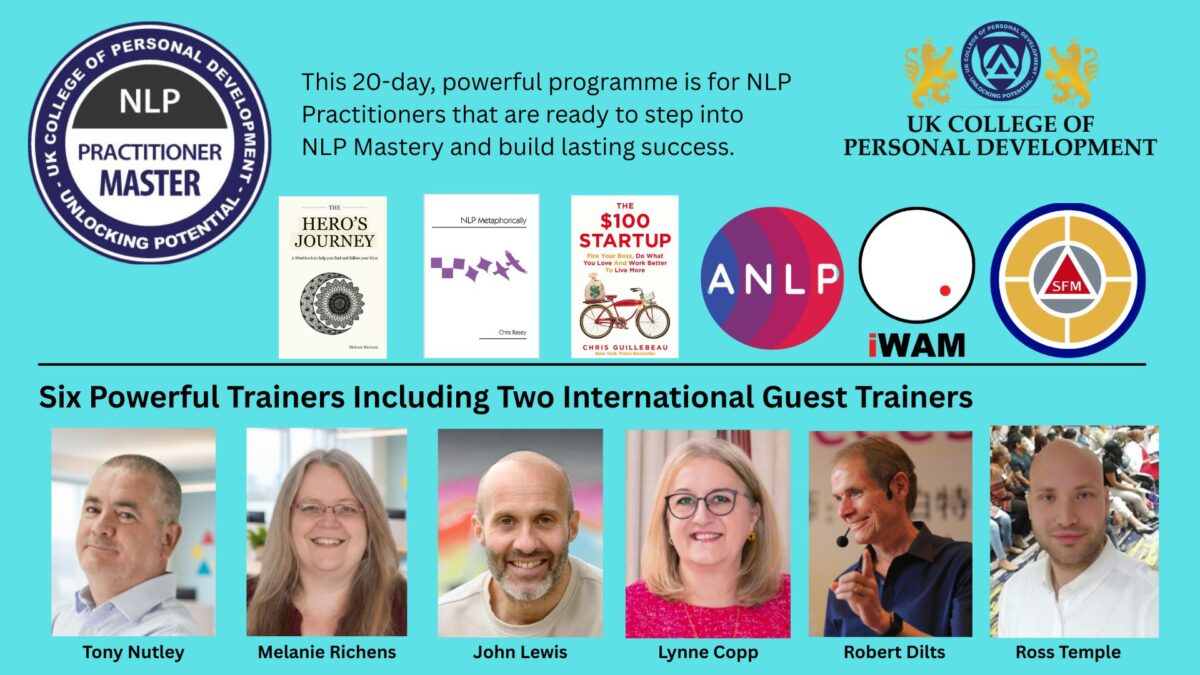
The UKCPD NLP Master Practitioner programme has been created for qualified NLP Practitioners who are ready to make that transition. The one word focus of this 20 day programme is SUCCESS! – How to use the skills and models from NLP to enable, create and develop lasting success – (personal and professional).
Delivered through 20 days of live online training over seven months, the programme explores advanced NLP Modelling, beliefs and values, identity-level coaching, NLP Meta Programmes, iWAM psychometric profiling, Quantum Linguistics, the Unified Theory of NLP, advanced change processes, presentation skills, group work and Success Factor Modelling™. It also includes contributions from internationally recognised guest trainers Robert Dilts and Ross Temple.
Here are seven compelling reasons to take the next step towards NLP mastery.
1. Move from applying NLP techniques to developing genuine mastery
Mastery is not achieved by collecting an ever-growing number of techniques.
It develops when knowledge, experience, feedback and reflective practice begin to work together. Instead of asking, “Which technique should I use?”, the master practitioner learns to ask more sophisticated questions:
- What is happening within this person’s wider system?
- At what level is change required?
- What is maintaining the current pattern?
- What values, beliefs or identity conclusions are involved?
- What resources are already available?
- What intervention will create the most useful and ecological movement?
- How will we know that meaningful change has occurred?
This represents a shift from procedure-led practice to principle-led practice.
The UKCPD programme describes this as moving beyond simply following procedures towards designing purposeful, dynamic and outcome-focused action. Learners are encouraged not only to understand what an NLP model does, but to explore how it works, why it may be useful and how it can be adapted to the individual client.
The structure of the programme is particularly important. Rather than compressing advanced development into one intensive block, the training is distributed across seven months. Learners have opportunities to practise, reflect, review recordings, complete client work, participate in tutor calls and engage in practice groups and developmental supervision discussions.
Research into learning has consistently demonstrated that practice distributed over time generally supports longer-term retention more effectively than massed learning undertaken in a single concentrated period. Cepeda and colleagues’ major review examined 839 assessments from 317 experiments and found substantial evidence for the benefits of distributed practice.
Research into expertise also highlights the importance of purposeful practice, feedback and progressively challenging development. Expertise does not arise from repetition alone. It is supported by practice designed to stretch current capability, reveal weaknesses and improve specific aspects of performance.
The UKCPD NLP Master Practitioner programme reflects these principles through:
- 20 days of live, interactive training;
- practical exercises and demonstrations;
- a complete NLP Modelling project;
- a client case study;
- tutor feedback;
- practice groups;
- group supervision discussions;
- presentation of modelling projects;
- and a final practical assessment.
This is significant because professional mastery requires more than intellectual understanding. It requires the ability to demonstrate skills appropriately, confidently and ethically while working with another person.
ANLP’s current professional standards require Master Practitioner training to include at least 80 hours of advanced synchronous training beyond Practitioner level, with live interaction, assessment, feedback and evidence of both knowledge and practical competence.
The UKCPD NLP Master Practitioner provides the space, structure and challenge necessary to begin converting NLP knowledge into professional wisdom.
2. Learn the foundation of NLP through advanced NLP Modelling
NLP is frequently presented as a collection of communication and change techniques. However, the original foundation of NLP was modelling.
Modelling involves studying how a person produces a particular capability, behaviour or result. Rather than merely admiring excellence, the modeller attempts to identify the patterns that make that excellence possible.
These may include:
- observable behaviours;
- internal strategies;
- beliefs and assumptions;
- attentional patterns;
- emotional states;
- language;
- decision-making processes;
- perceptual positions;
- and responses to challenge or feedback.
The objective is not to produce a superficial imitation of another person. It is to develop a practical map of the processes contributing to a successful performance and explore which elements can be learned, transferred or adapted.
Robert Dilts describes behavioural modelling as breaking a complex performance into sufficiently clear elements of thought and action so that aspects of the performance can be reproduced.
On the UKCPD NLP Master Practitioner programme, modelling is not treated as an interesting historical concept. It becomes a central practical methodology.
Learners explore the NLP Modelling process, participate in live modelling work and complete a full modelling project as part of their assessment. The programme also includes an example involving a previous UKCPD graduate who successfully developed an NLP and coaching practice by modelling sporting excellence and transferring the resulting mindset and strategies into a new professional context.
This can transform the way you work with clients.
At Practitioner level, you may help a client overcome a specific obstacle. At Master Practitioner level, you can begin helping clients identify and develop the deeper structures that underpin excellence.
For example, a client may want to become more confident when presenting. A procedural approach might focus on state management, anchoring or mental rehearsal. A modelling approach could go further by exploring:
- how outstanding presenters prepare;
- what they pay attention to;
- how they organise information;
- how they interpret nervousness;
- how they connect with an audience;
- how they recover from mistakes;
- what they believe about their role;
- and how they evaluate a successful presentation.
The outcome is not simply a temporary confidence boost. The client begins to develop a richer model of effective performance.
This methodology can be applied to coaching, leadership, entrepreneurship, education, sport, communication, creativity, consulting and organisational development.
The programme also includes optional evening workshops exploring Success Factor Modelling™, developed by Robert and John Dilts to identify and apply the patterns that support successful individuals, teams and organisations.
For practitioners who want to help clients move beyond problem-solving and towards developing excellence, NLP Modelling is one of the most valuable areas of advanced study.
3. Work more deeply with beliefs, values and identity
Many client issues appear initially to be behavioural:
“I keep procrastinating.”
“I need to become more confident.”
“I cannot motivate myself.”
“I struggle to promote my business.”
“I know what I should do, but I still do not do it.”
Behaviour is visible, but the factors maintaining the behaviour may exist at a deeper level.
A client who avoids promoting their business may not lack marketing knowledge. They may hold an unexamined belief that selling is manipulative.
Someone who repeatedly abandons goals may have a conflict between achievement and security.
A manager struggling to delegate may believe that asking others for help demonstrates weakness.
A new coach may possess excellent skills but still think, “Who am I to work with successful people?”
In these situations, repeatedly focusing on surface behaviour may produce limited progress. The practitioner needs the sensitivity and skill to explore the beliefs, values and identity conclusions influencing the behaviour.
The NLP Master Practitioner programme therefore includes dedicated work on:
- modelling beliefs;
- identifying limiting and enabling beliefs;
- coaching at the level of identity;
- understanding values;
- recognising values conflicts;
- exploring the relationship between values and motivation;
- and developing more supportive belief systems.
Within Dilts’ Success Factor Modelling framework, beliefs and values influence why people follow particular paths, while identity relates to who a person or group perceives themselves to be. Vision and purpose add an even broader systemic dimension by considering whom or what the person’s actions ultimately serve.
This helps the practitioner avoid assuming that every difficulty can be resolved at the same level.
Sometimes a behavioural intervention is enough. On other occasions, the client may need to reconsider the meaning they have attached to an experience, the value conflict behind a decision or the identity they believe they must preserve.
This work requires care. A skilled practitioner does not impose new beliefs upon clients or decide what their values should be. Instead, they create a respectful process through which clients can examine their own thinking, test assumptions and develop choices that remain aligned with their wider life and responsibilities.
Developing this depth can make client work more precise. It can also help the practitioner recognise when an issue sits outside their professional competence and requires referral to a suitably qualified mental-health or healthcare professional.
Mastery is not demonstrated by attempting to resolve every issue. It is demonstrated through judgement, ethical awareness and respect for the boundaries of practice.
4. Develop sophisticated language skills through Quantum Linguistics, the Unified Theory of NLP and advanced change processes
Language does more than communicate an experience. It can shape how the experience is organised, interpreted and maintained.
A small change in language can direct attention towards a different time, frame, relationship or possibility.
Consider the differences between:
“I am a failure.”
“I failed to achieve a particular outcome.”
“I have not achieved that outcome yet.”
“My current strategy did not produce the outcome I wanted.”
“What can this result teach me about my next strategy?”
Each statement creates a different relationship with the event. The facts may be similar, but the meaning, identity implications and possibilities for action are significantly different.
Master Practitioner development therefore requires a deeper understanding of language.
The UKCPD programme includes Quantum Linguistics, described within the syllabus as the exploration of advanced linguistic patterns involving time, space and change for personal and professional development.
Within this context, “Quantum Linguistics” is a term used for a particular approach to advanced language patterning. Its practical value should be understood through the disciplined exploration of language, perspective and meaning rather than presented as an application of quantum physics.
The programme also includes two days exploring the Unified Theory of NLP. This provides an opportunity to examine the concepts, assumptions and philosophy underpinning different NLP approaches and to begin developing new, personally designed change models.
Robert Dilts’ wider contribution to NLP includes the Unified Field Theory for NLP, systemic NLP, belief-change approaches, Neuro-Logical Levels, Sleight of Mouth patterns, reimprinting and generative processes.
An integrated understanding enables practitioners to recognise relationships between different areas of NLP rather than treating each model as an isolated technique.
For example, a practitioner may begin to see how:
- language reveals beliefs;
- beliefs influence state and behaviour;
- values affect motivation;
- identity shapes what a client believes is possible or appropriate;
- context changes meaning;
- timelines influence emotional responses;
- and systemic relationships affect whether change can be sustained.
The programme also includes a dedicated Advanced NLP Change Processes workshop.
This sits alongside Robert Dilts’ two-day guest workshop, The Success Blueprint: Strategies for Creating Lasting Success. During his contribution, Dilts will draw upon Success Factor Modeling™, the Logical Levels framework, Generative Intelligence and insights from his Strategies of Genius work.
Together, these elements help learners move away from asking, “Which NLP technique fixes this problem?” and towards the more useful question:
“What combination of language, attention, resources, meaning and action will enable this individual to create a more useful result?”
5. Gain deeper insight into motivation through iWAM psychometric profiling
One of the distinctive features of the UKCPD NLP Master Practitioner programme is the inclusion of a complete iWAM psychometric profile and debrief.
The Inventory for Work Attitude and Motivation—iWAM—is designed to explore motivational and attitudinal preferences within a work-related context.
It is based on Meta Programmes: patterns associated with how people direct attention, process information, respond to situations and become motivated.
The profile examines 48 parameters and is used in areas such as coaching, training, management, recruitment and team development.
Unlike simplistic personality descriptions that place people into a small number of fixed categories, iWAM is intended to produce a more individual pattern of preferences.
It can help you explore questions such as:
- What naturally attracts or holds your attention?
- Are you primarily energised by moving towards an outcome or avoiding a problem?
- How much choice and variety do you prefer?
- Do you respond more strongly to internal standards or external feedback?
- How do you approach rules, procedures and alternatives?
- What type of working environment is likely to support your motivation?
- What language patterns are most likely to engage you?
- How might your preferences change across different contexts?
Every delegate on the programme completes a full profile and receives an individual report and debrief. The course then connects this experience to the practical application of NLP Meta Programmes in coaching and personal development.
This creates two levels of learning.
First, you gain greater self-awareness. You may understand why certain projects energise you, why particular environments feel restrictive or why you communicate easily with some people but find others more challenging.
Second, you learn how motivational patterns can inform your work with clients.
A coach who assumes that everyone is motivated in the same way will inevitably miss important information. One client may be inspired by an ambitious future vision. Another may be more motivated by protecting what they have already created. One may need freedom and alternatives. Another may perform best when given a clear process and defined expectations.
Neither preference is automatically better. The practitioner’s role is to understand the person, the desired outcome and the context.
As with every profiling instrument, iWAM should be used as a structured aid to reflection and conversation rather than as an infallible label. A profile can suggest useful hypotheses, but the individual remains more complex than any report.
Used in this way, profiling can help practitioners ask better questions, adapt their communication and design development strategies that feel relevant to the person in front of them.
6. Experience the Hero’s Journey as a model for coaching, development and personal transformation
Before practitioners can guide others confidently through change, they must be willing to explore their own development.
For this reason, the UKCPD programme begins with an examination of mastery and the Hero’s Journey.
Popularised through the work of mythologist Joseph Campbell, the Hero’s Journey describes a recurring narrative in which an individual leaves the familiar, responds to a challenge, faces tests, encounters support, experiences transformation and returns with new insight or capability.
Campbell presented the journey not only as a storytelling pattern but as a metaphorical model for the transitions and initiations experienced throughout life.
The UKCPD programme dedicates its opening two days to exploring the Hero’s Journey and applying it to personal development, professional growth and coaching. Delegates also receive Melanie Richens’ book The Hero’s Journey as part of the programme.
The model can provide a powerful structure for client exploration.
A client may be experiencing:
- a call towards a new career;
- resistance to leaving a familiar role;
- fear at the threshold of change;
- uncertainty during a transition;
- challenges that test commitment;
- the need to seek mentors or allies;
- the loss of an old identity;
- or difficulty integrating learning after a major experience.
The Hero’s Journey helps place these experiences within a wider developmental narrative. Instead of interpreting uncertainty as proof of failure, a client may begin to see it as a natural part of transition.
This connects with research into narrative identity. McAdams and McLean describe narrative identity as an internalised and evolving life story through which people connect their reconstructed past with an imagined future, creating a degree of unity, purpose and meaning.
The role of the practitioner is not to force every client’s experience into a predetermined heroic story. Rather, the model can offer a framework for exploring:
- where the client believes they are;
- what they are being called towards;
- what they fear losing;
- what resources and allies they need;
- what challenges may be teaching them;
- who they are becoming;
- and what contribution they want to make.
For many learners, the NLP Master Practitioner itself will become a Hero’s Journey: a decision to leave the comfort of familiar techniques, accept a new level of challenge and return to their work with expanded capability and a deeper sense of professional identity.
7. Learn from outstanding guest trainers while gaining a recognised professional qualification
A Master Practitioner programme should expose learners to more than one perspective.
Different trainers bring different experiences, applications and interpretations. Encountering those differences helps learners become more flexible and prevents them from assuming that there is only one correct way to apply a model.
Alongside the UKCPD training team, the programme includes three powerful guest contributions.
Robert Dilts: The Success Blueprint
Robert Dilts has been involved in the development of NLP since the 1970s and has made major contributions in areas including strategies, belief systems, Systemic NLP, Neuro-Logical Levels, modelling, Sleight of Mouth and generative approaches.
His two-day workshop, The Success Blueprint, explores the factors that distinguish lasting success from short-term results.
The workshop includes:
- Success Factor Modelling™;
- the Logical Levels framework;
- Generative Intelligence;
- and insights from the Strategies of Genius series.
This represents an exceptional opportunity to learn directly from one of the most influential developers in the history of NLP.
Ross Temple: Presence, Pitch, Profit
Ross Temple’s contribution focuses on presentations, influence and ethical commercial communication.
Through his Presence, Pitch, Profit approach, learners explore how to develop a stronger presence, structure persuasive presentations and create offers that encourage action without relying on pressure or manipulation.
This is particularly valuable for coaches, trainers, consultants and practitioners who need to communicate their ideas, deliver workshops, run webinars, speak on camera or build a professional practice.
Professional recognition
The programme is accredited and recognised by the Association for Neuro Linguistic Programming (ANLP).
ANLP states that its accreditation process is intended to strengthen clarity, consistency, ethical practice and professional integrity across NLP qualifications. Its Master Practitioner standards require advanced live training, practical interaction and assessment beyond Practitioner level.
Graduates of the UKCPD programme also receive several practical professional benefits, including:
- an accredited NLP Master Practitioner qualification;
- a physical student study pack;
- three additional books;
- an individual iWAM profile and debrief;
- optional Success Factor Modelling™ workshops;
- regular tutor calls;
- practice groups and supervision discussions;
- recordings of live sessions for review;
- an insurance discount code;
- a complimentary CoachFinder listing;
- CPD opportunities;
- and access to the UKCPD Be Inspired Group.
These elements help make the programme more than a training event. They create a supported pathway towards a stronger professional identity and more confident application.
The deeper benefit: creating a more meaningful impact with clients
The ultimate value of Master Practitioner development is not the title printed on the certificate.
It is the quality of the difference you can make when working with another person.
Coaching research indicates that structured coaching can have positive effects on areas including performance, skills, wellbeing, coping, work attitudes and goal-directed self-regulation.
A separate meta-analysis of workplace coaching also found positive effects on learning and performance outcomes.
However, a qualification alone does not produce an effective practitioner. Impact depends upon the practitioner’s ability to listen, build an appropriate relationship, think critically, work ethically, remain within their competence and select interventions that fit the individual client.
Advanced training can support that development by expanding the practitioner’s range of choices.
As your knowledge deepens, you may become better able to distinguish between:
- a surface problem and a deeper pattern;
- lack of motivation and a values conflict;
- lack of skill and a limiting belief;
- a behavioural habit and an identity issue;
- the client’s goal and someone else’s expectation;
- a technique that produces temporary relief and a process that supports sustainable learning.
You also become less dependent upon scripts.
Instead of trying to make the client fit the model, you learn to use the model as a flexible map while continuing to pay attention to the actual person.
That is one of the clearest signs of developing mastery.
More than an advanced course
The UKCPD NLP Master Practitioner is designed as a journey of professional and personal development.
Across the programme, you will explore:
- the meaning of mastery;
- the Hero’s Journey;
- advanced NLP Modelling;
- modelling success;
- iWAM psychometric profiling;
- NLP Meta Programmes;
- beliefs and identity;
- values;
- Quantum Linguistics;
- the Unified Theory of NLP;
- advanced NLP change processes;
- Success Factor Modeling™;
- Logical Levels;
- Generative Intelligence;
- sporting excellence;
- successful presentations;
- NLP group work;
- and the development of your own modelling project.
You will be challenged to think more deeply, practise more deliberately and examine how you use NLP with yourself as well as with other people.
You will learn from experienced trainers, receive feedback, complete practical work and become part of a community of practitioners committed to continuing professional development.
Most importantly, you will begin moving from the question:
“Which technique should I use?”
towards the deeper questions:
“What is really happening here?”
“What does this person need?”
“What pattern is producing the current result?”
“What would create greater choice?”
“How can I support change responsibly, respectfully and effectively?”
That is the journey from Practitioner to Master Practitioner.
Who should enrol?
The UKCPD NLP Master Practitioner programme is suitable for people who have already completed a recognised NLP Practitioner qualification, including:
- professional coaches;
- NLP Practitioners;
- executive and business coaches;
- life coaches;
- trainers and facilitators;
- consultants;
- leaders and managers;
- learning and development professionals;
- personal development practitioners;
- and people preparing to progress towards NLP Trainer-level development.
It will be particularly valuable when you are ready to move beyond Practitioner-level procedures and develop a more flexible, systemic and individually responsive approach.
Take the next step towards NLP mastery
If you are already a qualified NLP Practitioner, the next stage of your development is not simply about learning more.
It is about understanding more deeply.
It is about becoming more flexible.
It is about developing the confidence to think beyond a script, recognise patterns, design meaningful interventions and work with clients at the level where change is genuinely required.
The UKCPD NLP Master Practitioner programme brings together advanced NLP, modelling, language, beliefs, values, identity, profiling, personal development, professional practice and world-class guest training within one comprehensive learning journey.
The question is no longer simply:
“Do I know NLP?”
The more important question is:
“How skilfully, flexibly and responsibly can I use what I know to help another person create meaningful change?”
That is the challenge of mastery—and the opportunity offered by the UKCPD NLP Master Practitioner programme.
References
ANLP. ANLP Accreditation: Professional Standards for NLP Training. Association for Neuro Linguistic Programming.
ANLP. Core Requirements: Professional Standards, Ethical Practice and Recognised Credibility. Association for Neuro Linguistic Programming.
Campbell, J. (1949). The Hero with a Thousand Faces. Princeton University Press.
Cepeda, N.J., Pashler, H., Vul, E., Wixted, J.T. and Rohrer, D. (2006). “Distributed Practice in Verbal Recall Tasks: A Review and Quantitative Synthesis.” Psychological Bulletin, 132(3), 354–380.
Dilts, R. (1998). Modeling with NLP. Meta Publications.
Dilts, R. (2003). From Coach to Awakener. Meta Publications.
Dilts, R. and DeLozier, J. (2000). Encyclopedia of Systemic Neuro-Linguistic Programming and NLP New Coding. NLP University Press.
Dilts Strategy Group. Success Factor Modeling™.
Ericsson, K.A., Krampe, R.T. and Tesch-Römer, C. (1993). “The Role of Deliberate Practice in the Acquisition of Expert Performance.” Psychological Review, 100(3), 363–406.
JobEQ. The Inventory for Work Attitude and Motivation—iWAM.
Jones, R.J., Woods, S.A. and Guillaume, Y.R.F. (2016). “The Effectiveness of Workplace Coaching: A Meta-analysis of Learning and Performance Outcomes from Coaching.” Journal of Occupational and Organizational Psychology, 89(2), 249–277.
McAdams, D.P. (2001). “The Psychology of Life Stories.” Review of General Psychology, 5(2), 100–122.
McAdams, D.P. and McLean, K.C. (2013). “Narrative Identity.” Current Directions in Psychological Science, 22(3), 233–238.
Theeboom, T., Beersma, B. and van Vianen, A.E.M. (2014). “Does Coaching Work? A Meta-analysis on the Effects of Coaching on Individual-level Outcomes in an Organisational Context.” The Journal of Positive Psychology, 9(1), 1–18.
UK College of Personal Development. NLP Master Practitioner: Course Overview, Syllabus, Accreditation and Programme Benefits.

