


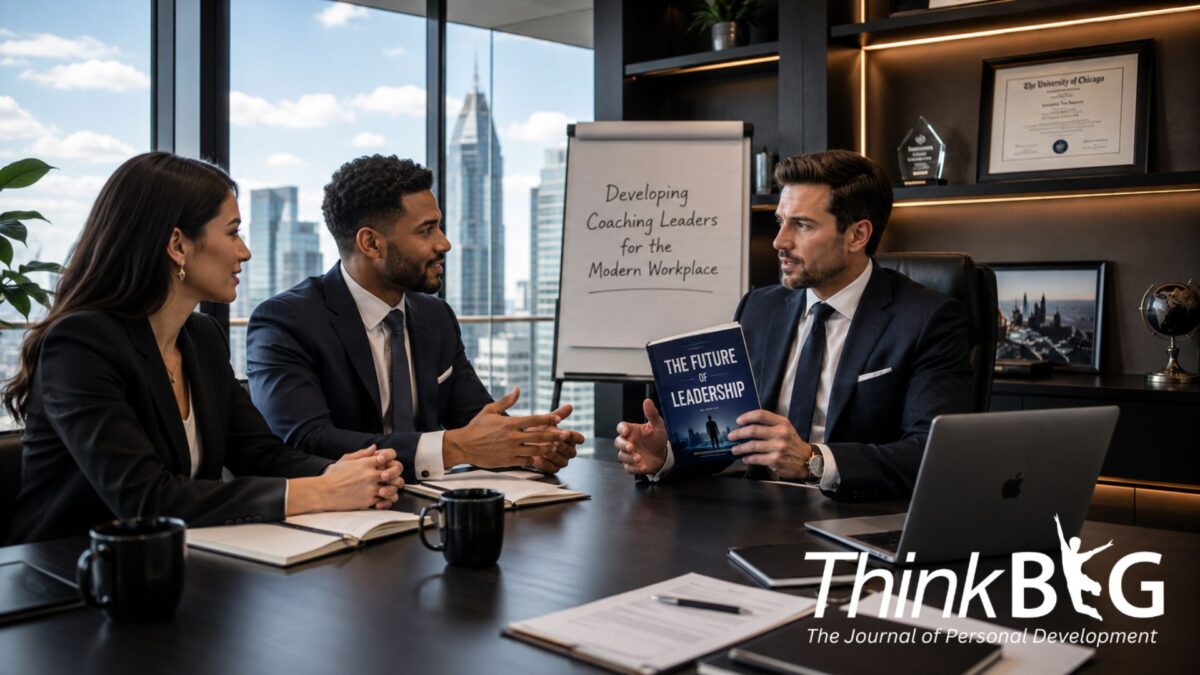
Developing Coaching Leaders for the Modern Workplace
“Leadership is no longer about having all the answers. It is increasingly about asking better questions, developing capability and creating environments where people can thrive.”
In Part One of this article, we explored how traditional command-and-control leadership models emerged from the industrial age and why they are increasingly challenged by the realities of today’s knowledge-based, fast-moving and highly connected workplaces.
Employees are no longer simply expected to follow instructions. They are expected to think critically, collaborate effectively, innovate continuously and adapt rapidly to changing circumstances. These demands require a different style of leadership.
The coaching leader has emerged as a compelling response to this challenge.
This second article explores what coaching leadership looks like in practice, examines examples of coaching cultures and discusses how managers and leaders can develop these capabilities through recognised professional qualifications.
What Does a Coaching Culture Look Like?
A coaching culture exists when coaching principles become embedded within the day-to-day practices, behaviours and conversations that take place throughout an organisation.
In organisations with strong coaching cultures, employees frequently describe feeling:
- Trusted;
- Valued;
- Heard;
- Supported;
- Empowered;
- Encouraged to learn.
Rather than waiting for annual appraisals, managers engage in regular developmental conversations.
Feedback becomes continuous.
Learning becomes part of everyday work.
Mistakes are viewed as opportunities to improve rather than occasions for blame.
The role of leadership shifts significantly.
Leaders become facilitators of learning rather than directors of activity.
Employees become active participants in their own development.
Coaching Leadership in Practice
The principles of coaching leadership can be observed across many sectors.
Example One – Performance Management
Traditional approach:
Manager:
“You missed your target. You need to work harder.”
Coaching approach:
Manager:
“Let’s look at what happened. What factors influenced the result?”
Employee:
“I think I spent too much time dealing with operational issues.”
Manager:
“What options might help you manage those competing priorities more effectively?”
Employee:
“I could delegate more and schedule dedicated client time.”
The difference is significant.
The employee develops insight.
Ownership increases.
Learning becomes sustainable.
Example Two – Supporting Career Development
Traditional approach:
Manager:
“I think you should apply for the senior role.”
Coaching approach:
Manager:
“What does your ideal career progression look like over the next two years?”
Employee:
“I’d like more responsibility but I’m not sure I’m ready.”
Manager:
“What strengths do you already possess that would support that transition?”
Employees begin recognising their own capabilities.
Confidence grows.
Engagement increases.
Example Three – Managing Change
Change initiatives often create uncertainty.
Leaders using coaching approaches ask questions such as:
- What concerns do you have?
- What opportunities do you see?
- What support would help you adapt?
- What strengths have helped you through previous periods of change?
Such conversations can significantly reduce resistance and increase commitment.
The Business Case for Coaching Leadership
There is a growing body of evidence suggesting that coaching-based leadership can positively influence organisational outcomes.
Research undertaken by Jones, Woods and Guillaume (2016) found that workplace coaching interventions are associated with improvements in:
- Goal attainment;
- Psychological wellbeing;
- Performance;
- Coping abilities;
- Work attitudes.
Similarly, Athanasopoulou and Dopson (2018) identified executive coaching as a valuable intervention for enhancing leadership capability and supporting organisational development.
Potential organisational benefits include:
Improved Employee Engagement
People are more likely to remain engaged when they feel listened to and involved.
Gallup’s research consistently highlights the influence managers have on engagement outcomes.
Increased Retention
Employees frequently leave managers rather than organisations.
Managers who coach effectively tend to build stronger relationships.
Greater Innovation
Psychological safety encourages experimentation.
Experimentation drives innovation.
Innovation supports organisational sustainability.
Better Succession Planning
Coaching leaders actively develop future talent.
Internal promotion pipelines become stronger.
Enhanced Wellbeing
Coaching conversations provide opportunities for reflection, perspective taking and resilience building.
The Coaching Conversation as a Leadership Tool
One of the greatest strengths of coaching is that it can be integrated into everyday management practice.
Managers do not necessarily need hour-long sessions.
A five-minute coaching conversation can have significant impact.
Examples include:
Instead of:
“Do this.”
Ask:
“How do you think we should approach this?”
Instead of:
“Here’s the answer.”
Ask:
“What possibilities can you identify?”
Instead of:
“You need to improve.”
Ask:
“What would outstanding performance look like for you?”
Over time, these small conversational shifts can transform organisational culture.
Developing Coaching Capability Through Professional Learning
Whilst some leaders naturally adopt coaching behaviours, coaching is a skill set that can be learned, practised and refined.
Professional qualifications provide structured opportunities to develop competence and confidence.
ILM Level 5 Effective Coaching and Mentoring
Middle managers occupy one of the most demanding positions within organisations.
They often manage competing expectations from senior leadership whilst supporting operational teams.
The ILM Level 5 qualifications in Effective Coaching and Mentoring are designed specifically for professionals wishing to integrate coaching approaches into management practice.
Suitable participants include:
- Team leaders;
- Department managers;
- HR practitioners;
- Learning and Development specialists;
- Emerging leaders.
Learners explore areas such as:
- Coaching ethics;
- Coaching models;
- Contracting;
- Goal setting;
- Coaching practice;
- Reflective development.
Middle managers who develop coaching capabilities frequently report improvements in:
- Communication;
- Delegation;
- Team motivation;
- Conflict management;
- Employee engagement.
Rather than simply supervising work, they learn to facilitate growth.
ILM Level 7 Executive Coaching and Mentoring
Senior leaders face increasingly complex challenges.
They are expected to:
Lead transformation.
Influence culture.
Manage uncertainty.
Develop future leaders.
Navigate competing priorities.
The ILM Level 7 Certificate and Level 7 Diploma in Executive Coaching and Mentoring provide advanced development opportunities for experienced professionals wishing to operate at executive coaching level.
Topics commonly include:
- Advanced coaching methodologies;
- Systems thinking;
- Executive leadership;
- Organisational dynamics;
- Reflective practice;
- Coaching supervision.
For many senior leaders, coaching becomes an integral component of strategic leadership.
It supports succession planning, talent development and organisational resilience.
Association for Coaching Accredited Programmes
Many professionals aspire to become qualified coaches.
Others seek coaching skills to complement existing leadership responsibilities.
UKCPD offers programmes accredited by the Association for Coaching (AC), one of the world’s leading professional coaching bodies.
Benefits of studying AC accredited programmes include:
- Professional recognition;
- Ethical frameworks;
- Practical coaching experience;
- Enhanced credibility;
- Structured progression pathways.
Such programmes are suitable for:
Managers.
Consultants.
HR professionals.
Entrepreneurs.
Healthcare practitioners.
Educators.
Individuals establishing independent coaching practices.
NLP Practitioner Qualifications
Many coaching professionals also choose to study Neuro Linguistic Programming (NLP).
NLP explores how people organise thoughts, emotions and behaviours.
Practitioner-level programmes often include:
- Rapport building;
- Language patterns;
- Goal setting;
- Submodalities;
- Belief change methodologies;
- Communication strategies.
NLP can complement coaching approaches by providing additional tools for facilitating behavioural change and improving interpersonal effectiveness.
Managers frequently report that NLP enhances their ability to:
Build relationships.
Influence positively.
Communicate effectively.
Support change initiatives.
Increase self-awareness.
Flexible Learning Designed Around Busy Professionals
One of the barriers many managers face is finding time to study.
At UKCPD, flexibility is considered essential.
Learners may benefit from:
- Online study options;
- Tutor support;
- Self-paced learning opportunities;
- Accessible resources;
- Practical assignments;
- Opportunities to connect with like-minded professionals.
Whether someone is taking their first steps into coaching or seeking advanced executive coaching capabilities, programmes are designed to fit around demanding professional commitments.
Leadership for the Future
Leadership is changing.
The most successful leaders of the future may not be those who exert the greatest control.
They may be those who ask the best questions.
Those who listen deeply.
Those who trust people.
Those who create psychologically safe environments.
Those who inspire individuals to realise potential they may not yet see within themselves.
Coaching leadership is not about abandoning accountability.
It is about recognising that people generally perform at their best when they feel empowered, respected and supported.
As organisations continue to navigate uncertainty, technological disruption and changing workforce expectations, the ability to coach, develop and inspire others may become one of the defining leadership competencies of the twenty-first century.
Discover Coaching Leadership with UKCPD
Whether you are a middle manager seeking practical coaching skills, a senior executive wishing to develop an executive coaching capability, or an aspiring professional coach looking for recognised qualifications, UKCPD offers flexible pathways designed to support your professional journey.
Explore our range of:
- ILM Level 5 Effective Coaching and Mentoring Qualifications
- ILM Level 7 Executive Coaching and Mentoring Qualifications
- Association for Coaching Accredited Programmes
- NLP Practitioner Training
- Continuing Professional Development Workshops
Study flexibly, learn at your own pace and join a supportive professional learning community committed to helping individuals realise their potential.
Suggested Calls to Action
Ready to become a coaching leader?
Download a prospectus and explore UKCPD’s flexible coaching and leadership qualifications.
Looking to inspire rather than instruct?
Discover how coaching skills can help you unlock the potential within your team.
Not sure which programme is right for you?
Book a Discovery Call and we will be happy to help you explore options and compare our ILM, AC and NLP pathways.
Additional References
Athanasopoulou, A., & Dopson, S. (2018). A systematic review of executive coaching outcomes. Leadership Quarterly, 29(1), 70–88.
Grant, A. M. (2014). The efficacy of executive coaching in times of organisational change. Journal of Change Management, 14(2), 258–280.
Jones, R. J., Woods, S. A., & Guillaume, Y. R. F. (2016). The effectiveness of workplace coaching: A meta-analysis. Journal of Occupational and Organizational Psychology, 89(2), 249–277.
International Coaching Federation (2023). Building a Coaching Culture Report.
Whitmore, J. (2017). Coaching for Performance (5th ed.). Nicholas Brealey Publishing.
Hawkins, P. (2021). Leadership Team Coaching. Kogan Page.

