


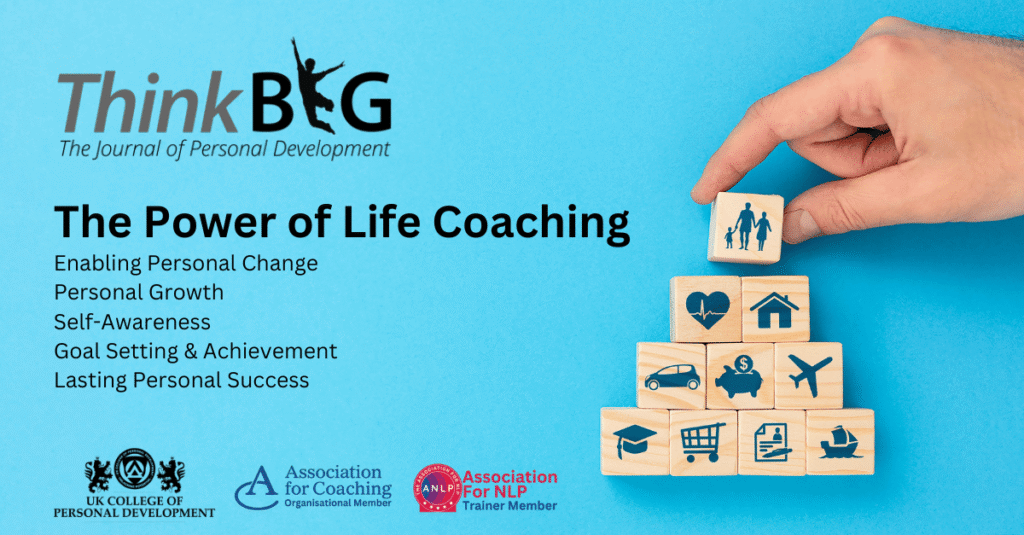

The Power of Life Coaching
Life coaching is an intervention strategy that has seen increased recognition and utilization for its role in aiding personal and professional development. Through the power of life coaching, individuals are guided to enhance their performance, maximise their potential, and actualise their desired life outcomes 1. This transformative process encapsulates aspects such as goal setting, self-awareness, personal success, personal breakthroughs, future planning, and outcome setting with Neuro-Linguistic Programming (NLP).
Later in this article, we will also look at the role of the UK College of Personal Development (UKCPD) in training and developing professional coaches.
The Power of Life Coaching – Start With The Power of Goal Setting
Goal setting is an essential component of life coaching. Goals provide individuals with a direction, serving as a roadmap towards desired outcomes 2. Life coaches utilise the SMARTS (Specific, Measurable, Achievable, Resourced, Time-Framed) model developed by Tony Nutley (UKCPD) to help clients create clear and achievable goals 3. According to goal-setting theory, setting specific and challenging goals leads to higher performance 4, thereby amplifying the importance of a life coach in facilitating the goal-setting process.
The Power of Life Coaching – Enhancing Self-Awareness
Life coaching significantly contributes to the enhancement of self-awareness, a vital aspect of personal development. Sutton (2016) defines self-awareness as the conscious knowledge of one’s character, feelings, motivations, and desires 5. Life coaches utilise various tools, such as reflective exercises and mindfulness practices, to help clients gain a deeper understanding of their strengths, weaknesses, beliefs, and behaviours. Increased self-awareness is associated with better decision-making, improved relationships, and overall well-being 6.
Cultivating Personal Success
Life coaching serves as a powerful tool for fostering personal success. By challenging self-limiting beliefs and behaviours, life coaches can empower clients to reach their full potential 7. Additionally, research has linked life coaching to improvements in various areas such as resilience, productivity, job satisfaction, and life satisfaction 8.
Facilitating Personal Breakthroughs
Life coaching can also prompt personal breakthroughs, transformative moments that lead to substantial changes in an individual’s life. Coaches can assist individuals in uncovering underlying beliefs and attitudes that may be limiting their progress 9. These breakthrough moments can dramatically alter an individual’s perspective, leading to significant shifts in their thoughts, behaviours, and actions. For instance, a study by Theeboom, Beersma, and van Vianen (2014) demonstrated that coaching could lead to increased self-efficacy, improved performance, and enhanced skills 10.
Future Planning
Life coaching plays a critical role in future planning. Life coaches assist individuals in envisioning their desired future, setting relevant goals, and developing strategies to achieve them. This forward-thinking approach enables individuals to anticipate potential challenges, devise effective coping strategies, and remain focused on their long-term goals 11.
Outcome Setting with NLP
Neuro-Linguistic Programming (NLP), a method that involves understanding and replicating excellence to achieve personal and professional goals, is often employed in life coaching. Through NLP, life coaches can help clients establish clear and compelling outcomes, identify resources, and devise strategies to achieve their goals 12.
The power of the NLP approach in planning for a better future is in the formula of Well Formed Outcomes. Find more on this topic HERE.
The Role of the UK College of Personal Development (UKCPD)
The UK College of Personal Development (UKCPD) plays a crucial role in the professional development of life coaches. It offers training courses in life coaching, NLP, and personal development, equipping aspiring coaches with the skills and knowledge needed to effectively guide clients in their journey of personal growth and change 13.
The transformative power of life coaching in fostering personal growth, change, and success cannot be overstated. Whether through goal setting, enhancing self-awareness, facilitating personal success and breakthroughs, aiding future planning, or utilising NLP for outcome setting, life coaching provides a supportive and empowering environment that encourages personal development. Furthermore, institutions such as UKCPD continue to play a critical role in the development of competent life coaches, thereby ensuring the continued efficacy of this intervention strategy.
References
-
Grant, A. M., & Cavanagh, M. J. (2007). The goal-focused coaching skills questionnaire: Preliminary findings. Social Behavior and Personality: an international journal, 35(6), 751-760.
-
Nutley, (2002). Life Coaching: An Introduction, UKCPD, Think Big, The Journal of Personal Development https://ukcpd.co.uk/the-smarts-outcome-setting-model/
-
Doran, G. T. (1981). There’s a S.M.A.R.T. way to write management’s goals and objectives. Management Review, 70(11), 35-36.
-
Locke, E. A., & Latham, G. P. (2006). New directions in goal-setting theory. Current Directions in Psychological Science, 15(5), 265-268.
-
Sutton, A. (2016). Measuring the Effects of Self-Awareness: Construction of the Self-Awareness Outcomes Questionnaire. Europe’s Journal of Psychology, 12(4), 645–658.
-
Silvia, P. J., & O’Brien, M. E. (2004). Self-awareness and constructive functioning: Revisiting “the human dilemma.” Journal of Social and Clinical Psychology, 23(4), 475-489.
-
Whitmore, J. (2009). Coaching for performance: GROWing human potential and purpose: The principles and practice of coaching and leadership. Nicholas Brealey Publishing.
-
Green, L. S., Oades, L. G., & Grant, A. M. (2006). Cognitive-behavioral, solution-focused life coaching: Enhancing goal striving, well-being, and hope. The Journal of Positive Psychology, 1(3), 142-149.
-
Grant, A. M. (2012). An integrated model of goal-focused coaching: An evidence-based framework for teaching and practice. International Coaching Psychology Review, 7(2), 146-165.
-
Theeboom, T., Beersma, B., & van Vianen, A. E. (2014). Does coaching work? A meta-analysis on the effects of coaching on individual level outcomes in an organizational context. The Journal of Positive Psychology, 9(1), 1-18.
-
Kauffman, C., & Scoular, A. (2004). Toward a positive psychology of executive coaching. In P. A. Linley & S. Joseph (Eds.), Positive psychology in practice (pp. 287-302). Wiley.
-
Bandler, R., & Grinder, J. (1979). Frogs into Princes: Neuro Linguistic Programming. Real People Press.
-
The UK College of Personal Development. (2021). Life Coaching Courses. https://ukcpd.co.uk/ac-coaching-qualifications/

