


Communication is based on our interpretation of reality, not reality itself. Discover how to enhance your communication skills and build rapport with the NLP communication model.
Developed by Richard Bandler and John Grinder during the 1970s, the NLP (Neuro Linguistic Programming) communication model has helped people understand how we receive and process information and how that influences our communication in response.
Whether it’s applied in business to build rapport with clients or used to rewire negative thought patterns, the NLP communication model provides the gateway for professional and personal development before advancing further with NLP submodalities, modelling, and anchoring techniques.
Read on to discover what’s involved in the NLP communication model and how you can use it to your advantage in a working environment.
How Was the NLP Communication Model Created?
Communication is the foundation of NLP. After all, NLP began as a model of communication between ourselves and others. However, that model developed further when Richard Bander and John Grinder took a deeper dive into explaining how external information is processed internally.
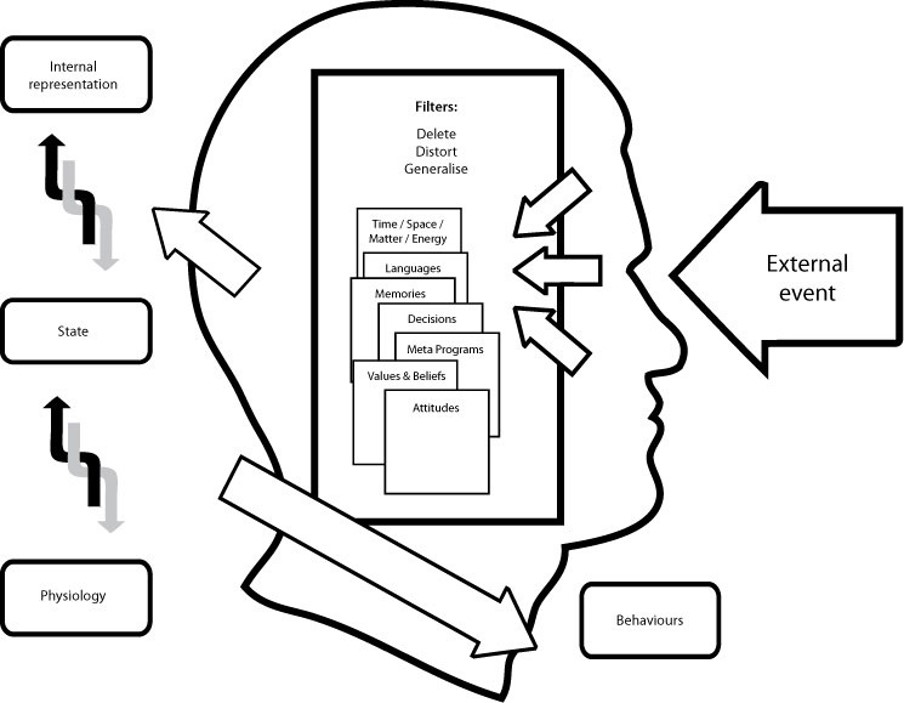
The idea of “the map is not the territory”, reveals how our perception of the world (reality) is not always coherent with the objective reality in which the world exists.
This phenomenon is influenced entirely by communication, hence why the NLP communication model is a profound learning tool for personal and professional development.
To comprehend the NLP communication model, we must begin to define communication beyond the general associations of simply talking and listening. For example, we constantly receive communication from the outside world through multiple senses.
Working on an internal and external level, the NLP communication model involves the following senses:
- Visual –What we see and how we’re perceived.
- Auditory – The words we hear and the way they sound.
- Kinaesthetic –External feelings of physical touch.
- Olfactory – What we can smell.
- Gustatory – What we taste.
We receive external influences through these senses as modes of communication. How we decide to process these influences is what establishes our communication model.
The NLP Communication Model Explained
As we receive external influences through our senses, we communicate the various influences within ourselves internally. According to the NLP communication model, these external influences and internal processes can take on one of three forms:
Deletion – Selectively focussing on specific aspects and not others.
Distortion – Misrepresentations of reality.
Generalisations – Developing an overarching opinion based on one or two experiences.
Now, these three factors distinguish why people perceive things differently. It’s rare for anyone to delete, distort and generalise the same thing the same way.
Receiving external information is based on five filters:
Meta Programmes – The way a person handles information.
Memories – Can generate or restrict influence upon our behaviour.
Belief Systems – Strong conclusions that ultimately create or deny our development.
Values – Define our actions as good or bad, right or wrong.
Decisions – Can create beliefs or impact our perceptions through experience.
All five filters, on some level, are influenced by our relationship with society. The social constraints we’ve experienced up to this point impact the conditioning and help shape our beliefs, values, language, behaviour, and overall perception of the world.
How the NLP Communication Model Can Help You Build Rapport
The NLP communication model has been proven in practice as a valuable rapport-building tool. After all, so much of our communication is non-verbal, with some studies suggesting as much as 93%.
Whether we’re working in teams or dealing with customers and clients, developing rapport is a vital component in working environments. It can create trust, put others at ease, and help you climb the corporate ladder of success.
Some NLP exercises for developing rapport include:
Noticing and emphasising similarities – Focus on similarities, not differences.
Matching – Reflect behaviour and actions with body language to place yourself within their model of the world.
Language patterns – Match language by using similar words.
You may already find you apply these techniques when building relationships personally and professionally. Naturally, we try and reflect the people we like or admire. But developing an awareness of this trait can enhance our rapport-building skills to the next level.
However, as discussed before, not everyone uses the same communication model. Building rapport relies on matching the communication model of the person you’re with.
The different styles of language include the following areas:
Visual people – Prefer visual language, are fast talkers and emanate high energy.
Auditory people – Articulate and speak clearly with rhythmic and resonant voices.
Kinaesthetic people – Slow tempo and long pauses in speech.
People can use all three systems, so it’s beneficial to remain open-minded and study all three styles. Try not to generalise an individual’s communication model, as it can cause a breakdown in rapport.
NLP Communication Model Exercises
Applying the correct language style to your recipient will help build rapport, but it may require you to increase your range of vocabulary. Adults are recommended to read two hours a day, with at least one hour dedicated in a single sitting.
Reports found teenagers who read in their spare time compared to those who didn’t know 26% more words. One NLP communication model exercise includes applying the correct type of vocabulary to the right language system, for example:
Auditory Person
“I hear you.”
“I heard something in the tone of their voice.”
“There was a real harmony and rhythm in the team today.”
Visual Person
“I see what you mean.”
“I think we can meet eye to eye on this.”
“Can you shed some light on that for me?”
Kinaesthetic Person
“I’m warming to that idea.”
“That must be tough.”
“Sometimes we must take the rough with the smooth.”
Another NLP communication model exercise can include eye accessing cues. As an advanced level NLP exercise, eye accessing cues can indicate what’s important to your listener when answering your questions. Discover more on this on our training programmes.
So How is This Useful in Day to Day Activities
Successful communication is about is essentially about 3 key outcomes:
- Its about influence.
- Its about developing meaningful rapportful relationships
- Its about getting your message across in a way that gets “buy in” from others.
Knowing about and understanding the various factors which affect human communication enables us to communicate with greater flexibility, while understanding other points of view better.
Therefore we’re able to relate to people easily and respond to them on their terms. This builds rapport and allows for successful outcomes in leadership, mediation and negotiation. It also facilitates empathy and compassion in human interactions.
On the personal side, knowledge about the NLP Communication Model along with the application of NLP approaches enables people to ‘run their own minds’.
More fulfilment in life is achievable when we are less affected by external circumstances, through gaining control of our internal processes. This leads to mental freedom, empowered responses, and mindful interactions with others.
Enhance Your NLP Communication Model With Professional Training, Resources, and Courses
UKCPD has been offering award-winning courses in NLP training and education since 2005. Our NLP programmes are accredited by professional governing bodies in NLP, with a range of levels from beginners to specialists.
So, if you fancy getting a taste of NLP, we have beginner courses, literature, and events free of charge before the introduction and foundation courses can begin. We also supply diplomas and advanced NLP qualifications for anyone looking to take the next step on their NLP journey.
For more information about how our NLP solutions can help you enhance your life, get in touch today.

